.webp&w=384&q=75)

Loading, please wait...
Loading, please wait...
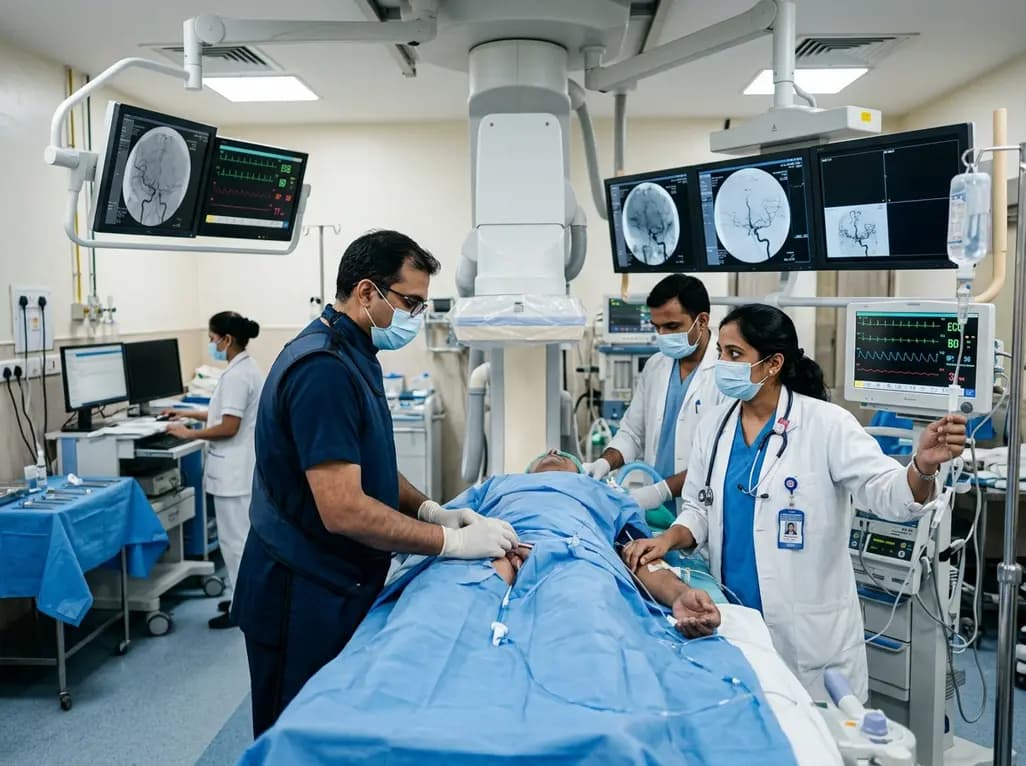
Acute ischemic stroke caused by emergent large vessel occlusion represents a critical medical emergency where every minute directly affects neuronal survival. Rapid restoration of cerebral blood flow via mechanical thrombectomy is standard care for eligible patients. However, orchestrating rapid procedural workflow while maintaining optimal hemodynamic stability and airway safety remains challenging in many emergency settings. Integrating a specialized neurocritical care rapid response team directly into the acute interventional pathway provides an effective solution to streamline periprocedural care and significantly accelerate endovascular interventions.
Timely endovascular therapy requires seamless coordination among emergency physicians, interventionalists, nursing personnel, and anesthesia providers. In routine practice, securing dedicated neuroanesthesiology coverage on short notice often encounters institutional hurdles, especially during off-hours or weekends. Procedural sedation and hemodynamic monitoring are traditionally managed by on-call anesthesia providers who may be occupied with concurrent operating room emergencies. Consequently, delays in airway evaluation, line placement, and pharmacological titration can inadvertently prolong door-to-groin puncture times. Moreover, uncontrolled patient agitation, airway compromise, or intraprocedural movement can impair angiographic visualization, increase vessel perforation risk, and delay recanalization. Inconsistent sedation practices between conscious sedation and general endotracheal anesthesia further complicate institutional standardization. Therefore, centers frequently experience unpredictable procedural start times, which undermines the core clinical mandate of rapid reperfusion in acute stroke management.
To overcome operational bottlenecks, comprehensive stroke centers have explored innovative multidisciplinary pathways. Deploying a dedicated neurocritical care rapid response team establishes an immediate, protocolized critical care presence within the angiography suite. This dedicated team assumes direct responsibility for expedited patient transport, continuous invasive hemodynamic monitoring, rapid airway management, and targeted analgosedation. Because neurointensivists and specialized critical care nurses understand cerebrovascular physiology deeply, they deliver precision care tailored to ischemic penumbral dynamics. The team initiates pre-procedural stabilization simultaneously with interventional suite preparation. By operating with standardized protocols, the neurocritical team eliminates handoff ambiguities and provides proactive physiological resuscitation. Consequently, interventional neuroradiologists can focus exclusively on technical vascular catheterization without distraction from evolving physiological emergencies, creating a smooth workflow from emergency arrival directly through arterial access.
Recent clinical evidence demonstrates that structured critical care deployment markedly enhances acute stroke metrics. Comparative analysis revealed that institutional implementation of a neurocritical response model achieved a statistically significant 11.7% reduction in median door-to-groin puncture intervals. Furthermore, median door-to-recanalization times decreased by 12.6%, ensuring faster reperfusion of threatened cerebral territory. The structured critical care presence also facilitated a 21.4% increase in the planned utilization of general anesthesia without introducing procedural delays. Notably, zero patients managed under this model required emergency rescue intubation or unplanned anesthesia call-ins during endovascular manipulation. By eliminating unexpected intraprocedural conversions and stabilizing the pre-puncture phase, the clinical team converted potentially chaotic transfers into tightly organized, predictable workflows. These findings confirm that dedicated neurocritical support successfully minimizes system-level delays while preserving procedural safety.
Maintaining physiological homeostasis is paramount when treating emergent large vessel occlusions. Blood pressure drops during induction or intraprocedural sedation can critically compromise collateral blood flow through leptomeningeal channels, precipitating penumbral infarction before recanalization occurs. Conversely, excessive blood pressure surges increase the risk of reperfusion injury and hemorrhagic transformation after vessel opening. The critical care team applies real-time vasopressor titration and precision fluid management to maintain strict mean arterial pressure targets throughout the procedure. Additionally, secure airway control prevents hypoxia, hypercapnia, and aspiration, all of which worsen secondary cerebral ischemic damage. Proactive endotracheal intubation executed by skilled intensivists ensures complete patient immobility, thereby enabling superior fluoroscopic road-mapping and precise stent-retriever deployment. Thus, intensive physiological monitoring directly translates into improved neurovascular safety and higher first-pass recanalization rates.
The neurocritical rapid response operational paradigm offers substantial relevance for tertiary hospitals and comprehensive stroke networks worldwide. Many regional facilities face critical shortages of specialized neuroanesthesia staff, creating unavoidable obstacles during emergent thrombectomy activations. Utilizing experienced intensive care physicians and emergency critical care specialists provides a practical, scalable alternative to conventional anesthesia-dependent pathways. Implementing standardized procedural sedation algorithms, invasive arterial line insertion bundles, and rapid sequence intubation pathways enables institutions to optimize their existing clinician workforce efficiently. Furthermore, cross-training critical care teams to support neurointerventional suites maximizes resource utilization while upholding rigorous safety standards. As stroke centers strive to meet national benchmark time targets, establishing proactive critical care response frameworks represents a sustainable strategy to expand endovascular service capabilities and improve functional independence for stroke survivors.
The specialized team oversees expedited inter-departmental transport, advanced airway control, real-time arterial pressure titration, and continuous analgosedation. By managing systemic physiology proactively, the critical care team allows neurointerventionalists to focus entirely on vascular access, catheter navigation, and clot retrieval without interruption.
The model cross-utilizes available neurocritical care physicians and specialized intensive care nursing staff rather than relying exclusively on dedicated operating room anesthesiologists. This proactive strategy prevents procedural delays, reduces competition for surgical anesthesia resources, and guarantees rapid on-demand critical care coverage.
Fluctuations in systemic blood pressure directly alter cerebral perfusion pressure across fragile penumbral collateral vessels. Preventing sudden hypotension avoids expanding cerebral infarction, whereas preventing severe hypertension mitigates post-recanalization reperfusion injury, cerebral edema, and secondary symptomatic intracranial hemorrhage.
Disclaimer: This content is for informational and educational purposes only and is not intended to serve as medical advice, clinical guidance, or diagnostic instruction. It does not replace professional clinical judgment or established clinical protocols. Healthcare providers should make independent clinical decisions based on each patient's individual presentation and medical history. While every effort is made to ensure clinical accuracy, always verify diagnostic criteria, procedural steps, and medication dosages against primary sources and official guidelines. Refer to the latest local and national guidelines for clinical practice.
References

Read summarized clinical updates, watch expert medical content, and earn CME certifications right from your smartphone.
Open your smartphone camera to scan and install.





Implementing a dedicated neurocritical care rapid response team significantly reduces door-to-puncture and recanalization times during mechanical thrombectomy for acute ischemic stroke, offering a scalable solution for hospitals lacking consistent neuroanesthesia coverage.
last month

Maharashtra FDA Commissioner Tukaram Mundhe warns that widespread non-compliance with food standards is driving a surge in non-communicable diseases. Healthcare professionals must bridge clinical practice with nutritional vigilance, recognizing dietary quality as a primary driver of premature cardiometabolic conditions.
Today

A multiparametric MRI approach combining quantitative T2 shading, apparent diffusion coefficient (ADC) measurements, and morphological signs provides superior diagnostic accuracy over subjective evaluation to differentiate ovarian endometriomas from benign hemorrhagic cysts.
Yesterday

Researchers developed a novel bezafibrate-L-proline cocrystal inclusion compound using ball milling, boosting saturation solubility by 3.9-fold and oral bioavailability twofold. This supramolecular strategy holds promising potential to enhance drug efficacy and consistency in atherogenic dyslipidemia management.
Today

Excessive screen exposure and sedentary routines are driving a silent surge in musculoskeletal pain among young patients. This comprehensive overview examines pediatric cervical strain, biomechanical loads, clinical evidence, and targeted physiotherapy interventions to safeguard growing spinal structures.
Today

A randomized crossover study reveals that exercise-induced glycogen depletion combined with a low-carbohydrate diet significantly enhances peak fat oxidation without impairing skeletal muscle mitochondrial coupling control or efficiency in healthy trained men.
Today
