.webp&w=384&q=75)

Loading, please wait...
Loading, please wait...
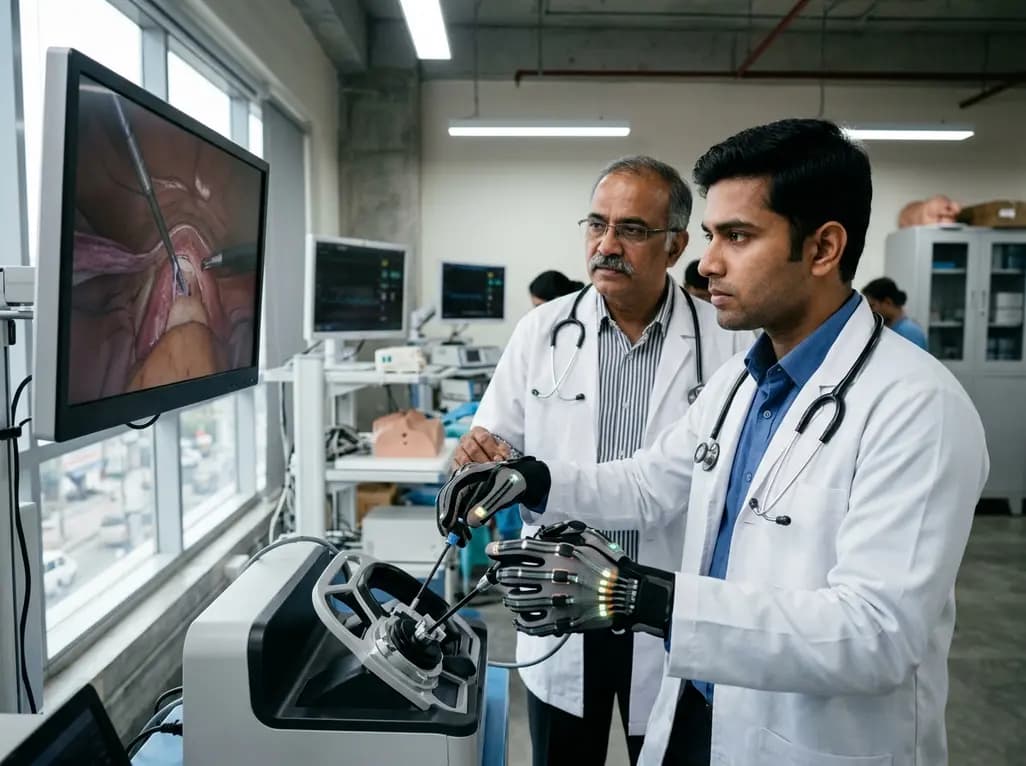
In the rapidly advancing landscape of modern medical technology, multimodal haptic feedback systems are emerging as pivotal tools for sensory restoration and surgical precision. Traditionally, designers have struggled to mimic the complex sensations of human touch using small, wearable devices. Specifically, existing electromagnetic actuators often lack the power or the precise range required for effective tactile feedback. To bridge this critical research gap, scientists have developed a new thin-film compliant mechanism that enhances the performance of cutaneous interfaces. This innovation allows for the simultaneous delivery of diverse stimuli, including skin stretch, indentation, and high-frequency vibration. Consequently, it offers significant new potential for assistive tools and neuro-rehabilitation systems. Furthermore, it improves the interactive experience between human users and digital simulation environments. This article explores the engineering marvel behind this interface and its profound implications for vision-guided assistance and modern clinical healthcare strategies.
Haptic technology has advanced far beyond the simple vibrations found in early mobile devices. Human skin contains a variety of specialized mechanoreceptors that respond to different physical triggers such as pressure, shear, and movement. Therefore, creating a truly immersive digital experience requires sophisticated multimodal haptic feedback. Engineers are now focusing on creating interfaces that can combine multiple mechanical forces to trigger these receptors effectively. Moreover, these systems must remain lightweight and portable for practical clinical applications in hospitals or home settings. Consequently, the recent development of thin-film mechanisms represents a major technological leap for the industry. These micro-thin films allow for complex multi-axis motions without adding significant bulk to wearable devices. Furthermore, they enable the simultaneous delivery of both shear and normal forces to the skin surface. This capability allows users to perceive the texture and shape of virtual objects with surprising accuracy. Additionally, researchers are investigating how these sensations can improve surgical accuracy in teleoperated robotic systems. By providing real-time tactile feedback, the system helps surgeons feel the resistance of virtual tissues during procedures. Resultantly, this technology effectively bridges the gap between digital data and physical perception. Ultimately, this evolution will redefine how medical professionals interact with robotic tools and assistive devices.
The core of this new interface utilizes a highly sophisticated thin-film compliant mechanism. Specifically, this innovative design provides exceptional flexibility along the X, Y, and Z translational axes. This freedom is vital for accurately mimicking the diverse ways that human skin deforms during physical contact. Therefore, the device can deliver precise indentation and skin stretch stimuli with minimal mechanical resistance. Moreover, the mechanism maintains high stiffness against unwanted rotations about the X and Y axes. This structural rigidity ensures that the tactile feedback remains stable and predictable, even during intense user activity. Resultantly, the module successfully constrains unwanted degrees of freedom that typically interfere with the accuracy of electromagnetic actuators. In addition, the thin-film architecture allows for a compact footprint, which is ideal for creating high-density wearable arrays. Scientists prefer using electromagnetic actuators because they offer high controllability and extremely fast dynamic response times. Consequently, when paired with the compliant mechanism, these actuators achieve both large displacement and high output force. This specific combination was previously very difficult to achieve at such a small, wearable scale. Thus, the engineering behind this thin-film structure provides a reliable foundation for the next generation of advanced sensory feedback systems and human-machine interfaces.
Existing electromagnetic actuators often struggle to balance small size with high mechanical performance in multimodal systems. Many current devices are either too bulky for long-term wear or lack the force required to create realistic tactile sensations. However, the introduction of thin-film compliant mechanisms offers a novel and effective solution to these hardware limitations. These mechanisms leverage the inherent elasticity of high-performance thin films to guide motion and store energy efficiently. Consequently, the actuators can generate significant mechanical force without needing massive or power-hungry components. Furthermore, the design allows for the complex superposition of different types of stimuli. For instance, a user can feel a high-frequency vibration while the underlying skin is simultaneously being stretched. This layering of sensations is vital for simulating complex medical tasks, such as feeling a patient\'s pulse or palpating a tumor. Therefore, the interface can trigger multiple types of cutaneous mechanoreceptors at the same time. Additionally, the fast dynamic response of these electromagnetic systems ensures that the haptic feedback feels instantaneous to the user. This low latency is crucial for maintaining a high level of immersion in virtual reality environments. Meanwhile, the protective structure ensures durability for daily clinical use in various medical settings.
Notably, this haptic technology shows immense promise in assisting individuals who are visually impaired. Researchers recently implemented a vision-guided, human-in-the-loop system to demonstrate this life-changing potential. Specifically, the system uses high-resolution cameras and advanced sensors to map the user\'s surrounding environment in real time. Therefore, it can identify physical obstacles and guide the user toward specific targets or safe paths. Moreover, the wearable haptic array converts this complex visual data into intuitive tactile cues on the forearm skin. To achieve this, engineers employed a sophisticated spatiotemporal encoding strategy. This method translates directional data into specific, recognizable patterns of vibration and skin stretch. Consequently, users can "feel" which way to turn or where a potential hazard is located without needing sight. In clinical tests, participants achieved an impressive mean discrimination accuracy of 79.5% for four-directional haptic cues. This high level of precision suggests that the interface is highly intuitive and very easy for new users to learn. Additionally, the system provides a discreet way for users to receive navigation assistance without relying on loud auditory prompts. This silence is particularly beneficial in noisy public spaces. Resultantly, this system empowers visually impaired users to perform daily tasks with greater independence.
Ultimately, the integration of haptic systems into clinical care will transform the landscape of modern medicine. Furthermore, surgeons who utilize robotic surgery platforms will benefit significantly from enhanced tactile sensitivity during delicate operations. Currently, many robotic platforms lack sufficient force feedback, which can occasionally lead to accidental tissue damage or surgical errors. However, these new thin-film haptic modules can provide the necessary sensations of pressure and tension directly to the surgeon. Consequently, medical professionals can perform complex procedures with much higher levels of confidence and technical precision. In addition, this technology has significant potential applications in the field of neuro-rehabilitation. For instance, patients recovering from severe strokes can use haptic sleeves to retrain their vital sensory-motor pathways. Specifically, the device can guide their limb movements through gentle skin stretches and rhythmic vibrations. Therefore, it provides a closed-loop feedback system that may significantly accelerate the neural recovery process. Moreover, the lightweight and flexible design ensures that patients can wear the device for extended periods without discomfort. As the technology continues to mature, we expect to see these modules integrated into prosthetic limbs, giving amputees a restored sense of touch. Accordingly, the future of healthcare will blend digital intelligence with high-fidelity sensation.
The thin-film compliant mechanism provides high flexibility along the translational axes while maintaining rotational stiffness. Consequently, it allows electromagnetic actuators to deliver precise indentation and skin stretch without unwanted mechanical noise. Therefore, the device can trigger various mechanoreceptors simultaneously, creating a richer and more realistic tactile experience. This precision is essential for mimicking complex physical interactions, which significantly improves the user\'s ability to interpret digital haptic information accurately and safely during clinical procedures.
Spatiotemporal encoding translates environmental or digital data into specific patterns of touch across the skin\'s surface over time. Specifically, it uses a wearable array to deliver directional cues through a combination of vibrations and stretches. This method allows users to distinguish between different signals, such as left, right, forward, or backward movements. Moreover, it ensures that the information is conveyed intuitively, allowing for high discrimination accuracy even in complex or high-stress navigation scenarios for visually impaired users.
Yes, these modules can significantly enhance robotic surgical training by providing realistic force feedback. Traditionally, trainees struggle because they cannot "feel" the tissues they are manipulating on a screen. However, integrating this multimodal interface allows them to experience the tension and resistance of virtual organs. Consequently, they develop better motor skills and spatial awareness. Furthermore, this tactile feedback reduces the risk of tissue trauma during practice, ultimately leading to safer and more effective surgical outcomes in real environments.
Disclaimer: This content is for informational and educational purposes only and does not constitute medical advice. The technology described is undergoing research and should be interpreted within the context of emerging scientific literature. Refer to the latest local and national guidelines for clinical practice.
References
Wan J et al. A Multimodal Haptic Feedback Interface with Thin-Film Compliant Mechanism. Adv Sci (Weinh). 2026 Jul 08. doi: 10.1002/advs.76412. PMID: 42420784.
Huang Y et al. A skin-integrated multimodal haptic interface for immersive tactile feedback. Nat Electron. 2023;6:1020-1031.
Shi G et al. Fluidic haptic interface for mechano-tactile feedback. IEEE Trans Haptics. 2020;13(1):204-210.

Read summarized clinical updates, watch expert medical content, and earn CME certifications right from your smartphone.
Open your smartphone camera to scan and install.





A groundbreaking thin-film compliant mechanism is revolutionizing haptic technology, enabling realistic tactile sensations for surgical training and assisting the visually impaired with daily tasks. Learn how this multimodal interface bridges the gap between digital data and physical perception.
3 months ago

A retrospective cohort study of 7,716 ICU patients from the MIMIC-IV database demonstrates that Gradient Boosting Decision Trees significantly outperform traditional SOFA scores in predicting in-hospital mortality among patients with sepsis and diabetes, with SHAP analysis providing clinical interpretability.
Today

A prenatal case highlights severe glutaric acidemia type II presenting as bilateral hyperechoic cystic kidneys at 18 weeks. Whole-exome sequencing revealed a novel homozygous ETFDH frameshift variant, demonstrating the power of rapid genetic testing in fetal renal anomalies.
Today
This article reviews the forensic and clinical complexities of acute myocarditis arising on left ventricular hypertrophy in children, highlighting early diagnostic red flags and multidisciplinary postmortem autopsy protocols.
Today

This comparative study evaluates posterior labral tears with and without glenohumeral instability, highlighting distinct demographic patterns, MRI underestimation in stable shoulders, and successful arthroscopic repair outcomes.
Yesterday

A clinical study demonstrates that early intervention with tocilizumab, either as monotherapy or bridged with corticosteroids, achieves significant proptosis reduction and resolves active inflammation in treatment-naive thyroid eye disease.
Yesterday
