.webp&w=384&q=75)

Loading, please wait...
Loading, please wait...
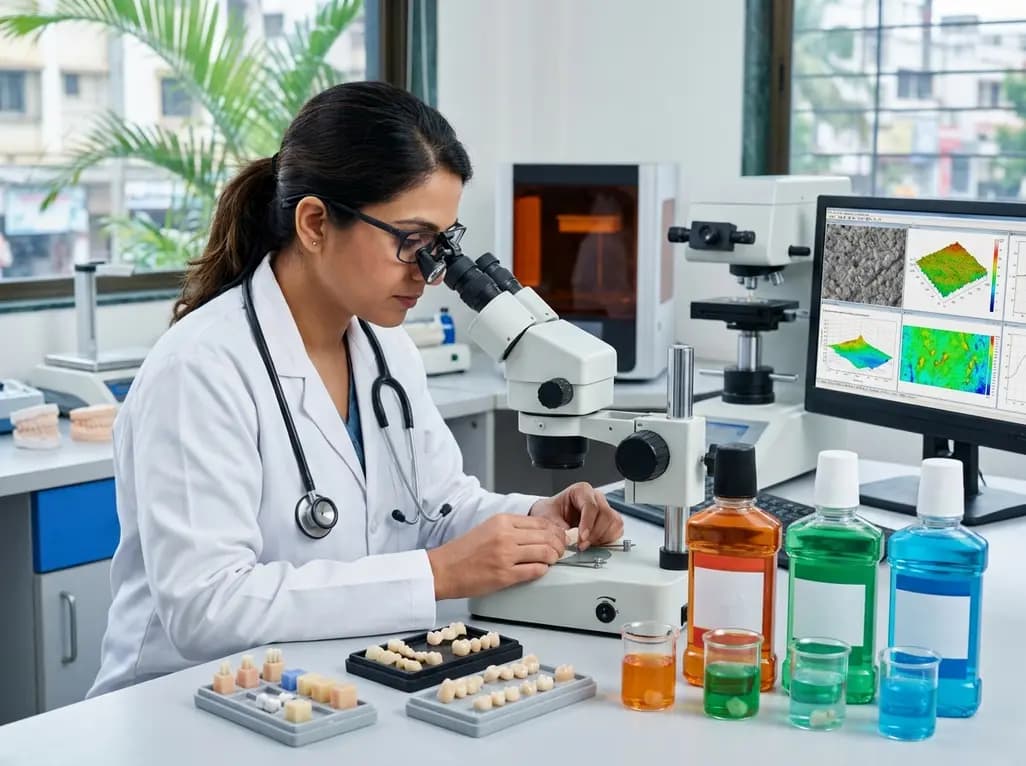
Digital dentistry has revolutionized the landscape of restorative treatments in India. Clinicians increasingly adopt 3D printing and CAD/CAM technologies to produce crowns, bridges, and inlays with high precision. However, the intraoral longevity of these materials remains a subject of intense investigation. Specifically, the daily use of mouthwash on dental resins can potentially alter their structural integrity over time. A recent study by Güvenç BG and colleagues provides critical insights into how various mouthwash formulations interact with modern resin materials. This investigation is vital because patients often use these rinses for plaque control or aesthetic enhancement. Furthermore, the chemical composition of these rinses varies significantly, ranging from alcohol-based solutions to those containing whitening agents. Consequently, understanding these interactions helps dentists recommend the most suitable maintenance protocols for their patients. As digital manufacturing becomes the gold standard, we must evaluate how everyday habits impact the physical properties of our restorations. Therefore, this article examines the surface changes occurring in 3D-printed and CAD/CAM materials after exposure to common mouthwashes available in the market.
To evaluate these complex interactions, researchers examined three distinct types of restorative materials commonly used in clinical practice. Specifically, they utilized Stereolithography (SLA) resin, Digital Light Processing (DLP) resin, and a resin-based CAD/CAM composite block. This selection reflects the most common digital manufacturing paths used in modern dental clinics today. The study prepared 120 specimens and subjected them to rigorous finishing and polishing using professional diamond-impregnated systems. Researchers then measured surface roughness using confocal microscopy and microhardness through the Vickers hardness test. Additionally, they determined wettability by measuring the contact angle using the sessile drop method. These parameters are crucial because surface changes can lead to increased plaque accumulation or premature structural failure. Following baseline recordings, researchers divided the specimens into five groups based on immersion solutions. These included alcohol-containing, alcohol-free, and whitening mouthwashes, alongside artificial saliva as a control group. The team repeated all measurements after 24 hours and one week of exposure. This systematic approach allowed for a clear comparison between short-term and medium-term effects on the materials. Moreover, it highlighted how specific chemical agents target the polymer matrix.
The study results indicated that the chemical composition of mouthwash significantly dictates the extent of material degradation. For instance, mouthwash on dental resins containing alcohol often leads to plasticization of the polymer matrix. Ethanol acts as a solvent that can penetrate the resin chains, causing them to swell and lose their structural rigidity. Consequently, this process often results in a measurable decrease in microhardness over a short period. On the other hand, whitening mouthwashes utilize different mechanisms of action to achieve their goals. Many of these solutions contain hydrogen peroxide or other oxidizing agents designed to remove surface stains. While these agents effectively brighten teeth, they can also oxidize the resin-filler interface. This oxidation potentially increases surface roughness and alters the wettability of the restoration. Interestingly, the research showed that time was a major factor in these physical changes. Surface roughness and contact angles shifted significantly as the immersion duration increased from 24 hours to one week. Therefore, even short-term usage of aggressive rinses can begin the process of surface wear. Dentists must remain aware that the perceived benefits of mouthwash might come at the cost of restorative durability.
One of the most significant findings was the performance difference between 3D-printed resins and CAD/CAM composite blocks. Generally, manufacturers produce CAD/CAM blocks under high pressure and temperature in a controlled industrial environment. This rigorous process ensures a higher degree of polymerization and a more dense, homogeneous structure. In contrast, 3D-printed materials like SLA and DLP resins are cured layer by layer in the clinic or lab setting. Although post-curing units enhance their strength, they may still possess a slightly lower degree of conversion compared to factory-milled blocks. Resultantly, the 3D-printed resins showed different levels of susceptibility to surface changes when exposed to various mouthwash types. The study observed that the material type significantly influenced the final microhardness and wettability outcomes. Specifically, the DLP and SLA resins reacted uniquely to whitening formulations compared to the CAD/CAM composite material. This suggests that the layer-based architecture of 3D-printed objects might offer more entry points for chemical solvents to penetrate. Consequently, clinicians should consider the specific manufacturing method when predicting how a restoration will age over several years. While 3D printing offers immense flexibility, CAD/CAM blocks might provide superior resistance to chemical challenges.
For dental professionals in India, these findings have direct practical applications for daily patient management. Many patients routinely use alcohol-based or whitening mouthwashes without realizing the potential impact on their expensive digital crowns. Therefore, practitioners should incorporate specific mouthwash recommendations into their post-operative care instructions. If a patient has 3D-printed permanent restorations, it might be safer to recommend alcohol-free, neutral pH rinses to maintain surface smoothness. Furthermore, the increase in surface roughness is not merely a cosmetic concern for the patient. Rougher surfaces facilitate the adhesion of Streptococcus mutans and other cariogenic bacteria. This can lead to secondary caries at the margin or localized gingival inflammation. Additionally, changes in microhardness might predispose the material to premature wear, especially in patients with parafunctional habits like bruxism. Since many Indians use over-the-counter mouthwashes for halitosis or gum health, educating them on material-specific risks is essential. Clinicians should also prioritize high-quality polishing protocols, as a smooth initial surface provides better resistance to chemical leaching. By tailoring maintenance advice to the restorative material used, dentists can significantly extend the lifespan of digital prosthetics.
In summary, the choice of mouthwash on dental resins plays a pivotal role in the long-term success of digital restorations. Both 3D-printed and CAD/CAM materials undergo measurable changes in roughness and hardness when exposed to active chemical agents. Alcohol and whitening components appear to be the most disruptive to the resin matrix. As 3D printing technology continues to evolve, we expect the development of even more resilient resins. However, the current evidence suggests that a cautious approach to mouthwash prescription is warranted. By understanding the chemical interactions at play, dentists can provide evidence-based guidance that protects both the patient's oral health and their restorative investment.
Alcohol, specifically ethanol, acts as a potent solvent that can penetrate the polymer matrix of 3D-printed resins. This interaction often leads to plasticization, which softens the material and reduces its microhardness. Over time, this softening makes the crown more susceptible to surface wear and potential deformation. Consequently, patients with 3D-printed restorations should ideally use alcohol-free mouthwashes to preserve the structural integrity and longevity of their dental prosthetics during daily oral hygiene routines.
Whitening mouthwashes often contain oxidizing agents like hydrogen peroxide to target extrinsic stains. However, these chemicals can also interact with the resin-filler interface of CAD/CAM composite blocks. This process can lead to the selective leaching of components or the degradation of the silane coupling agent. Resultantly, the surface becomes microscopically uneven, increasing its roughness. This higher roughness is problematic because it encourages bacterial plaque accumulation and may eventually lead to the staining of the restoration itself.
Yes, SLA and DLP 3D-printed resins can exhibit different reactions due to their distinct polymerization processes and chemical formulations. SLA uses a laser to cure resin, while DLP uses a projector light source. These methods can result in different cross-linking densities and surface characteristics. The study found that material type significantly influenced microhardness and wettability when exposed to various mouthwashes. Therefore, clinicians must realize that not all 3D-printed materials will perform identically under identical chemical challenges.
Disclaimer: This content is for informational and educational purposes only and does not constitute medical advice. Always seek the advice of a qualified healthcare provider with any questions regarding a medical condition. Refer to the latest local and national guidelines for clinical practice.
References
Güvenç BG et al. Investigation of the effects of mouthwashes on the surface properties of CAD/CAM blocks and 3D-printed resins. BMC Oral Health. 2026 Jul 15. doi: 10.1186/s12903-026-09245-y. PMID: 42458489.
Hazar A, Hazar E. Effects of different antiviral mouthwashes on the surface roughness, hardness, and color stability of composite CAD/CAM materials. J Appl Biomater Funct Mater. 2024;22. doi: 10.1177/22808000241248886.
Salonen R, Garoushi S, Vallittu P, Lassila L. Characterization of temporary and permanent 3D-printed crown and bridge resins. Biomater Investig Dent. 2025;12(1). doi: 10.2340/biid.v12.43584.

Read summarized clinical updates, watch expert medical content, and earn CME certifications right from your smartphone.
Open your smartphone camera to scan and install.





This study evaluates how various mouthwash formulations, including alcohol-based and whitening types, affect the surface properties of 3D-printed resins and CAD/CAM blocks. Findings highlight significant changes in microhardness and roughness over time, offering critical guidance for dental maintenance.
3 months ago

A retrospective cohort study of 7,716 ICU patients from the MIMIC-IV database demonstrates that Gradient Boosting Decision Trees significantly outperform traditional SOFA scores in predicting in-hospital mortality among patients with sepsis and diabetes, with SHAP analysis providing clinical interpretability.
Today

Occult maternal malignancy accounts for 3.82% of persistent unreportable NIPT results with genomic noise. Multiple chromosomal aberrations, notably on chromosome 18, warrant thorough oncological evaluation and whole-body MRI to ensure timely maternal diagnosis while preserving fetal care.
Today

This article reviews the forensic and clinical complexities of acute myocarditis arising on left ventricular hypertrophy in children, highlighting early diagnostic red flags and multidisciplinary postmortem autopsy protocols.
Today

This comparative study evaluates posterior labral tears with and without glenohumeral instability, highlighting distinct demographic patterns, MRI underestimation in stable shoulders, and successful arthroscopic repair outcomes.
Yesterday

A clinical study demonstrates that early intervention with tocilizumab, either as monotherapy or bridged with corticosteroids, achieves significant proptosis reduction and resolves active inflammation in treatment-naive thyroid eye disease.
Yesterday
