.webp&w=384&q=75)

Loading, please wait...
Loading, please wait...
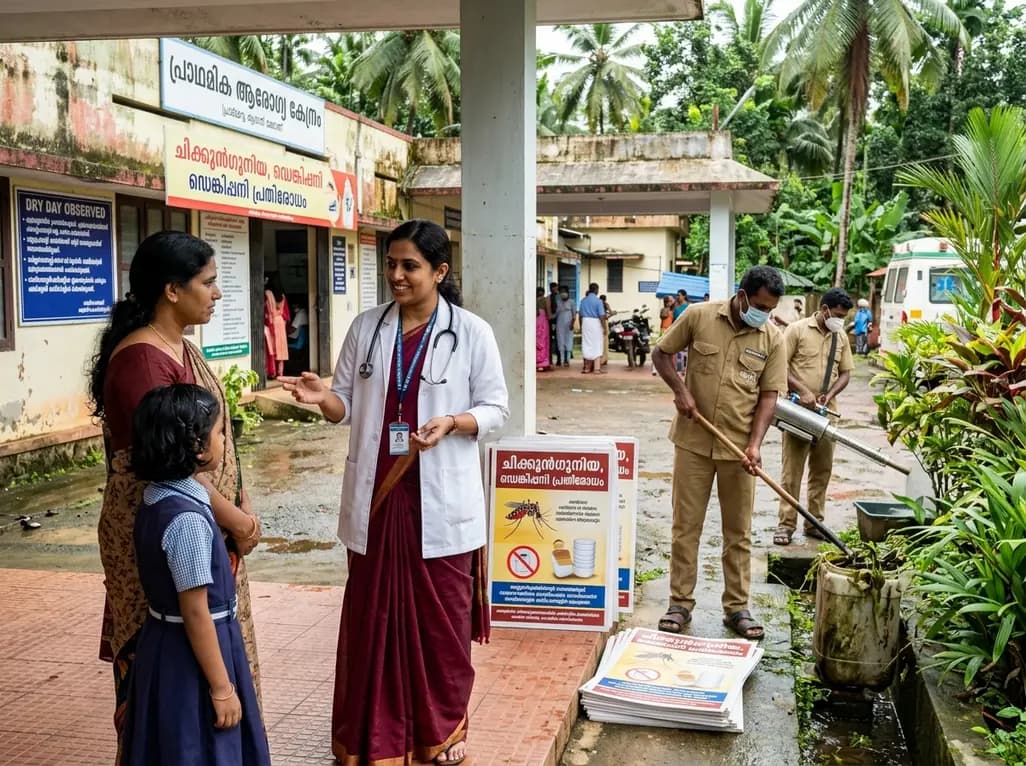
Effective mosquito-borne disease prevention requires robust community participation alongside aggressive administrative intervention. In Kerala, state health authorities have issued a clear call for collective vigilance during the observance of World Mosquito Day. Vector-borne illnesses, particularly dengue fever and chikungunya, present recurring public health challenges across tropical regions during monsoon and post-monsoon transitions. Consequently, healthcare providers and local administrative bodies must coordinate their actions to prevent widespread transmission. When rainfall creates stagnant water collections, populations of Aedes aegypti and Aedes albopictus surge rapidly. Therefore, sustained vector control remains the cornerstone of disease suppression.
Primary care clinicians and community leaders play a pivotal role in this public health framework. Furthermore, clinicians must recognize that individual treatment alone cannot halt community outbreaks. Community-based larval elimination directly diminishes vector density, which in turn reduces clinical caseloads at health centers. In addition, public awareness campaigns help demystify transmission dynamics and encourage household responsibility. As a result, institutional stakeholders are urging residents to take proactive measures rather than waiting for formal municipal fumigation. By integrating environmental sanitation with high clinical alertness, healthcare systems can reduce preventable morbidity and mortality from arboviral infections across both rural and urban areas.
A central pillar of the renewed strategy involves the strict institutionalization of weekly Dry Day observances. The state government has structured these source reduction drives across consecutive days to guarantee comprehensive environmental coverage. Specifically, schools observe Dry Day on Fridays, government and commercial offices on Saturdays, and residential households on Sundays. This targeted calendar ensures that every sector systematically uncovers and eliminates micro-breeding habitats. Because Aedes mosquitoes prefer artificial containers with relatively clean standing water, even minimal domestic accumulations can generate significant vector populations. Consequently, identifying hidden water reservoirs is essential.
During these routine inspections, participants must empty, scrub, and invert all potential water storage receptacles. For instance, flower vases, refrigerator defrost trays, discarded coconut shells, unused tyres, and terrace drain gutters require meticulous examination. Moreover, mechanical scrubbing removes adherent mosquito eggs that can survive dry periods for several months. Institutional administrators must also inspect overhead tanks, sunshades, and cooling towers on commercial properties. In addition, local health workers and municipal inspectors provide technical oversight to ensure compliance. When communities practice disciplined, synchronous source reduction weekly, they disrupt the mosquito life cycle effectively. Consequently, this intervention prevents pupal emergence and curtails local transmission before epidemic thresholds are breached.
Timely identification of febrile clusters forms another vital defense against communicable disease escalations. Educational institutions represent key sentinel sites because children gather in high densities during peak vector-biting hours. Therefore, the Health Department has directed school authorities to report any emergence of acute febrile illnesses among students without delay. Immediate reporting enables rapid epidemiological investigations and localized vector control interventions before cases multiply. Furthermore, school administrations must advise symptomatic students to seek medical evaluation and rest at home rather than attending classes. This proactive approach prevents secondary transmission within crowded classrooms.
In parallel, primary care practitioners and pediatricians must maintain high diagnostic sensitivity for vector-borne infections. Clinicians should record detailed travel histories and geographic clustering when evaluating febrile patients. In addition, prompt notification of suspected dengue cases through the Integrated Disease Surveillance Programme allows public health teams to initiate targeted fogging and source reduction in affected neighborhoods. Digital surveillance tools and sentinel laboratory networks significantly accelerate this response timeline. Consequently, seamless communication between primary clinicians, educational administrators, and district epidemiologists ensures that emerging hot spots receive rapid containment measures. Thus, institutional surveillance acts as a vital early warning system for the broader community.
Primary healthcare institutions must maintain complete operational readiness to manage sudden seasonal surges in patient volume. State directives require all Primary Health Centres and Community Health Centres to maintain adequate inventories of essential medications, intravenous fluids, diagnostic kits, and supportive supplies. Clinicians must follow standardized national protocols for triaging and managing dengue fever. In particular, recognizing warning signs during the critical phase—such as persistent vomiting, severe abdominal pain, mucosal bleeding, lethargy, and progressive hematocrit elevation—remains vital for preventing dengue shock syndrome.
Medical practitioners should prioritize judicious fluid therapy over unindicated platelet transfusions. Oral rehydration suffices for stable ambulatory patients, whereas severe plasma leakage demands meticulous crystalloid titration. Furthermore, clinicians must caution patients against the unguided use of nonsteroidal anti-inflammatory drugs like ibuprofen or mefenamic acid, which exacerbate hemorrhagic complications. Instead, paracetamol remains the antipyretic of choice for symptomatic relief. In addition, healthcare facilities should provide dedicated mosquito netting in observation wards to prevent vector biting of viremic patients. By reinforcing primary care capacity and standardizing bedside management, health systems can ensure favorable clinical outcomes and minimize tertiary hospital congestion during seasonal epidemics.
While vector control remains paramount, public health authorities are simultaneously addressing co-circulating enteric and water-borne pathogens. Monsoon conditions frequently compromise drinking water distribution networks, thereby elevating the risk of acute diarrheal illnesses, typhoid, and viral hepatitis. Consequently, health authorities have directed all commercial eateries, hotels, and roadside establishments to serve only boiled and cooled drinking water. Municipal food safety teams have expanded spot inspections to penalize establishments operating under unhygienic conditions. These sanitary regulations safeguard the general public from preventable gastrointestinal outbreaks.
Clinicians must therefore adopt a broad diagnostic perspective when evaluating patients presenting with nonspecific febrile illness or abdominal complaints. In some instances, co-infections between arboviruses and enteric pathogens can occur, complicating initial clinical assessment. Furthermore, local self-government institutions are actively chlorinating domestic wells, community borewells, and overhead storage tanks to ensure potable water safety. Health workers also educate households on maintaining strict personal hand hygiene and consuming freshly prepared food. By addressing vector-borne and water-borne transmission pathways in tandem, the healthcare administration creates a resilient barrier against concurrent monsoon-related epidemics. This dual approach safeguards vulnerable populations and optimizes public health resources.
Q1: What is the primary clinical purpose of observing structured Dry Days?
Observing weekly Dry Days systematically eliminates artificial stagnant water sources where Aedes mosquitoes breed. Because the aquatic cycle from egg to adult mosquito spans approximately seven to ten days, weekly emptying and cleaning of containers interrupts vector development. Consequently, this simple community practice reduces adult mosquito populations, limits arboviral transmission rates, and protects surrounding neighborhoods from sudden seasonal dengue and chikungunya outbreaks.
Q2: Why must clinicians exercise caution when prescribing antipyretics for suspected dengue?
Clinicians must avoid nonsteroidal anti-inflammatory drugs, including aspirin and ibuprofen, because they impair platelet function and increase the risk of gastrointestinal hemorrhage. Paracetamol remains the safest antipyretic for dengue-related fevers when prescribed at age-appropriate dosages. Furthermore, clinicians should counsel patients against self-medicating with over-the-counter analgesics, emphasizing adequate oral fluid intake and monitoring for clinical warning signs instead.
Q3: How do timely fever reports from schools aid public health interventions?
Prompt fever reporting from educational institutions allows district epidemiological teams to detect emerging geographical disease clusters immediately. Once alerted, vector control personnel can conduct targeted indoor residual spraying, larvicidal treatments, and source reduction in surrounding communities. This rapid containment stops localized transmission chains early, protecting other vulnerable schoolchildren and preventing larger community-wide epidemics during high-risk seasons.
Disclaimer: This content is for informational and educational purposes only. It does not constitute medical advice or replace professional judgment. Refer to the latest local and national guidelines for clinical practice.
References

Read summarized clinical updates, watch expert medical content, and earn CME certifications right from your smartphone.
Open your smartphone camera to scan and install.





Kerala has intensified public health measures against vector-borne infections, mandating structured weekly Dry Day observations across schools, offices, and households. Clinicians must stay alert to fever trends, prompt case reporting, and early fluid management during seasonal surges.
last month

UK Research and Innovation is deploying £80 million across the NHS to trial nine cutting-edge technologies. The initiative features seven-minute brain MRIs, blood biomarker assays, and predictive AI tools, aiming to evaluate 92% of suspected cases within 18 weeks and overcome lengthy diagnostic backlogs.
Today

A mixed-methods study identifies key drivers of PMTCT service utilization among adolescent girls and young women aged 15-24. Highlighting age disparities, PrEP uptake, and systemic barriers, the evidence guides clinicians toward adolescent-responsive, integrated maternal HIV prevention protocols.
Today

PepsiCo and Monster Beverage have challenged the FSSAI ban on the energy drink label in Indian courts. While companies highlight supply disruptions, regulatory actions spotlight severe cardiovascular and metabolic risks associated with excessive caffeine, sugar, and taurine consumption, especially in adolescents.
Today

A narrative review investigates whether the articularis genus muscle functions as an independent anatomical entity or blends with the vastus intermedius. We evaluate its morphology, role in retracting the suprapatellar bursa, and direct clinical significance in anterior knee pain and arthroplasty.
Today
A Bayesian multilevel meta-analysis reveals that aerobic training combined with moderate carbohydrate restriction modestly lowers HbA1c in type 2 diabetes. However, sparse data and very low certainty leave incremental benefits over exercise or diet alone unproven, highlighting the need for individualized care.
Yesterday
