

Loading, please wait...
Loading, please wait...

Metacarpal fractures account for nearly 44% of all hand injuries presenting to acute care units, predominantly affecting young, productive, working-age individuals. Because intact hand function remains essential for daily occupational and domestic tasks, these skeletal injuries impose significant socioeconomic burdens. Clinicians routinely prioritize metacarpal fracture conservative management for closed extra-articular injuries because non-surgical care eliminates perioperative infection risks, hardware complications, and costly surgical interventions. However, clinical practices vary considerably across emergency departments, orthopedic clinics, and rehabilitation centers worldwide. Medical teams encounter stark differences in immobilization duration, orthotic design, and follow-up rehabilitation protocols. While extra-articular metacarpal injuries are exceptionally common, comprehensive literature has historically lacked standardized summaries regarding current concepts and clinical gaps. A recent comprehensive scoping review systematically evaluated published trials, highlighting significant variability in acute care pathways and identifying substantial shortcomings in late functional rehabilitation.
Metacarpal fractures represent a substantial portion of upper extremity trauma. Young active males demonstrate the highest incidence, frequently sustaining closed injuries during athletic activities, accidental falls, or direct blows. Among these presentations, fifth metacarpal neck fractures, commonly known as boxer fractures, occur most frequently. Anatomically, the second and third metacarpals form a rigid, immobile central pillar, whereas the fourth and fifth metacarpals possess substantial carpometacarpal mobility. Consequently, acceptable sagittal angulation varies widely depending on the involved bone. Surgeons can safely permit greater sagittal deformity in the mobile ulnar digits without causing noticeable functional deficits. In contrast, clinicians must strictly prevent rotational malalignment across all digits. Even a minor five-degree rotational error produces digital overlap during full fist closure, causing significant grip impairment. In addition, associated soft tissue edema and intrinsic muscle contractures often complicate recovery. Therefore, accurate initial radiographic diagnosis and careful functional evaluation are crucial for guiding non-operative decision-making and preventing long-term disability.
Recent scoping data synthesize findings from thirty-four studies encompassing 2,857 patients across five global databases. The investigative cohort incorporated eleven randomized controlled trials, fourteen observational studies, and nine secondary reviews. Strikingly, narrative synthesis highlights remarkable clinical heterogeneity across treatment settings. Orthopedic specialists and emergency providers exhibit substantial disagreement regarding splint selection, immobilization intervals, and referral pathways. Furthermore, existing literature reveals a profound evidence gap regarding therapeutic care beyond the acute zero to six-week healing phase. Most published clinical investigations terminate observations once primary radiological union occurs. Consequently, researchers frequently overlook crucial intermediate and long-term milestones, including dynamic grip strength, fine manual dexterity, and vocational resumption. Additionally, disparate outcome measures across published trials hinder meaningful data pooling and meta-analyses. While acute osseous healing occurs predictably in most non-operative cases, the absence of standardized longitudinal data leaves clinicians uncertain regarding optimal rehabilitation protocols.
Traditional non-operative management historically enforced rigid immobilization utilizing forearm-based plaster splints or casts for four to six weeks. Practitioners commonly molded these casts in the intrinsic-plus position to prevent collateral ligament shortening. However, contemporary biomechanical research demonstrates that prolonged rigid immobilisation generates adverse sequelae, including joint contracture, muscular atrophy, and tendon adhesions. Consequently, modern practice is shifting rapidly toward functional orthoses and early mobilization. Hand-based thermoplastic splints, metacarpal cuffs, and buddy taping reliably preserve fracture alignment while allowing adjacent joints to move freely. Buddy taping harnesses neighboring intact rays to maintain digital stability while immediately encouraging metacarpophalangeal and interphalangeal movement. Randomized clinical trials indicate that patients managed with functional splints achieve significantly earlier functional recovery and quicker return to work than those treated with rigid casts. Importantly, early functional mobilization achieves comparable union rates without increasing secondary displacement. Therefore, functional orthotic strategies provide substantial advantages in patient comfort and occupational productivity.
Clinicians must adapt conservative treatment according to fracture location and regional hand anatomy. Metacarpal neck injuries, particularly in the fifth ray, tolerate substantial apex-dorsal sagittal angulation because the mobile fourth and fifth carpometacarpal joints compensate for residual sagittal tilt up to fifty degrees. Conversely, index and long metacarpal neck fractures tolerate less than fifteen degrees of sagittal angulation due to their rigid carpometacarpal joints. Metacarpal shaft fractures present distinct biomechanical challenges, displaying transverse, spiral, or oblique patterns. Spiral and oblique fractures carry elevated risks of shortening and rotational deformity. Because the deep transverse intermetacarpal ligament tethers adjacent metacarpal heads, stable isolated third and fourth shaft fractures often maintain length without internal fixation. Nevertheless, clinicians must scrupulously examine digit alignment during clinical visits. If physical examination reveals digital crossover or scissoring during active flexion, conservative care fails to provide an acceptable functional outcome. Under such conditions, prompt orthopedic referral for surgical stabilization remains imperative.
Although primary fracture union establishes skeletal integrity, complete functional recovery requires dedicated rehabilitation. Recent scoping data emphasize that post-acute therapeutic management remains remarkably under-researched and frequently omitted from standard clinical pathways. Following splint removal, patients commonly struggle with joint stiffness, intrinsic tightness, and reduced grip strength. Specialized hand therapists utilize structured regimens, including differential tendon gliding, passive joint stretching, and active-assisted range of motion, to eliminate soft tissue adhesions. Furthermore, therapists implement progressive resistance loading and targeted functional grip training to rebuild manual strength safely. When persistent flexion contractures occur, therapists fabricate dynamic or static-progressive splints to restore composite digital motion gradually. Additionally, early therapist involvement provides patient education regarding edema control and safe workplace ergonomics. By actively addressing biomechanical restrictions during the post-acute phase, specialized hand therapy optimizes recovery trajectories and prevents long-term occupational disability.
Clinicians recommend conservative care for closed, stable extra-articular fractures exhibiting acceptable sagittal angulation, minimal shortening, and no rotational deformity. Because the surrounding intermetacarpal ligaments provide intrinsic structural support, stable shaft and neck fractures often heal predictably without surgical fixation. However, surgeons must rigorously verify digital alignment in full flexion. Any rotational malalignment or severe multiplanar instability mandates prompt surgical evaluation to prevent persistent cross-finger overlap and functional hand disability.
Historically, clinicians maintained rigid splinting for four to six weeks. Modern evidence, however, demonstrates that prolonged immobilization causes joint stiffness, intrinsic muscle tightness, and soft tissue adhesions. Consequently, current protocols advocate brief immobilization lasting between two and three weeks, or even immediate functional buddy taping for stable fifth metacarpal neck injuries. Furthermore, early controlled active motion promotes rapid cartilage nutrition, accelerates bone remodeling, minimizes sick leave, and successfully restores grip strength without increasing secondary displacement.
Hand therapy plays a vital role beyond the acute six-week healing phase. Therapists design progressive active-assisted exercises, isolated tendon-gliding routines, and targeted intrinsic muscle conditioning. Additionally, therapists implement static-progressive stretching to eliminate stubborn contractures and restore composite finger flexion. Furthermore, therapists supervise gradual resistance loading, workplace ergonomic adaptations, and functional grip tasks. Therefore, structured hand therapy ensures rapid return to pre-injury occupations and prevents long-term biomechanical deficits following closed extra-articular injuries.
Disclaimer: This content is for informational and educational purposes only... Refer to the latest local and national guidelines for clinical practice.
References

Read summarized clinical updates, watch expert medical content, and earn CME certifications right from your smartphone.
Open your smartphone camera to scan and install.





A comprehensive review analyzes the conservative management of closed extra-articular metacarpal fractures, identifying major practice variations in orthotic splinting and highlighting critical gaps in post-acute hand therapy and functional rehabilitation.
Today
The VOCAL-AHF study reveals that most acute heart failure patients across reduced and non-reduced ejection fraction categories are eligible for in-hospital GDMT initiation. Notably, nearly two-thirds of HFrEF patients qualify for quadruple therapy, while non-reduced EF patients show high eligibility for dual therapy.
Today

Ascertainment bias in cancer case-control studies inflates odds ratios and penetrance estimates when cases are drawn from high-risk clinics. A landmark modeling study demonstrates substantial bias ranging up to 23.72, highlighting the critical need for ascertainment adjustment in genetic risk counseling.
Today
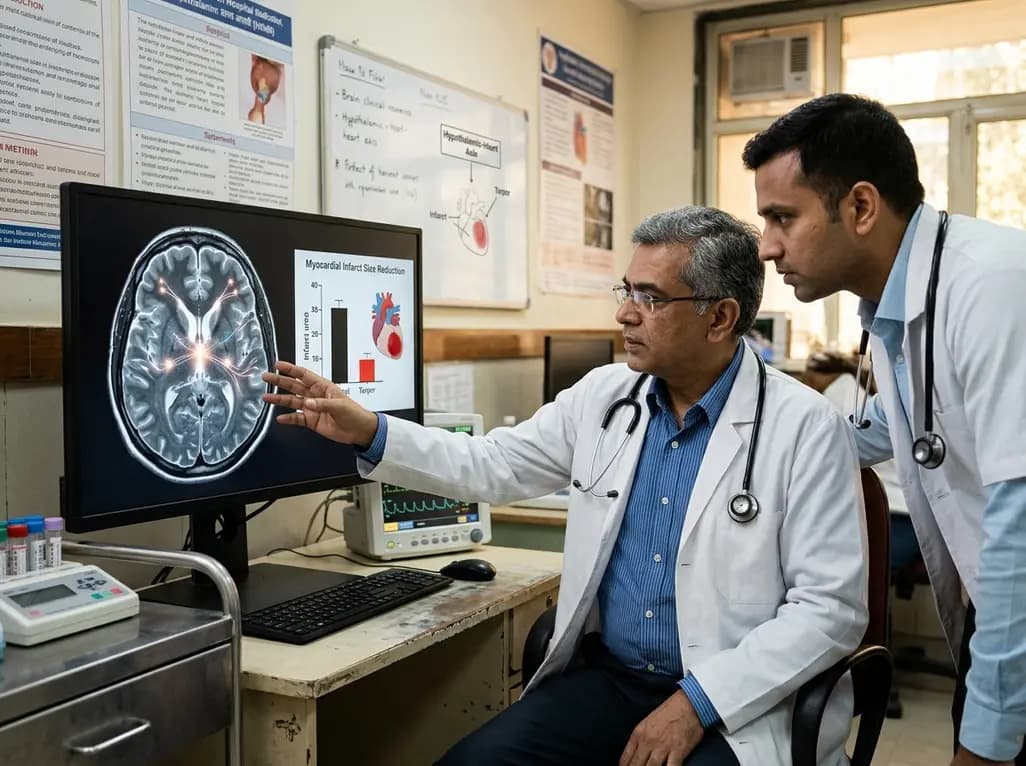
Researchers demonstrate that central induction of synthetic torpor in non-hibernating rats provides striking cardioprotection, reducing myocardial infarct size by ~40% during ischaemia-reperfusion injury through endogenous survival signaling, independent of hypothermia.
Today

A novel fluorine-functionalized near-infrared copper fluorescent probe selectively illuminates lung tissue, revealing critical links between hyperglycemia, ER stress, and pulmonary malignancy for improved early diagnosis.
Today
