.webp&w=384&q=75)

Loading, please wait...
Loading, please wait...

Targeted therapeutics have fundamentally altered hematologic oncology, particularly for historically aggressive leukemia subtypes. Small-molecule menin inhibitors, including revumenib and ziftomenib, disrupt the critical interaction between menin and lysine methyltransferase 2A. Consequently, these agents induce robust differentiation and marrow clearance in leukemias harboring KMT2A rearrangements and NPM1 mutations. However, clinical durability remains severely limited because menin inhibitor resistance frequently emerges within months of monotherapy initiation. Clinicians routinely observe complete remissions followed by swift hematologic relapses. Therefore, understanding the multifaceted biology behind treatment failure has become an urgent clinical priority. Malignant myeloblasts deploy diverse genetic, epigenetic, and microenvironmental adaptations to circumvent menin inhibition. Because therapy failure carries a dismal prognosis, hematologists must identify emerging escape routes early. Furthermore, unraveling these diverse resistance pathways provides the exact biological blueprint required to design effective next-generation combination protocols. As targeted oral agents enter routine leukemia management, understanding therapeutic failure mechanisms will empower clinicians to anticipate relapses and select rational consolidation regimens.
Primary on-target resistance arises directly within the MEN1 gene that encodes menin. Specifically, selective pressure from targeted exposure leads to the emergence of somatic missense mutations within the menin binding pocket. For example, amino acid substitutions such as M327I, G331E, and G332R disrupt drug-protein contacts without abolishing physiological KMT2A interaction. Consequently, the small molecule loses its competitive binding potency, whereas the leukemic transcription complex remains functionally intact. Furthermore, these structural alterations emerge rapidly under the selective pressure of monotherapy. Serial sequencing studies reveal that resistant MEN1 clones frequently expand from undetectable baseline frequencies within two to four cycles of therapy. Interestingly, different menin inhibitors demonstrate distinct susceptibility profiles to these mutations. Revumenib resistance frequently features binding pocket alterations, whereas ziftomenib exhibits distinct structural tolerance against specific MEN1 variants. Nevertheless, once an on-target binding mutation achieves clonal dominance, escalating the dosage of the same agent rarely restores clinical efficacy. Therefore, hematologists must recognize that point mutations within the target pocket represent an efficient, irreversible mechanism of single-agent pharmacological failure.
Beyond direct target modifications, leukemic blasts frequently evade menin blockade through secondary off-target mutations and clonal evolution. Rather than altering the menin protein itself, resistant sublineages activate parallel oncogenic cascades. In particular, activating mutations in signaling genes such as FLT3, NRAS, KRAS, and PTPN11 frequently emerge at the time of relapse. These hyperactive tyrosine kinase pathways deliver sustained proliferative signals that bypass the transcriptional suppression induced by menin inhibition. Moreover, preexisting minor sublineages harboring adverse alterations, including TP53 disruptions or complex karyotypes, often expand rapidly under selective therapeutic pressure. Consequently, the leukemia switches its fundamental biological driver away from KMT2A-dependent differentiation arrest toward autonomous, receptor-driven proliferation. Additionally, cell-cycle regulators and anti-apoptotic proteins become transcriptionally upregulated, dampening the apoptotic response to targeted menin disruption. Because these bypass mechanisms decouple cell survival from menin-KMT2A binding, sequential monotherapies directed solely against menin fail completely. Therefore, comprehensive genomic profiling at progression remains crucial to identify newly acquired targetable kinase alterations.
Epigenetic plasticity represents another formidable route of therapeutic escape in acute myeloid leukemia. Exposure to menin inhibitors normally represses critical leukemogenic homeobox genes, specifically HOXA9 and MEIS1. However, resistant leukemic blasts can restore expression of downstream transcriptional networks through alternative chromatin-modifying pathways. For instance, cells recruit alternative histone acetyltransferases, including KAT6A, or alter Polycomb repressive complex activity to re-establish transcriptional activation independently of menin. Furthermore, MYC overexpression often sustains blast survival despite successful disruption of the primary menin-MLL complex. In addition to intrinsic epigenetic rewiring, protective bone marrow stroma actively shields leukemic blasts from drug-induced differentiation and apoptosis. Stromal cells secrete high concentrations of protective cytokines, such as interleukin-6 and CXCL12, which activate survival programs through JAK-STAT and AKT pathways. Consequently, leukemic stem cells sheltered within specific endosteal niches evade pharmacological clearance and serve as a reservoir for clinical recurrence. Therefore, addressing non-genetic transcriptional adaptation and stroma-derived protection is imperative to achieve deep, durable remissions.
Currently, no standard clinical assays reliably predict imminent menin inhibitor failure, leaving salvage strategies largely empiric and challenging. When patients relapse, oncologists must rapidly deploy alternative regimens tailored to previous treatment exposures and performance status. For patients who have not previously received venetoclax, combining hypomethylating agents with BCL-2 inhibition represents a logical salvage option. Similarly, clinicians should direct therapy against newly expanded driver mutations, such as utilizing gilteritinib for acquired FLT3-mutated clones. In eligible individuals, intensive re-induction chemotherapy serves as a crucial bridge toward allogeneic hematopoietic stem cell transplantation. Ultimately, moving menin inhibitors into upfront combinations provides the strongest opportunity to eliminate resistant clones before therapeutic escape occurs. Preclinical data strongly endorse triplet regimens combining menin inhibitors, hypomethylating agents, and venetoclax to induce concurrent apoptotic stress and differentiation. Furthermore, evaluating these agents in frontline clinical trials substantially decreases the evolutionary space available for leukemic cells to develop resistance, offering the best path toward cure.
Primary risk factors include high baseline disease burden, heavily pretreated bone marrow, and the presence of preexisting adverse subclonal mutations. Specifically, patients harboring baseline signaling mutations in FLT3, RAS, or TP53 display an increased propensity for rapid clonal selection. Furthermore, single-agent monotherapy consistently elevates the evolutionary pressure that drives point mutations in the MEN1 binding pocket, accelerating clinical treatment failure.
Switching menin inhibitors can occasionally restore clinical response, but success depends entirely on the underlying resistance mechanism. If relapse stems from a specific MEN1 point mutation that spares the binding pocket of a distinct chemical scaffold, a second inhibitor may retain efficacy. However, if treatment failure involves off-target kinase bypass signaling or global epigenetic reprogramming, sequential menin monotherapy rarely produces durable remission.
Upfront combination regimens eliminate leukemic clones simultaneously through complementary biological mechanisms, significantly narrowing the opportunity for evolutionary escape. By combining menin inhibitors with venetoclax and hypomethylating agents, therapy forces blast differentiation while triggering massive intrinsic apoptosis. Consequently, this multi-targeted cytotoxic pressure eradicates both target-dependent myeloblasts and minor subclones before on-target binding mutations or bypass signaling pathways can emerge.
Disclaimer: This content is for informational and educational purposes only. It is not intended to substitute professional medical advice, diagnosis, or treatment. Refer to the latest local and national guidelines for clinical practice.
References
Alhajahjeh A et al. Resistance mechanisms and therapeutic strategies after menin inhibitor failure in acute myeloid leukemia. Expert Rev Hematol. 2026 Sep 13. doi: 10.1080/17474086.2026.2732994. PMID: 42733002.
Issa GC, et al. The promise of menin inhibitors: from approval to triplet regimens. Blood. 2025;146(23):2501-2512.
Joshi U, et al. Menin Inhibition in Acute Myeloid Leukemia: Pathobiology, Progress and Promise. Cancers. 2026;18(3):550.

Read summarized clinical updates, watch expert medical content, and earn CME certifications right from your smartphone.
Open your smartphone camera to scan and install.





Menin inhibitors represent a major breakthrough in targeted acute myeloid leukemia care, yet resistance limits durability. This review examines on-target mutations, bypass signaling, and emerging frontline combination strategies designed to overcome therapeutic failure and optimize patient survival.
Today
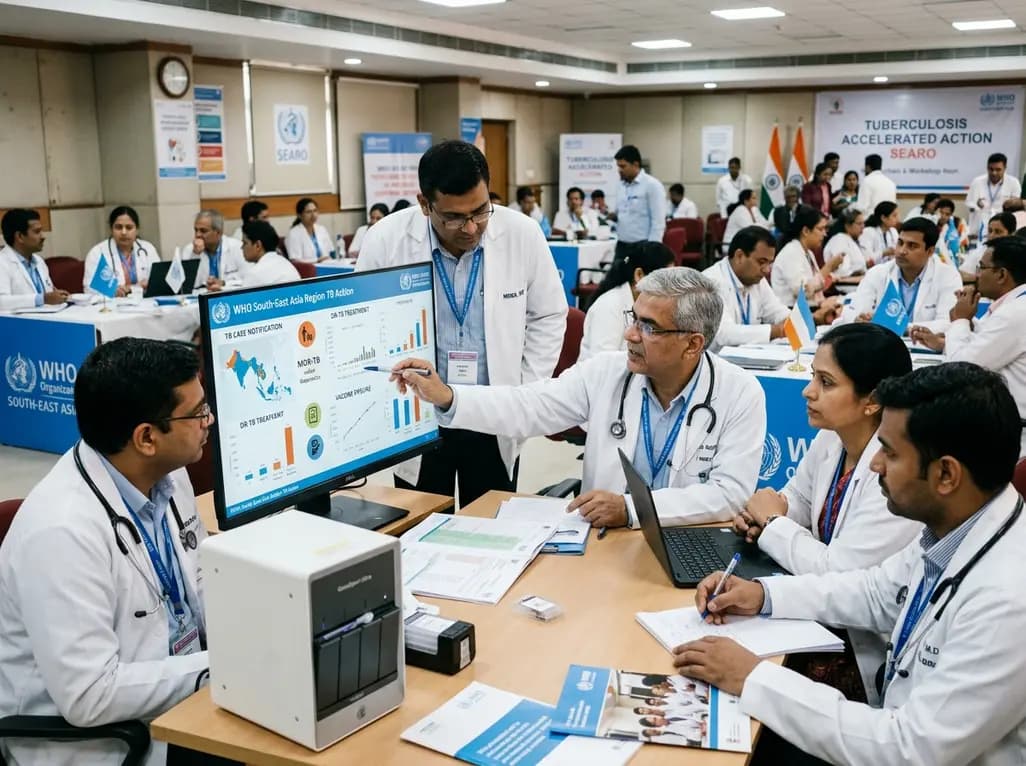
At the 79th Regional Committee session, WHO South-East Asia Member States pledged intensified action against tuberculosis. Key priorities include scaling up rapid molecular diagnostics, addressing drug-resistant strains, expanding preventive therapy, and preparing health systems for upcoming novel vaccines.
Today

A comprehensive meta-analysis of over 278,000 women demonstrates that maternal atopic dermatitis significantly increases risks of premature rupture of membranes and low birth weight. Discover essential clinical insights on disease mechanisms, serial antenatal growth monitoring, and safe therapeutic interventions.
Today

Over 60 international public health researchers have advised FSSAI to mandate front-of-pack warning labels for any packaged product high in even one critical nutrient: sugar, saturated fat, or sodium. This reform counters phased rollouts to accelerate consumer protection and address India's chronic disease burden.
Today

Apollo Global Management is in talks to acquire Johnson & Johnson's DePuy Synthes orthopedics unit in a potential $20 billion transaction. This comprehensive analysis reviews the MedTech restructuring, product lines in joint reconstruction, ongoing legal issues, and key implications for global orthopedic surgery.
Today

A cross-sectional study reveals that elevated METS-IR is independently associated with higher myopia odds in adolescents, showing biological synergy with obesity and highlighting the need for metabolic screening in pediatric eye care.
Yesterday
