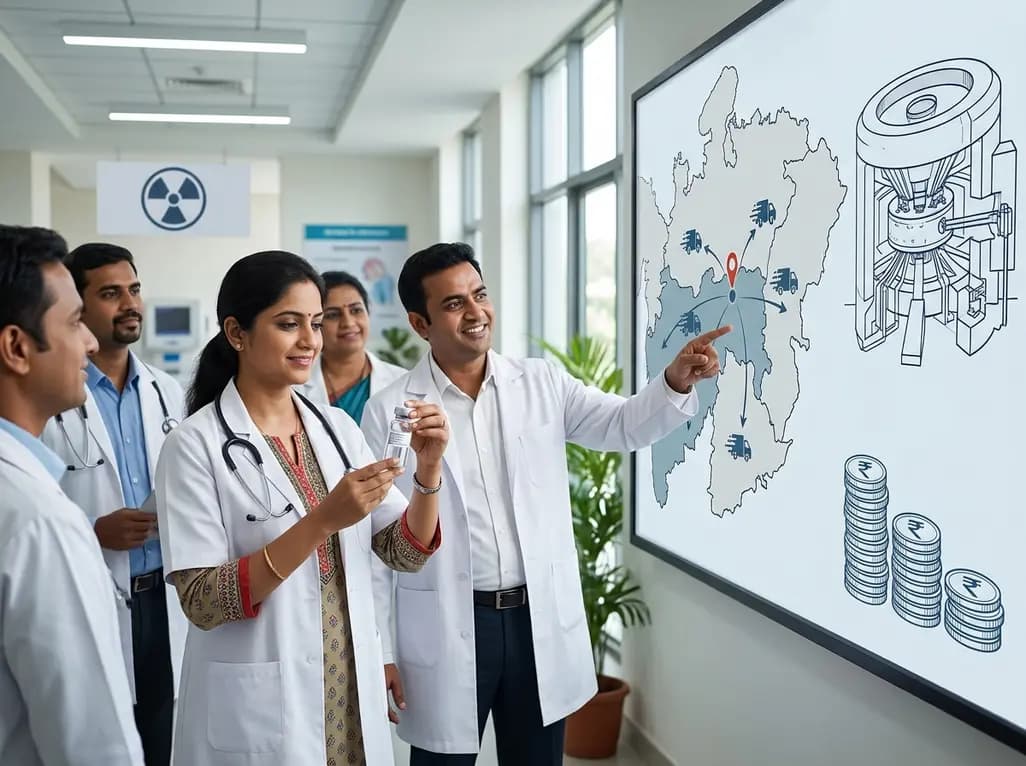
The government of Maharashtra has officially granted in-principle approval for a state-of-the-art medical cyclotron in Nagpur. This ₹300-crore project marks a critical shift for cancer diagnostics in Central India. Consequently, healthcare providers and oncologists in the region will gain unprecedented, localized access to highly sensitive diagnostic materials. Furthermore, this landmark decision addresses the historical challenges associated with importing short-lived radioisotopes from distant urban centers. Therefore, local clinical systems will become far more resilient and self-sustaining in the near future.
Understanding the Medical Cyclotron in Nagpur and Its Specifications
The newly approved high-energy particle accelerator will operate at an energy level of 30 million electronvolts (MeV). Specifically, a cyclotron uses electromagnetic fields to propel charged subatomic particles along a rapidly expanding spiral path. When these particles reach extreme speeds, they collide with a stable target material. Consequently, this high-energy collision alters the target's atomic nuclei, producing highly valuable medical radioisotopes. The state government has earmarked 30 hectares of land at Bhansoli (Kinhi) in Hingna taluka of Nagpur for this purpose. Moreover, this extensive site will accommodate the core accelerator machinery alongside specialized, lead-shielded synthesis laboratories. These facilities will allow technicians to safely bond raw isotopes with biological molecules to create patient-ready radiopharmaceuticals. Thus, local medical institutions will receive a steady, daily supply of diagnostic tracers. Additionally, the strategic location ensures that the production site remains close to major regional oncology clinics. This proximity represents a vital clinical advantage, as the radioactive decay of these materials begins immediately. Ultimately, local manufacturing will eliminate the massive transport delays that currently plague oncology practices in Vidarbha.
Overcoming the Challenges of Radioisotope Decay and Logistics
Currently, nuclear medicine departments in Central India depend almost entirely on radioisotopes transported from Mumbai or Hyderabad. However, these diagnostic agents possess extremely short half-lives, which means they decay rapidly during transit. For instance, Fluorine-18, a staple tracer for oncological imaging, has a half-life of approximately 110 minutes. Consequently, a significant portion of the radioactive payload is lost during long flight times and road transport. This rapid degradation makes cancer staging scans exceptionally expensive and logistically fragile. Furthermore, any flight cancellation or traffic delay immediately disrupts scheduled patient appointments at regional hospitals. In contrast, the medical cyclotron in Nagpur will produce these tracers locally, bypassing regional transport bottlenecks entirely. Local production ensures that clinicians receive optimal isotopic activity, which directly improves the resolution and accuracy of diagnostic scans. Therefore, physicians can detect microscopic metastases with greater confidence. Additionally, the elimination of interstate logistics will dramatically reduce the overhead expenses of nuclear medicine departments. As a result, hospitals can pass these savings directly to patients, making advanced cancer care more affordable and highly accessible.
Strategic Funding and State-Backed Governance Framework
To execute this ambitious project, the state government designed a unique, inter-departmental financial framework. Specifically, the Medical Education and Drugs Department and the Industries and Mining Department will split the ₹300 crore budget equally. Each department will contribute ₹150 crore, demonstrating a shared commitment to healthcare infrastructure and industrial development. Additionally, the facility will operate under MAHACARE, a state-owned Section 8 non-profit company. Subsequently, the government will incorporate a dedicated subsidiary to manage the daily operations of the facility. To prevent administrative delays during this transition, a steering committee under Dr. Shrikant Pardeshi will oversee the initial setup. Furthermore, a multidisciplinary board of experts will guide the project's long-term strategic direction. This board includes representatives from elite national institutions, including AIIMS Nagpur, Tata Memorial Centre, and the Bhabha Atomic Research Centre. Consequently, the project will benefit from world-class expertise in nuclear physics, industrial management, and clinical oncology. Moreover, this collaborative oversight ensures that the facility complies with strict national atomic energy safety standards. Thus, the administrative framework combines fiscal responsibility with peerless scientific guidance, protecting public health and optimizing state spending.
Positioning Nagpur as a Regional Radiopharmaceutical Hub
Nagpur sits at the geographical heart of India, making it an ideal distribution center for nuclear medicine. Consequently, the new facility will serve patients residing within a 500-kilometer radius of the city. This expansive catchment area covers parts of Maharashtra, Madhya Pradesh, Chhattisgarh, Telangana, and Andhra Pradesh. Historically, patients in these regions had to travel to major metropolises for advanced diagnostic testing. Now, however, the establishment of this project will position Nagpur as a dominant healthcare and radiopharmaceutical innovation hub. Specifically, the city already boasts a powerful healthcare ecosystem, including AIIMS Nagpur and the National Cancer Institute. Therefore, introducing a localized cyclotron will create synergistic opportunities for clinical collaboration and academic research. Furthermore, the local availability of raw isotopes will encourage pharmaceutical companies to establish manufacturing units nearby. This industrial growth will generate highly specialized jobs in radiochemistry, nuclear physics, and biomedical engineering. Additionally, it will attract global research funding and clinical trials to Central India. Ultimately, this development will significantly elevate the economic and clinical profile of Vidarbha, paving the way for unprecedented clinical breakthroughs.
Enhancing Clinical Oncology and Cancer Research
From a purely clinical perspective, the cyclotron will fundamentally upgrade how physicians diagnose and treat cancer. Specifically, positron emission tomography (PET) scans rely heavily on short-lived radiopharmaceuticals to identify metabolic anomalies in tissues. Because the facility will produce these tracers locally, clinicians can perform highly accurate PET-CT scans without delay. Consequently, this will enable early cancer detection, precise tumor staging, and the immediate monitoring of therapeutic efficacy. Furthermore, the 30 MeV cyclotron is capable of producing isotopes used in targeted radionuclide therapies. These advanced therapies deliver concentrated radiation directly to cancer cells while sparing healthy surrounding tissues. Therefore, local oncology teams can design highly customized treatment regimens for patients with complex or advanced malignancies. Additionally, the project will catalyze cutting-edge academic and clinical research at neighboring medical universities. Researchers can study novel radiotracers and run preclinical trials on site, accelerating the translation of scientific discoveries to patient bedsides. As a result, Vidarbha will emerge as a prominent destination for oncology training and clinical trials, shaping the future of medicine. Moreover, patients will no longer face devastating delays or prohibitive travel costs to receive life-saving diagnoses.
Frequently Asked Questions
Q1: What is a medical cyclotron and how does it help cancer patients?
A medical cyclotron is a high-energy particle accelerator that manufactures short-lived radioisotopes for medical imaging and targeted therapies. Specifically, these isotopes are crucial components of radiopharmaceuticals used in PET-CT scans to detect cancer, evaluate tumor stages, and monitor treatment response. By producing these agents locally, the facility ensures that clinicians have immediate access to highly active diagnostic tracers, leading to more accurate and timely scans for cancer patients.
Q2: Why is local production of radioisotopes in Nagpur so important?
Currently, healthcare facilities in Vidarbha must transport medical isotopes from Mumbai or Hyderabad. However, because these radioactive materials decay rapidly, much of their potency is lost during transit, making scans extremely expensive and scheduling highly fragile. Local production at the Nagpur facility completely eliminates these logistical bottlenecks. Consequently, patient diagnostic costs will decrease, treatment delays will be avoided, and clinical outcomes will improve across Central India.
Q3: Who will manage and guide the medical cyclotron project in Nagpur?
The state government will execute and manage this project through a dedicated subsidiary under MAHACARE, a Section 8 state-owned company. Additionally, a multidisciplinary board of directors will guide the facility's operations. This board comprises leaders from prominent institutions, such as AIIMS Nagpur, the Tata Memorial Centre, and the Bhabha Atomic Research Centre. Therefore, the facility will maintain the highest standards of clinical precision, technological innovation, and atomic safety guidelines.
Disclaimer: This content is for informational and educational purposes only. It does not constitute medical advice or replace professional judgment. Refer to the latest local and national guidelines for clinical practice.
References
- Maha govt approves ₹300cr high-energy medical cyclotron project in Nagpur - ETHealthworld
- Maharashtra Govt to set up medical cyclotron project in Nagpur to elevate cancer research - The Hindu
- To boost cancer treatment & research, medical cyclotron facility to be set up in Nagpur - The Indian Express
.webp&w=384&q=75)