.webp&w=384&q=75)

Loading, please wait...
Loading, please wait...

Healthcare environments are inherently high-stress zones where split-second decisions occur daily. Consequently, managing healthcare impatience becomes a critical priority for ensuring patient safety and diagnostic accuracy. A recent study conducted at Kyoto University Hospital explored how structured group-work sessions can help radiological technologists (RTs) regulate their emotional responses. Because impatience often leads to poor decision-making and increased clinical incidents, implementing targeted behavioral interventions is essential for long-term professional development.
The study utilized a specialized program titled "Coping with Impatience and Its Effects." Researchers focused on 16 technologists with varying levels of experience to assess the intervention's impact. The results were quite significant. Immediately after the sessions, participants reported a marked decrease in impatience triggered by others, such as doctors or nurses. Furthermore, their self-driven impatience also declined as they learned to identify and mitigate internal frustration.
Most importantly, the benefits of this intervention were not limited to the short term. The investigators followed the participants for six months to evaluate the durability of the behavioral changes. They found that the reduction in impatience levels remained stable throughout this entire period. This stability suggests that group-work sessions provide technologists with lasting psychological tools rather than temporary relief. Additionally, the study highlighted that impatience contributes to clinical incidents regardless of a professional's years of experience. By addressing these behavioral triggers early, healthcare facilities can create a much safer and more harmonious working environment for all staff members.
Implementing similar programs in busy clinical settings could mirror these successful outcomes. For instance, creating a structured space for reflection allows staff to process high-pressure scenarios in a supportive environment. As a result, technologists become more resilient to external stressors and less likely to experience burnout. In conclusion, behavioral interventions are a cost-effective and efficient way to enhance both staff well-being and the quality of patient care.
Impatience is closely linked to increased stress and anxiety. These emotional states often impair task performance and critical decision-making, which can lead to clinical incidents regardless of a technologist's experience level.
Yes. Research indicates that group-work sessions focusing on coping mechanisms can lead to a sustained reduction in impatience for at least six months, helping staff manage interpersonal and self-induced stressors more effectively.
Disclaimer: This content is for informational and educational purposes only and does not constitute medical advice or professional consultation. Always seek the advice of a qualified healthcare provider regarding any medical condition. Refer to the latest local and national guidelines for clinical practice.
References
Mabuchi R et al. Managing radiological technologists' impatience: testing the effectiveness of a group work intervention. Radiol Phys Technol. 2026 Jun 06. doi: 10.1007/s12194-026-01075-5. PMID: 42250204.
Mundt MP, et al. Effects of healthcare team size and social network structure on patient safety culture. BMJ Qual Saf. 2014;23:35–46. doi: 10.1136/bmjqs-2012-001744.
Andersson J, et al. Radiographers' experience of preventing patient safety incidents in the context of radiological examinations. Scand J Caring Sci. 2023;37(2):450-459. doi: 10.1111/scs.13110.

Read summarized clinical updates, watch expert medical content, and earn CME certifications right from your smartphone.
Open your smartphone camera to scan and install.





A study at Kyoto University Hospital demonstrates that group-work interventions significantly reduce impatience in radiological technologists for over six m...
4 months ago

A retrospective cohort study of 7,716 ICU patients from the MIMIC-IV database demonstrates that Gradient Boosting Decision Trees significantly outperform traditional SOFA scores in predicting in-hospital mortality among patients with sepsis and diabetes, with SHAP analysis providing clinical interpretability.
Today
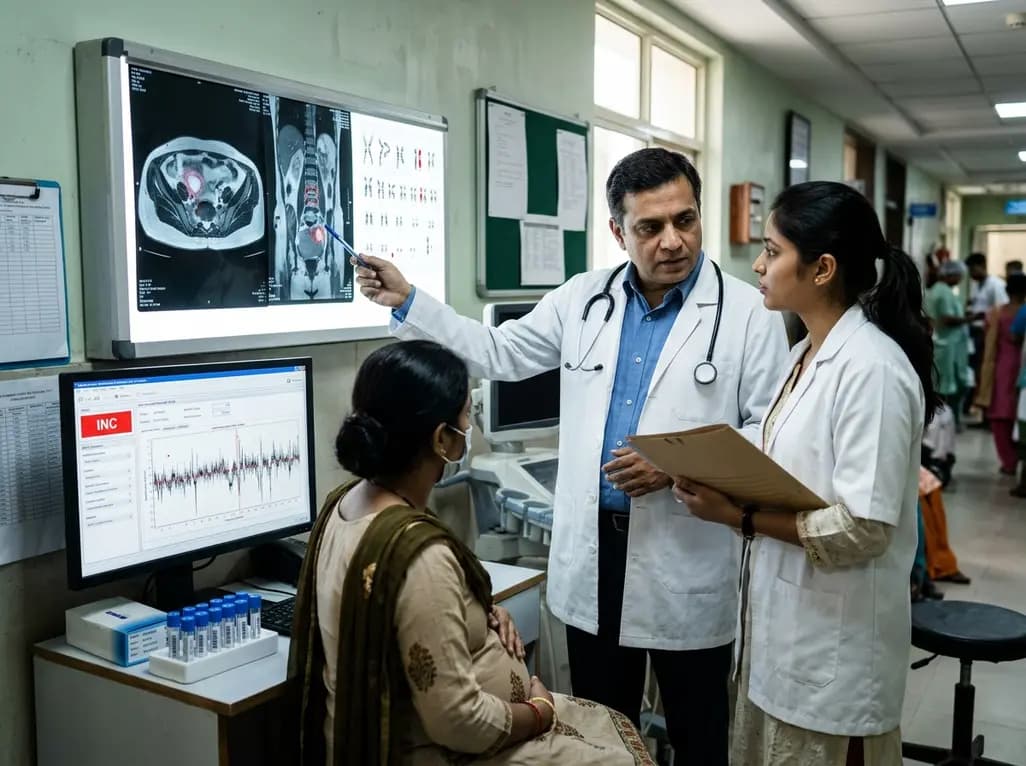
Occult maternal malignancy accounts for 3.82% of persistent unreportable NIPT results with genomic noise. Multiple chromosomal aberrations, notably on chromosome 18, warrant thorough oncological evaluation and whole-body MRI to ensure timely maternal diagnosis while preserving fetal care.
Today

This article reviews the forensic and clinical complexities of acute myocarditis arising on left ventricular hypertrophy in children, highlighting early diagnostic red flags and multidisciplinary postmortem autopsy protocols.
Today

This comparative study evaluates posterior labral tears with and without glenohumeral instability, highlighting distinct demographic patterns, MRI underestimation in stable shoulders, and successful arthroscopic repair outcomes.
Yesterday

A clinical study demonstrates that early intervention with tocilizumab, either as monotherapy or bridged with corticosteroids, achieves significant proptosis reduction and resolves active inflammation in treatment-naive thyroid eye disease.
Yesterday
