.webp&w=384&q=75)

Loading, please wait...
Loading, please wait...
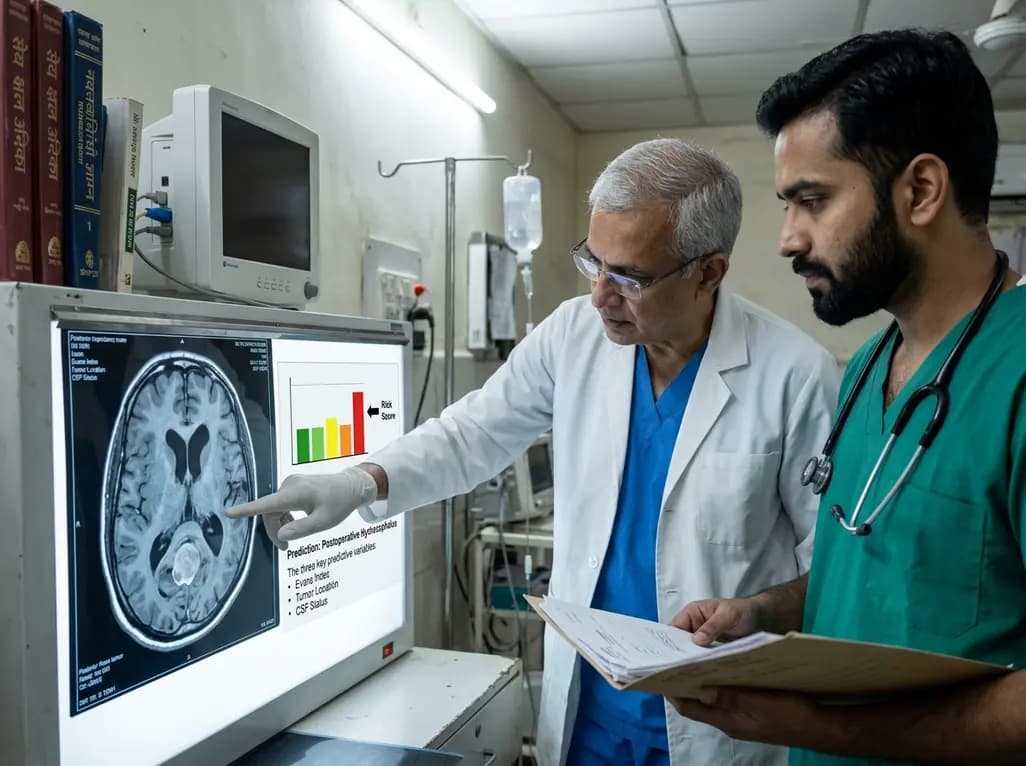
Surgical resection remains the primary therapeutic approach for posterior fossa tumors in neurosurgical practice. However, the tight anatomical space of the posterior cranial fossa predisposes patients to severe complications, among which postoperative hydrocephalus represents one of the most challenging conditions. Epidemiological studies indicate that postoperative hydrocephalus occurs in 7% to 40% of patients undergoing infratentorial tumor surgery. This wide variation stems from distinct tumor histopathologies, baseline ventricular anatomy, and varied surgical techniques. When hydrocephalus persists after tumor resection, patients often suffer from elevated intracranial pressure, extended intensive care stays, delayed neurological recovery, and the necessity for permanent shunt placement. Historically, neurosurgeons have relied on subjective clinical assessments and variable institutional protocols to determine the need for cerebrospinal fluid diversion. Consequently, clinicians urgently need reliable, evidence-based tools that can accurately stratify individual risk before craniotomy. Accurate predictive instruments enable surgical teams to design targeted surveillance regimens and counsel families effectively.
To establish an objective predictive framework, researchers performed a comprehensive multicenter study analyzing 1,073 patients who underwent surgical resection for posterior fossa tumors across five tertiary neurosurgical centers. The investigators divided the cohort into a development dataset of 854 patients and an external validation dataset of 219 patients. The multidisciplinary team initially evaluated 30 perioperative clinical, radiological, and surgical variables from the multicenter electronic medical records. To optimize routine clinical utility, the investigators restricted candidate predictors to variables accessible before surgical incision. The researchers used Shapley additive explanations to systematically rank feature importance and uncover complex nonlinear interactions among variables. Subsequently, the investigators trained and benchmarked seven machine learning algorithms, including support vector machines, random forest classifiers, gradient boosting algorithms, and logistic regression. The researchers evaluated model discrimination using receiver operating characteristic curves, precision-recall metrics, sensitivity, specificity, and decision curve analysis to establish net clinical benefit.
Through feature selection and algorithmic modeling, the investigators developed a concise, clinically implementable three-variable model. The first vital predictor was the Evans index, which measures the ratio of maximal frontal horn diameter to the internal diameter of the calvarium. A high Evans index indicates preoperative ventriculomegaly and compromised supratentorial compliance. The second crucial feature was the anatomical relationship between the tumor and the fourth ventricle. Infratentorial lesions that invade, efface, or distort the fourth ventricle severely obstruct cerebrospinal fluid outflow pathways, which heightens the likelihood of persistent hydrodynamic failure after tumor removal. The third parameter was the preoperative cerebrospinal fluid diversion status, reflecting whether patients had received external ventricular drainage or endoscopic third ventriculostomy prior to craniotomy. Together, these three routinely available variables capture baseline ventricular disturbance and structural obstruction. They provide a practical, objective basis for forecasting postoperative hydrocephalus without requiring complex intraoperative or postoperative diagnostic testing.
Independent external validation is critical to evaluate the reliability and real-world generalizability of clinical machine learning tools. In the external validation cohort of 219 patients, the support vector machine model exhibited excellent discriminatory performance, achieving an area under the receiver operating characteristic curve of 0.877. In addition, the model demonstrated an overall accuracy of 81.3%, with a balanced sensitivity of 80.8% and a specificity of 81.7%. Logistic regression models achieved comparable discrimination, demonstrating that a parsimonious set of well-defined parameters maintains high predictive value across diverse algorithmic architectures. However, calibration assessments revealed evidence of dataset shift between the derivation and validation cohorts. This variance suggests that differing baseline institutional incidence rates and surgical referral patterns can alter absolute risk estimates. Therefore, neurosurgeons must interpret absolute predicted probabilities carefully across different healthcare settings, ensuring that algorithmic outputs complement comprehensive clinical assessments.
Applying this three-variable predictive model in clinical practice provides substantial advantages for neurosurgical workflows and perioperative planning. By calculating individualized risk before surgery, surgical teams can design targeted postoperative surveillance pathways for high-risk patients. These high-risk individuals can receive prioritized neuroimaging schedules, extended bedside neurological monitoring, and proactive evaluation for cerebrospinal fluid circulation issues. Furthermore, structured risk stratification supports transparent communication with patients and caregivers, establishing clear expectations regarding recovery milestones and potential secondary procedures. However, the study authors emphasize that this algorithm should function solely as a supportive clinical tool rather than a standalone criterion for surgical diversion. Clinicians must synthesize algorithmic predictions with real-time operative observations, patient hemodynamic stability, and serial bedside neurological examinations. Utilizing the model as a collaborative decision aid enhances vigilant monitoring while preventing unnecessary invasive procedures in low-risk patients.
Although the multicenter design and external validation confirm the utility of this model, several important limitations require careful consideration. First, the retrospective design across historic cohorts exposes the findings to institutional practice variations and evolving surgical protocols over time. Second, the observed dataset shift between institutions highlights the necessity of prospective validation across diverse regional populations. Third, centers must recalibrate decision thresholds locally before integrating the algorithm into routine electronic health records. Future investigations should examine whether adding automated three-dimensional magnetic resonance volumetry or perioperative inflammatory biomarkers can enhance predictive accuracy while preserving practical simplicity. Additionally, prospective clinical trials should assess whether algorithm-guided proactive management directly reduces overall morbidity, intensive care duration, and healthcare expenses. As digital neurosurgery advances, streamlined machine learning tools that leverage routine clinical metrics will play an essential role in improving neurosurgical oncology care worldwide.
The Evans index measures the ratio of maximal frontal horn width to inner cranial diameter. An elevated Evans index indicates pre-existing ventricular enlargement and altered intracranial compliance, which strongly correlates with an increased likelihood of persistent cerebrospinal fluid circulation failure following posterior fossa tumor resection.
Tumors that directly invade, distort, or efface the fourth ventricle mechanically block normal cerebrospinal fluid pathways and aqueductal outflow. This anatomical distortion impairs baseline ventricular compliance, predisposing patients to persistent hydrodynamic obstruction even after successful macroscopic surgical resection of the infratentorial tumor.
No, the predictive model cannot replace clinical judgment or serve as an independent indication for cerebrospinal fluid diversion. Instead, surgical teams should use the tool alongside bedside neurological evaluations, radiological assessments, and intraoperative findings to guide postoperative surveillance intensity and family risk communication.
Disclaimer: This content is for informational and educational purposes only and does not constitute medical advice. Refer to the latest local and national guidelines for clinical practice.
References
Li R et al. Development and external validation of a machine learning model for predicting postoperative hydrocephalus in 1,073 posterior fossa tumor patients. Neurosurg Rev. 2026 Jul 30. doi: 10.1007/s10143-026-04403-w. PMID: 42530672.
Chen T, Ren Y, Wang C, et al. Risk factors for hydrocephalus following fourth ventricle tumor surgery: A retrospective analysis of 121 patients. PLoS One. 2020;15(11):e0241853.
Riva-Cambrin J, Detsky AS, Lamberti-Pasculli M, et al. Predicting postresection hydrocephalus in pediatric patients with posterior fossa tumors: validation and modification of a predictive model. J Neurosurg Pediatr. 2012;9(4):437-444.

Read summarized clinical updates, watch expert medical content, and earn CME certifications right from your smartphone.
Open your smartphone camera to scan and install.





A multicenter study of 1,073 patients developed and validated a three-variable machine learning model utilizing Evans index, tumor-fourth ventricle relationship, and CSF diversion status to predict postoperative hydrocephalus after posterior fossa tumor resection, supporting surgical planning and surveillance.
last month

A review of incidental intestinal parasitic infections detected during colonoscopy, highlighting diagnostic morphology, the absence of peripheral eosinophilia, and tailored antihelminthic treatment.
Today

A nationwide South Korean study shows underreporting of smoking among women dropped from 57.4% to 36.4% between 2008 and 2021. However, over one-third of female smokers still conceal their habit, highlighting the critical role of cotinine verification in clinical risk assessment.
Today

PepsiCo and Monster Beverage have challenged the FSSAI ban on the energy drink label in Indian courts. While companies highlight supply disruptions, regulatory actions spotlight severe cardiovascular and metabolic risks associated with excessive caffeine, sugar, and taurine consumption, especially in adolescents.
Today
Persistent and recurrent musculoskeletal pain in youth athletes is often dismissed as simple growing pains. A developmentally informed biopsychosocial framework is essential to guide return-to-sport decisions, addressing biological vulnerabilities, psychological appraisals, and sociocultural expectations.
Today

A Bayesian multilevel meta-analysis reveals that aerobic training combined with moderate carbohydrate restriction modestly lowers HbA1c in type 2 diabetes. However, sparse data and very low certainty leave incremental benefits over exercise or diet alone unproven, highlighting the need for individualized care.
Yesterday
