.webp&w=384&q=75)

Loading, please wait...
Loading, please wait...
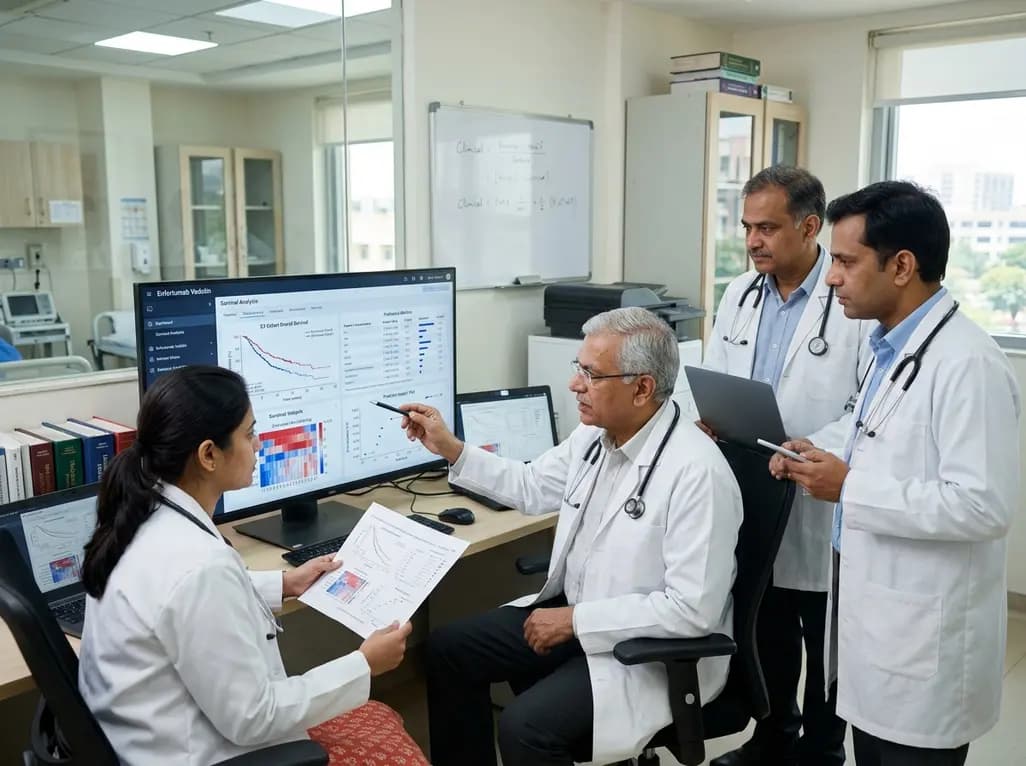
Recent therapeutic advances have fundamentally altered the clinical management of advanced urothelial carcinoma, offering meaningful systemic options for heavily pretreated individuals. In this rapidly shifting paradigm, accurate enfortumab vedotin survival prediction allows oncologists to better understand patient risk profiles and anticipate clinical trajectories. A recent global real-world analysis evaluated multiple machine learning algorithms combined with explainable artificial intelligence to forecast overall survival after standard systemic regimens. Although these computational models illuminate crucial prognostic drivers, their current predictive capacity remains exploratory and serves primarily to generate scientific hypotheses rather than dictate immediate bedside decisions.
Advanced urothelial carcinoma represents an aggressive malignancy with historically poor clinical outcomes following disease progression on frontline platinum regimens. Fortunately, the development of enfortumab vedotin, an antibody-drug conjugate directed against Nectin-4, has substantially expanded modern treatment algorithms. Landmark clinical trials demonstrated significant overall survival and response benefits in patients previously treated with platinum-based chemotherapy and immune checkpoint inhibitors. Consequently, international clinical guidelines widely endorse this therapeutic agent across standard oncologic practice.
Nevertheless, patient outcomes in routine clinical practice exhibit considerable heterogeneity. Real-world populations frequently include individuals with substantial medical comorbidities, reduced performance scores, or disparate metastatic distributions who were excluded from pivotal clinical trials. Because therapeutic benefit varies markedly across individual patients, oncologists require reliable prognostic frameworks to guide therapeutic expectations and post-progression planning. Identifying baseline clinical variables that govern survival helps multidisciplinary cancer care teams tailor supportive management and optimize therapeutic sequencing.
To evaluate complex clinical interactions, investigators conducted an exploratory analysis involving 544 patients with advanced urothelial carcinoma across 51 medical centers in 24 countries. Every patient received enfortumab vedotin after prior platinum-based chemotherapy and immunotherapy. Investigators trained four advanced computational algorithms on 80% of the patient cohort and validated them on the remaining 20% test set.
Specifically, the study evaluated Random Survival Forest, eXtreme Gradient Boosting (XGBoost), Elastic Net-regularized Cox regression, and Support Vector Machine models. Algorithmic discrimination was evaluated using the concordance index (C-index) and time-dependent Area Under the Curve (AUC) metrics. Among the evaluated algorithms, Elastic Net and XGBoost demonstrated the highest discriminative ability, achieving C-indices of 0.60 and 0.59, respectively. Moreover, XGBoost delivered notable time-dependent AUC values of 0.77 at one year, 0.87 at two years, and 0.93 at three years. These mathematical metrics highlight the capacity of non-linear algorithms to capture temporal survival patterns in heterogeneous cancer cohorts.
Complex machine learning algorithms often operate as opaque black boxes, which severely limits their clinical interpretability and practical adoption. To overcome this critical barrier, investigators applied SHapley Additive exPlanations (SHAP) to the top-performing XGBoost model. This interpretability technique quantifies the exact contribution and directional influence of each clinical variable on survival predictions.
Through SHAP analysis, explainable artificial intelligence revealed essential insights for enfortumab vedotin survival prediction in real-world settings. Prior exposure to specific immune checkpoint inhibitors, such as pembrolizumab, atezolizumab, or nivolumab, correlated with a reduced mortality hazard. Similarly, prior radiotherapy and primary tumor localization within the upper urinary tract were associated with favorable survival trajectories. In contrast, extensive visceral dissemination significantly elevated mortality hazards. By making algorithmic reasoning transparent, explainable AI bridges computational mathematics and clinical oncology, enabling clinicians to assess whether data-driven findings align with established biologic principles.
The SHAP interpretability framework underscored patient functional performance and specific metastatic patterns as the primary drivers of survival. Eastern Cooperative Oncology Group (ECOG) performance status emerged as one of the most decisive prognostic indicators. Patients presenting with impaired functional status consistently experienced accelerated disease progression and inferior survival outcomes.
Furthermore, metastatic disease distribution significantly influenced overall survival duration. The presence of metastases in the liver, lungs, bones, and soft tissues substantially increased mortality risks during therapy. Conversely, patients with disease limited to regional lymph nodes or upper tract urothelial carcinoma displayed noticeably longer survival. In addition, prior systemic treatments provided vital context regarding underlying tumor biology and treatment sensitivity. Therefore, integrating anatomical tumor distribution, patient performance status, and treatment history provides clinicians with a practical foundation to identify high-risk individuals who require proactive supportive care and closer surveillance during systemic treatment.
Although machine learning algorithms identify biologically plausible prognostic markers, their current discriminative capacity remains modest. A C-index around 0.60 indicates that these models offer moderate risk stratification rather than definitive clinical decision support. Consequently, these algorithmic findings must be viewed as hypothesis-generating insights rather than tools ready for immediate bedside deployment.
In addition, retrospective multicenter data collection introduces potential confounding factors, including differing imaging schedules, local treatment preferences, and documentation practices across international centers. These limitations emphasize that computational risk models cannot replace comprehensive multidisciplinary oncology evaluations. Clinicians must continue to integrate established clinical guidelines, patient preferences, and individualized clinical assessments when determining treatment plans. Future investigations must focus on prospective multi-institutional validation and the integration of genomic, transcriptomic, and digital pathology markers to build robust clinical decision support systems for precision oncology.
Machine learning models like XGBoost and Elastic Net demonstrate modest overall discrimination, with C-indices ranging between 0.59 and 0.60. However, XGBoost achieved strong time-dependent AUCs of 0.77 at one year and 0.93 at three years. While these tools effectively identify broad prognostic patterns, they are currently exploratory and hypothesis-generating rather than ready for routine clinical decision-making.
The explainable AI analysis identified ECOG performance status and metastatic distribution as key prognostic determinants. Specifically, metastases in the liver, lungs, bones, and soft tissues significantly increased mortality risk. Conversely, upper tract tumor origin, prior radiotherapy, and previous treatment with immune checkpoint inhibitors were associated with reduced mortality risk in patients receiving enfortumab vedotin.
Explainable artificial intelligence provides essential transparency by quantifying how individual patient characteristics influence mathematical risk estimates. Standard machine learning often operates as a black box, limiting clinical trust and adoption. By utilizing tools like SHAP values, oncologists can verify that algorithmic predictions align with clinical pathophysiology, ensuring safer and more interpretable artificial intelligence tools in precision oncology.
Disclaimer: This content is for informational and educational purposes only, and should not be taken as medical advice or used for clinical decision-making. Healthcare providers should exercise their independent clinical judgment and seek appropriate professional guidance where necessary. Refer to the latest local and national guidelines for clinical practice.
References

Read summarized clinical updates, watch expert medical content, and earn CME certifications right from your smartphone.
Open your smartphone camera to scan and install.





A global real-world study analyzed machine learning and explainable AI models to predict overall survival in advanced urothelial carcinoma patients treated with enfortumab vedotin, highlighting performance status and metastatic distribution as key prognostic determinants.
4 weeks back

A systematic review of 41 preclinical studies reveals that baicalin dampens systemic inflammation, inhibits NF-κB and NLRP3 pathways, and improves organ preservation in sepsis models. However, substantial study heterogeneity and a complete lack of human clinical trials highlight the need for further translational research.
Today
Discover the crucial distinctions between mesonephric and mesonephric-like proliferations of the female genital tract. Learn the key histomorphologic, immunohistochemical, and molecular differences essential for accurate diagnosis and clinical management.
Today
A large UK Biobank study reveals that plasma proteomic signatures capture preclinical organ damage and improve multiorgan risk prediction across early CKM syndrome stages 0 to 2 beyond traditional PREVENT clinical models.
Today
A narrative review investigates whether the articularis genus muscle functions as an independent anatomical entity or blends with the vastus intermedius. We evaluate its morphology, role in retracting the suprapatellar bursa, and direct clinical significance in anterior knee pain and arthroplasty.
Today

A Bayesian multilevel meta-analysis reveals that aerobic training combined with moderate carbohydrate restriction modestly lowers HbA1c in type 2 diabetes. However, sparse data and very low certainty leave incremental benefits over exercise or diet alone unproven, highlighting the need for individualized care.
Today
