.webp&w=384&q=75)

Loading, please wait...
Loading, please wait...
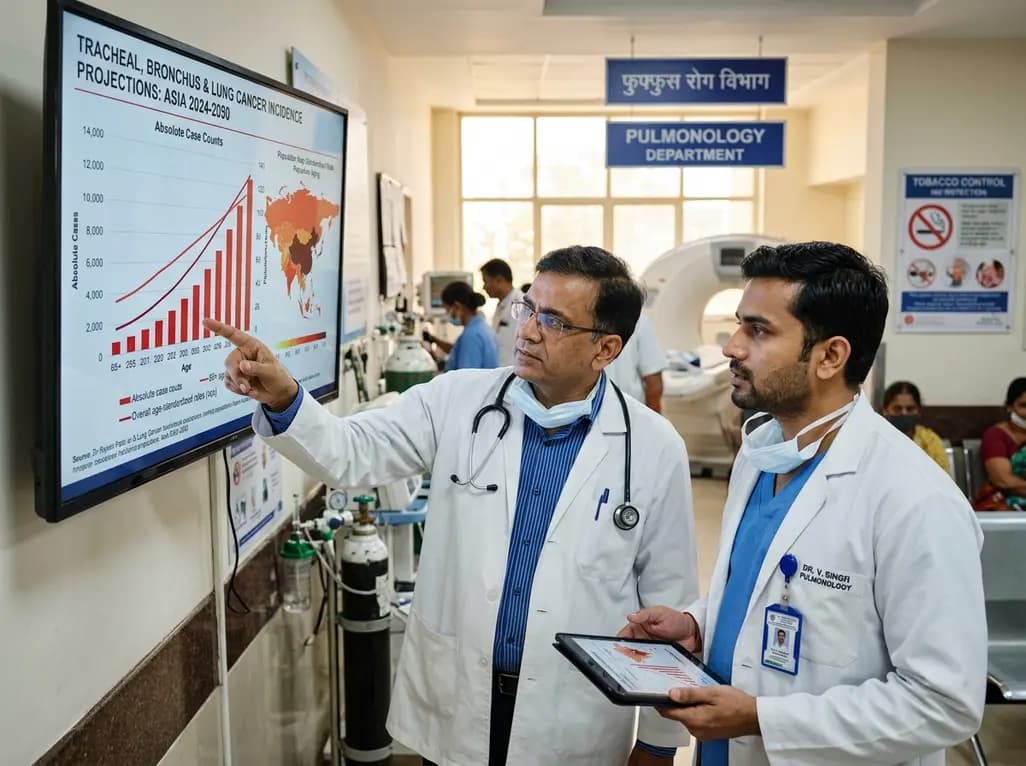
The epidemiological transition across Asian nations has fundamentally transformed oncological care. In recent decades, tracheal, bronchus, and lung neoplasms have emerged as predominant public health priorities. A rigorous Global Burden of Disease investigation reveals that the growing burden of lung cancer in Asia is heavily driven by rapidly expanding older populations. Consequently, healthcare providers must re-examine existing clinical strategies and resource distribution models.
Over the past three decades, tracheal, bronchus, and lung cancer patterns have shifted dramatically across the continent. Researchers evaluating longitudinal data from 1990 to 2023 documented a massive expansion in absolute disease burden among adults aged sixty years and older. Specifically, new cancer diagnoses surged from 334,563 cases in 1990 to more than 1.1 million cases by 2023. In addition, disability-adjusted life years rose from 7.3 million to an alarming 19.4 million. Despite these profound increases in gross numbers, age-standardized rates changed only modestly across most territories. The estimated annual percentage changes for the continent remained statistically indistinguishable from zero during this observation period. Furthermore, the clinical burden consistently exhibited a steep age-dependent trajectory. Older individuals faced substantially higher malignancy rates than younger cohorts. Similarly, male patients carried an elevated diagnostic and mortality risk across every geographic zone. These baseline figures underscore that gross morbidity continues to mount despite stable population-adjusted indicators. Pulmonologists and oncologists must recognize this dual reality during regular clinical practice.
Demographic growth represents the principal catalyst accelerating thoracic malignancies in contemporary Asia. When statisticians decompose the historical metrics, sheer population expansion accounts for most of the gross case rise. Because life expectancy has increased, millions more elderly individuals now enter high-risk age brackets. Consequently, malignant transformations accumulate more frequently over extended cellular lifespans. However, the underlying epidemiological dynamics remain distinct across different subregions. In several Central Asian countries, negative age-specific rate components actually counterbalanced demographic pressure. Thus, reduced baseline exposure or changing regional circumstances mitigated what would otherwise have been steeper case surges. Nevertheless, throughout East, South, and Southeast Asia, demographic momentum completely overpowered individual protective trends. Healthcare teams now encounter an ageing demographic paradox. While individual age-adjusted risk appears manageable, the gross volume of elderly patients overwhelms hospital wards. Primary physicians must anticipate this influx by actively screening vulnerable older demographics. Moreover, healthcare administrators must fund specialised diagnostic tools to manage the growing geriatric patient volume effectively.
Disparities in cancer outcomes have historically mirrored the socioeconomic gradient across Asian countries. Historically, nations with lower developmental indicators struggled with late-stage detection and inadequate therapeutic options. However, recent analyses demonstrate that socioeconomic inequality has attenuated considerably over the past thirty years. This gradual convergence is particularly evident for mortality rates and disability-adjusted life years. Broad improvements in diagnostic access, urbanization, and public healthcare funding likely explain this narrowing gap. In addition, widespread dissemination of modern targeted therapies and advanced surgical approaches has improved survival rates across diverse populations. Nevertheless, distinct regional disparities continue to challenge oncological equity. For instance, urban healthcare centres frequently possess cutting-edge molecular pathology laboratories, whereas remote and rural clinics lack basic diagnostic imaging. Furthermore, environmental carcinogens, industrial emissions, and household biomass fuel use remain heavily concentrated in developing communities. Therefore, clinicians must assess environmental and occupational exposures alongside classical lifestyle habits. Bridging this remaining gap demands concerted governmental intervention and equitable resource distribution across underfunded provincial medical systems.
Advanced predictive modelling reveals compelling future trends for thoracic malignancies across the Asian continent. Utilizing Bayesian age-period-cohort projections, researchers evaluated expected trajectory changes between 2024 and 2050. The model projects remarkable declines in standardized indicators over the coming decades. Specifically, the age-standardized incidence rate will decline by 44.2% across Asian territories. Similarly, the age-standardized death rate will experience an estimated 45.6% reduction by 2050. These impressive reductions reflect ongoing tobacco cessation policies, cleaner energy adoption, and earlier clinical interventions. However, the absolute disease burden will tell a completely different story. Because the elderly population continues to multiply rapidly, absolute cases will decrease only modestly. Consequently, thoracic oncology wards will experience sustained clinical pressure for decades. In addition, the sheer complexity of managing older patients will escalate hospital resource consumption. Healthcare policymakers cannot afford complacency based on falling per-capita rates. Instead, public health authorities must allocate long-term capital toward comprehensive geriatric cancer care networks.
The rising absolute cancer burden requires fundamental transformations in clinical practice. Because older adults frequently present with severe cardiovascular comorbidities and reduced pulmonary reserve, standard curative therapies pose unique challenges. For example, traditional radical surgical resection often carries unacceptable perioperative morbidity for frail individuals. Therefore, multidisciplinary teams must integrate minimally invasive thoracic surgery and stereotactic body radiation therapy into standard protocols. Furthermore, clinicians must regularly utilize validated geriatric assessment tools to quantify physiological vulnerability before starting systemic treatment. Modern targeted therapies and immune checkpoint inhibitors have revolutionized modern thoracic oncology. However, elderly patients remain susceptible to immune-related adverse events and significant toxicities. In addition, polypharmacy complicates medication adherence and elevates adverse drug interaction risks. Consequently, pulmonologists, oncologists, and geriatricians must foster tight interdisciplinary collaboration. Establishing integrated geriatric oncology outpatient clinics will optimize clinical outcomes, preserve functional status, and enhance quality of life for vulnerable older populations.
Although age-standardized incidence and mortality rates are steadily decreasing due to lifestyle improvements and tobacco control, rapid population ageing expands the total pool of elderly individuals across Asia. Because advancing age represents the most potent non-modifiable oncological risk factor, absolute case volumes continue to rise. Consequently, national healthcare systems must prepare for sustained clinical workloads even as statistical per-capita incidence shows welcome improvements.
Geriatric thoracic oncology patients frequently present with significant comorbidities, compromised organ reserves, and chronic respiratory disorders. In addition, polypharmacy elevates the likelihood of drug interactions during systemic chemotherapy or targeted therapy. Therefore, clinicians must carefully tailor diagnostic pathways and therapeutic regimens. Incorporating comprehensive geriatric assessments ensures that oncologists balance oncological efficacy with treatment tolerability, maintaining functional independence and quality of life for these frail elderly individuals.
Healthcare authorities must proactively decentralize diagnostic infrastructure and expand thoracic screening capacities across secondary and primary care networks. Furthermore, expanding geriatric oncology fellowship training prepares specialists for complex clinical decisions in frail patients. In addition, strengthening regional palliative care integration guarantees symptom relief alongside active oncological management. Ultimately, health systems must secure sustainable financing models to subsidize essential molecular testing, targeted therapies, and radiation technologies across diverse populations.
Disclaimer: This content is for informational and educational purposes only... Refer to the latest local and national guidelines for clinical practice.
References

Read summarized clinical updates, watch expert medical content, and earn CME certifications right from your smartphone.
Open your smartphone camera to scan and install.





A new Global Burden of Disease analysis highlights the escalating burden of tracheal, bronchus, and lung cancer among older adults across Asia. While age-standardized rates will decline through 2050, rapid population ageing will sustain high absolute case numbers, requiring urgent healthcare adaptation.
last month

Review how tailored exercise programs benefit frail older patients with heart failure. Explore pathophysiological mechanisms, individualized training prescriptions, and strategies to overcome adherence barriers in clinical practice.
Today

Recent clinical studies reveal maternal autoantibodies targeting IL-1RA as potential triggers for preterm labor, opening avenues for targeted cytokine therapies. Concurrently, new perioperative findings show inhaled cannabis increases propofol requirements during upper endoscopy compared to oral edible consumption.
Today

In high-risk pulmonary embolism complicated by severe anemia and active uterine bleeding, systemic thrombolysis is contraindicated. Large-bore aspiration thrombectomy provides rapid hemodynamic rescue without fibrinolysis, supported by inferior vena cava filter placement and multidisciplinary critical care.
Today

This comparative study evaluates posterior labral tears with and without glenohumeral instability, highlighting distinct demographic patterns, MRI underestimation in stable shoulders, and successful arthroscopic repair outcomes.
Today

A clinical study demonstrates that early intervention with tocilizumab, either as monotherapy or bridged with corticosteroids, achieves significant proptosis reduction and resolves active inflammation in treatment-naive thyroid eye disease.
Today
