.webp&w=384&q=75)

Loading, please wait...
Loading, please wait...
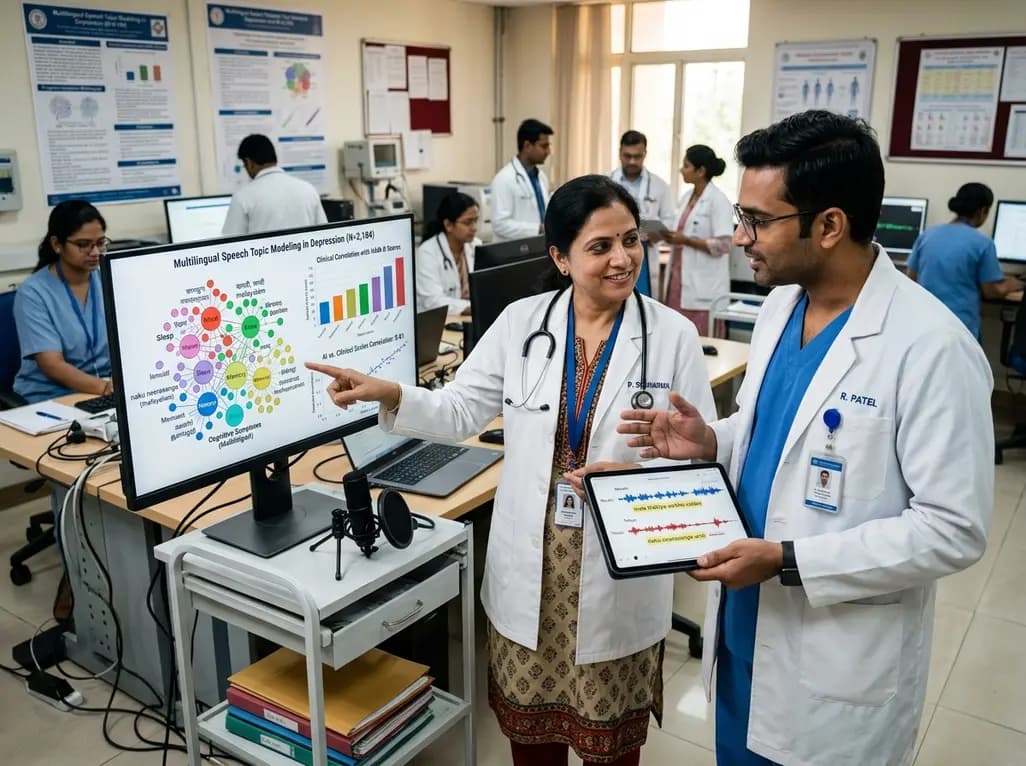
Depression remains one of the leading contributors to the global burden of disease, yet diagnostic delays continue to hinder effective psychiatric management worldwide. Clinicians traditionally evaluate depressive disorders through structured interviews and qualitative observations of patient narrative. However, manual transcript analysis requires substantial clinical time and lacks the scalability needed for widespread screening. Recent advances in artificial intelligence have introduced automated speech analysis in depression as a viable clinical avenue. Historically, computational linguistic models relied on rigid keyword frequencies, which frequently missed nuanced semantic expressions and emotional context. To address these diagnostic challenges, researchers have combined multilingual neural embeddings with large language models to construct interpretable, patient-centered linguistic profiles. This novel methodology transforms raw conversational transcripts into structured, clinically relevant thematic clusters without losing contextual depth. Furthermore, clinicians can readily interpret these computational themes because advanced language models generate natural-language descriptions for each emergent cluster. Consequently, this computational framework bridges the long-standing gap between black-box artificial intelligence and explainable clinical decision-making. By capturing subtle communicative markers, automated speech analysis offers a transformative tool for psychiatric screening, objective assessment, and longitudinal outcome monitoring across diverse patient populations.
The technical implementation of this diagnostic approach relies on a multi-stage machine learning pipeline designed to preserve semantic meaning. First, investigators capture unstructured patient speech during standardized clinical interviews and convert these acoustic recordings into verbatim textual transcripts. Next, a multilingual language model transforms the transcribed sentences into dense numerical vector embeddings. These high-dimensional representations capture rich contextual relationships across diverse languages rather than treating words in isolation. Subsequently, investigators apply dimensional reduction techniques, such as uniform manifold approximation, to map the complex semantic space into lower dimensions. Following this reduction, density-based spatial clustering algorithms group semantically similar patient responses together in an unsupervised manner. Importantly, researchers prompt a large language model to inspect these clusters and generate fine-grained, human-readable thematic summaries. This critical step eliminates the cryptic keyword lists that historically limited topic modeling in psychiatric research. Clinicians receive coherent narrative descriptions that explain precisely why specific patient statements cluster together. As a result, medical practitioners can review intuitive thematic labels alongside objective psychometric data, fostering greater trust in automated linguistic evaluations.
A major limitation of previous computational psychiatry tools has been their inability to generalize across distinct languages and cultural contexts. To overcome this critical hurdle, the investigators evaluated their unsupervised clustering pipeline across four independent cohorts. Specifically, the study analyzed a massive French general population cohort alongside three specialized clinical cohorts speaking Italian, Chinese, and Spanish. Each sample underwent identical computational preprocessing and clustering procedures to ensure cross-linguistic consistency. The results demonstrated robust statistical associations between speech cluster membership and clinical depression metrics in the French, Italian, and Chinese cohorts. Additionally, the smaller Spanish cohort revealed strong exploratory patterns that aligned with the primary findings. Notably, the multilingual language model successfully captured shared semantic constructs despite marked grammatical and cultural variations across European and Asian speech patterns. Therefore, this technology demonstrates that core psychological themes in depressive illness transcend linguistic borders. Furthermore, the unsupervised nature of the initial clustering prevents developer bias from distorting the underlying patient narrative. Consequently, this multi-cohort validation establishes a reliable foundation for deploying automated linguistic assessment tools in diverse global healthcare systems.
To establish clinical validity, researchers tested whether automated cluster assignments corresponded with standardized psychiatric measurement scales. The investigators examined well-established instruments, including the Patient Health Questionnaire-9, the Beck Depression Inventory, and the Generalized Anxiety Disorder 7-item scale. In the French general population sample, Patient Health Questionnaire-9 scores differed significantly across distinct speech clusters, accounting for substantial variance in symptom severity. Furthermore, the linguistic clusters demonstrated meaningful associations with clinician-assigned psychiatric diagnoses in the Italian and Chinese hospital samples. The analysis also revealed robust correlations with secondary clinical dimensions, including sleep disruption measured by the Athens Insomnia Scale and physical fatigue measured by the Multidimensional Fatigue Inventory. Most importantly, specific thematic clusters exhibited statistically significant links to suicidal ideation assessed via the Columbia Suicide Severity Rating Scale. For instance, clusters characterized by severe feelings of entrapment and hopelessness correlated with higher suicide risk profiles. Consequently, these findings confirm that spontaneous speech patterns directly reflect the multifaceted symptom domains of major depressive illness, offering clinicians objective indicators of clinical severity.
The study also investigated how specific conversational prompts influence the diagnostic yield of automated linguistic modeling. Open-ended questions that prompted patients to discuss daily emotional struggles, existential perspectives, or personal challenges generated the most informative clusters. In contrast, highly structured or factual inquiries yielded clusters with weaker correlations to clinical depression scales. Thus, semi-structured conversational designs appear ideal for eliciting rich semantic material during clinical evaluations. Moreover, the investigators analyzed whether sociodemographic factors, such as participant age, biological sex, or educational attainment, confounded cluster membership. While minor demographic variations emerged, the primary clinical associations remained robust after adjusting for these confounding variables. This finding indicates that depressive semantic markers reflect core psychopathology rather than simple demographic speech styles. Nevertheless, clinicians must maintain awareness of how educational background and age-related communication styles shape narrative structure. Future clinical algorithms should incorporate adaptive calibration to ensure equitable diagnostic performance across varied sociodemographic strata. In summary, optimizing conversational prompts enhances semantic clarity, providing rich data while preserving cross-demographic reliability.
The integration of interpretable topic modeling into routine clinical workflows offers major advantages for primary care practitioners and mental health specialists alike. Primary care physicians often encounter time constraints that complicate comprehensive psychiatric evaluations during routine consultations. By implementing automated speech processing during preliminary triage or telemedicine intake, clinicians can rapidly identify patients at elevated risk for major depression. Furthermore, psychiatric specialists can utilize natural-language cluster summaries to track therapeutic response during pharmacotherapy or psychotherapy. Because large language models provide human-readable thematic explanations, clinicians can understand the precise psychological themes driving a patient's diagnostic score. This transparency directly addresses the black-box criticisms that frequently hamper artificial intelligence adoption in clinical medicine. Additionally, this non-invasive digital biomarker facilitates longitudinal monitoring without imposing substantial administrative burdens on overworked clinical staff. As digital health infrastructures mature, integrating validated linguistic analysis tools into electronic medical records will empower practitioners to deliver proactive, individualized psychiatric care across diverse clinical settings.
Traditional natural language processing tools in psychiatry relied primarily on keyword counts, dictionary matching, or basic statistical topic models like latent Dirichlet allocation. These legacy systems produced ambiguous keyword lists that missed conversational context and clinical subtlety. In contrast, large language model pipelines preserve contextual semantics across entire sentences, cluster responses by deep conceptual meaning, and generate transparent, human-readable explanations that clinicians can readily interpret during routine care.
No, automated speech analysis cannot replace comprehensive clinical evaluations conducted by qualified medical practitioners. Instead, this technology serves as an objective, scalable decision-support tool that assists clinicians during triage, diagnostic screening, and longitudinal monitoring. Clinicians must always combine linguistic insights with structured psychiatric assessments, comprehensive physical examinations, and holistic clinical judgment to formulate accurate diagnoses and tailored treatment plans for individual patients.
Modern multilingual language models utilize shared high-dimensional vector spaces that capture underlying semantic meaning across diverse grammatical systems. By mapping sentences into these contextual spaces, the system identifies common psychological themes such as hopelessness, sleep disruption, and anhedonia regardless of the spoken language. Independent validation across French, Italian, Chinese, and Spanish cohorts confirms that semantic depressive markers remain statistically reliable across distinct cultural environments.
Disclaimer: This content is for informational and educational purposes only, and should not be taken as professional medical advice. Always consult a qualified healthcare provider for diagnosis, treatment, or specific clinical questions. Refer to the latest local and national guidelines for clinical practice.
References

Read summarized clinical updates, watch expert medical content, and earn CME certifications right from your smartphone.
Open your smartphone camera to scan and install.





A landmark multilingual four-cohort study demonstrates that combining neural embeddings with large language models provides interpretable, scalable topic modeling of spontaneous speech, strongly correlating with validated clinical depression scales.
last month

A review of incidental intestinal parasitic infections detected during colonoscopy, highlighting diagnostic morphology, the absence of peripheral eosinophilia, and tailored antihelminthic treatment.
Today

A nationwide South Korean study shows underreporting of smoking among women dropped from 57.4% to 36.4% between 2008 and 2021. However, over one-third of female smokers still conceal their habit, highlighting the critical role of cotinine verification in clinical risk assessment.
Today

PepsiCo and Monster Beverage have challenged the FSSAI ban on the energy drink label in Indian courts. While companies highlight supply disruptions, regulatory actions spotlight severe cardiovascular and metabolic risks associated with excessive caffeine, sugar, and taurine consumption, especially in adolescents.
Today
Persistent and recurrent musculoskeletal pain in youth athletes is often dismissed as simple growing pains. A developmentally informed biopsychosocial framework is essential to guide return-to-sport decisions, addressing biological vulnerabilities, psychological appraisals, and sociocultural expectations.
Today

A Bayesian multilevel meta-analysis reveals that aerobic training combined with moderate carbohydrate restriction modestly lowers HbA1c in type 2 diabetes. However, sparse data and very low certainty leave incremental benefits over exercise or diet alone unproven, highlighting the need for individualized care.
Yesterday
