.webp&w=384&q=75)

Loading, please wait...
Loading, please wait...

Cognitive assessment in geriatric medicine constantly seeks sensitive, non-invasive markers for detecting neurodegenerative conditions early. Clinicians widely administer the semantic fluency task to evaluate verbal production, memory retrieval, and executive functioning in older adults. Traditionally, scoring relies on the total number of correct exemplars produced within a single minute. However, raw total scores often fail to capture subtle qualitative disruptions in semantic networks. Recent psycholinguistic investigations demonstrate that analyzing specific lexical properties of generated words can distinguish older adults experiencing cognitive decline from those who maintain stable cognitive scores over time.
The standard semantic fluency task requires individuals to name as many distinct items from a designated category, such as fruits and vegetables or animals, in sixty seconds. Clinicians recognize that successful completion involves more than vocabulary size. Participants must strategically search semantic memory, activate relevant conceptual nodes, suppress irrelevant associations, and monitor prior responses. Consequently, performance reflects a coordinated network linking the temporal cortex with prefrontal executive control circuits.
Although total word count serves as a quick screening metric, it frequently misses early stages of mild cognitive impairment. For instance, two patients might generate ten words each, yet their lexical selection patterns may reveal drastically different underlying neural integrity. One individual might access rare, highly specific terms requiring intact hierarchical semantic search. Conversely, an individual facing early neurodegeneration might produce only high-frequency, highly familiar items that require minimal retrieval effort. Therefore, evaluating psycholinguistic characteristics provides deeper insight into discrete cognitive breakdowns.
Research examining verbal output highlights two fundamental lexical metrics: word frequency and age of acquisition. Word frequency indicates how commonly a specific word appears in natural language corpora. Age of acquisition reflects the average developmental age at which native speakers learn that particular word. In healthy aging, individuals retrieve both early-acquired, common words and late-acquired, specialized items across the category.
However, comparative investigations reveal that individuals with mild cognitive impairment or dementia generate items with significantly higher mean word frequency and earlier age of acquisition. After controlling for age and education, cognitively impaired patients rely heavily on basic, ubiquitous terms such as "apple" or "carrot." In contrast, cognitively stable peers retrieve sophisticated exemplars like "pomegranate" or "artichoke." This lexical restriction indicates degradation or restricted accessibility of fine-grained semantic representations. Because deeply consolidated, early-learned vocabulary demonstrates greater resistance to neuropathology, patients instinctively default to these accessible prototypes as executive and semantic searching degrades.
Beyond semantic attributes, researchers also evaluate phonological neighborhood size. This structural property measures how many words differ from a target word by substituting, adding, or deleting a single phoneme. Words with many neighbors inhabit dense phonological environments, whereas words with few neighbors reside in sparse neighborhoods.
Theoretical models previously predicted that impaired individuals might produce words with fewer phonological neighbors due to degraded lexical access. Surprisingly, longitudinal data indicate that cognitively stable older adults produce words with larger phonological neighborhoods than impaired individuals. This finding suggests that accessing structurally dense lexical clusters demands robust phonological activation and efficient lexical selection. When structural network connectivity weakens during early cognitive decline, navigating dense phonological neighborhoods becomes challenging. Consequently, tracking phonological metrics alongside semantic indices provides a multi-dimensional perspective on linguistic disintegration.
Lexical output on verbal fluency tests does not operate in isolation. Instead, psycholinguistic parameters correlate directly with broader neuropsychological domains, including executive functioning, processing speed, and working memory. Successfully navigating a semantic category requires rapid clustering within subcategories and flexible switching between clusters once an associative pool is exhausted.
When processing speed slows, search efficiency across semantic memory declines. Patients take longer to traverse associative pathways, leading to repetitive clustering around high-frequency prototypes. Furthermore, diminished executive control impairs response inhibition and strategic retrieval, compounding the reliance on automatic lexical activations. Although correlations across varied cognitive tests sometimes show domain-specific heterogeneity, psycholinguistic metrics consistently mirror the overall strain placed on frontal-subcortical and temporoparietal networks. Thus, qualitative word analysis bridges linguistic performance with comprehensive cognitive profiles.
Incorporating lexical analysis into clinical workflows represents a promising frontier for geriatric neurology and psychiatry. Automated natural language processing algorithms can now transcribe, annotate, and analyze spoken responses from standard audio recordings within seconds. Clinicians can rapidly obtain word frequency, acquisition age, and clustering metrics alongside traditional word counts without extending appointment duration.
Nevertheless, clinicians must interpret these automated linguistic metrics in context. Sociocultural background, regional dialect, multilingualism, and educational attainment substantially influence baseline lexical exposure. Future clinical validation requires standardized normative datasets across diverse demographic populations. When utilized judiciously alongside biomarker testing and clinical history, lexical profiling provides incremental diagnostic validity, empowering healthcare providers to detect neurodegenerative decline long before severe functional impairment manifests.
Analyzing lexical properties allows clinicians to evaluate the qualitative depth of semantic memory and executive search strategies. While raw counts only measure output volume, metrics like word frequency and age of acquisition identify early lexical restriction. This enables the detection of subtle cognitive decline that standard scoring might completely overlook.
Words learned early in childhood are deeply embedded within neural networks and resist initial neurodegenerative damage. Patients experiencing cognitive decline lose access to later-acquired, specialized vocabulary first. Consequently, they disproportionately produce early-acquired, common words during category fluency tests compared to cognitively stable peers.
Yes, modern natural language processing software can automatically transcribe verbal fluency recordings and calculate lexical parameters in real time. These digital tools allow physicians to obtain advanced psycholinguistic insights rapidly without adding administrative burden or extending the duration of routine cognitive evaluations.
Disclaimer: This content is for informational and educational purposes only, and should not be considered medical advice or relied upon as a substitute for professional clinical consultation, diagnosis, or treatment. Healthcare professionals should exercise their independent clinical judgment. Refer to the latest local and national guidelines for clinical practice.
References
Jankowski A et al. Can lexical properties of words produced on a semantic fluency task distinguish older adults with cognitive decline from older adults with stable cognitive scores? J Clin Exp Neuropsychol. 2026 Aug 28. doi: 10.1080/13803395.2026.2725549. PMID: 42665569.
Sailor KM, Zimmerman ME, Sanders AE. Differential impacts of age of acquisition on letter and semantic fluency in Alzheimer's disease patients and healthy older adults. Q J Exp Psychol. 2011;64(6):1108-1124.
Vonk JM, Bouteloup V, Mangin JF, et al. Semantic loss marks early Alzheimer's disease-related neurodegeneration in older adults without dementia. Alzheimers Dement. 2020;12(1):e12066.

Read summarized clinical updates, watch expert medical content, and earn CME certifications right from your smartphone.
Open your smartphone camera to scan and install.





Evaluating lexical metrics like word frequency and age of acquisition during semantic fluency testing can uncover subtle cognitive decline, enhancing early detection of dementia beyond conventional total word counts.
4 weeks back

This clinical review examines the dangerous intersection of climate change and antimicrobial resistance (AMR). It highlights thermal selection, altered transmission pathways, and the imperative for One Health and Planetary Health adaptation frameworks to preserve therapeutic efficacy.
Today
Discover the crucial distinctions between mesonephric and mesonephric-like proliferations of the female genital tract. Learn the key histomorphologic, immunohistochemical, and molecular differences essential for accurate diagnosis and clinical management.
Today
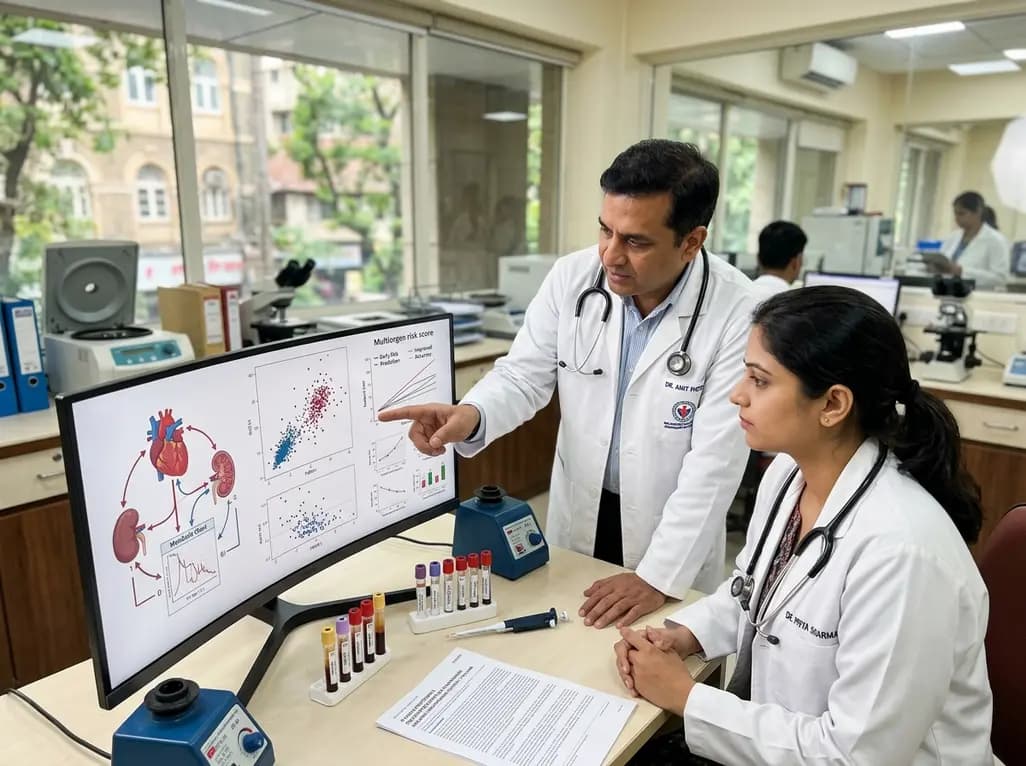
A large UK Biobank study reveals that plasma proteomic signatures capture preclinical organ damage and improve multiorgan risk prediction across early CKM syndrome stages 0 to 2 beyond traditional PREVENT clinical models.
Today

A narrative review investigates whether the articularis genus muscle functions as an independent anatomical entity or blends with the vastus intermedius. We evaluate its morphology, role in retracting the suprapatellar bursa, and direct clinical significance in anterior knee pain and arthroplasty.
Today

A Bayesian multilevel meta-analysis reveals that aerobic training combined with moderate carbohydrate restriction modestly lowers HbA1c in type 2 diabetes. However, sparse data and very low certainty leave incremental benefits over exercise or diet alone unproven, highlighting the need for individualized care.
Today
