.webp&w=384&q=75)

Loading, please wait...
Loading, please wait...
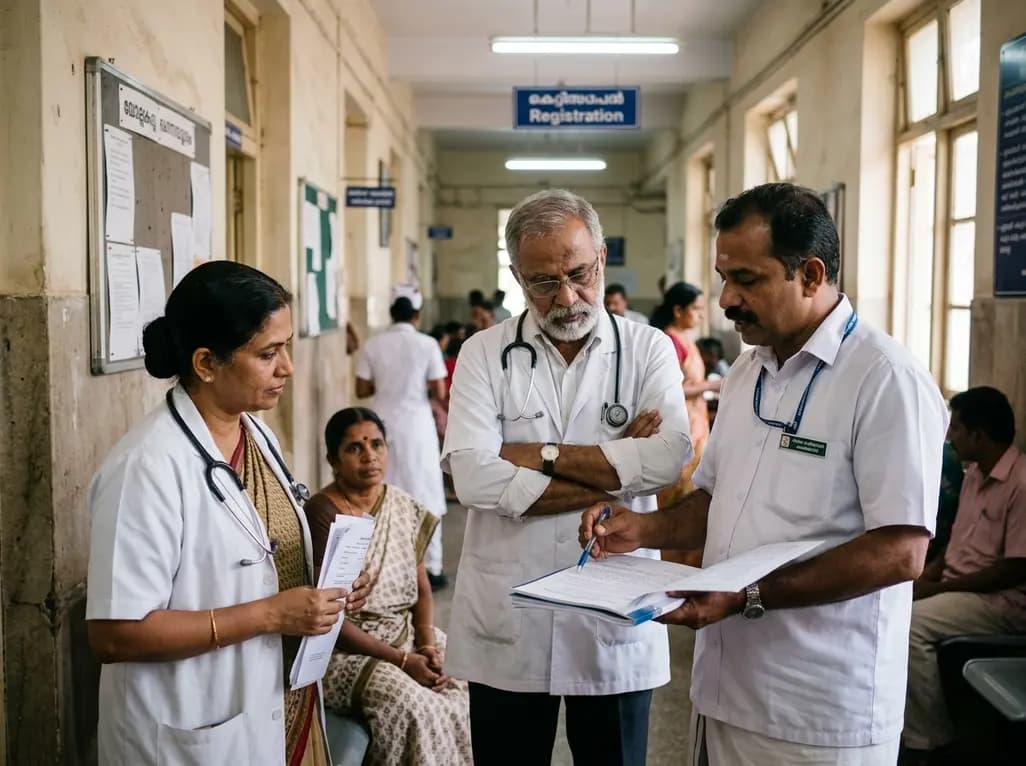
Rising out-of-pocket medical expenditure poses a severe financial strain for numerous families across India. Therefore, the Kerala government has announced legislative measures to establish statutory hospital treatment cost regulation across private healthcare. Health Minister K Muraleedharan confirmed that a specialized four-member committee will draft this landmark bill. Consequently, authorities seek to curb excessive commercialization and enhance billing transparency while protecting vulnerable patients.
Public discontent regarding unpredictable medical bills has surged across several urban centers. Many households face severe economic vulnerability after acute hospital admissions. Health Minister K Muraleedharan emphasized that excessive commercialization harms underprivileged patients who cannot afford basic interventions. Consequently, state authorities decided to step in through legislative measures.
The state previously implemented the Kerala Clinical Establishments Act to enforce structural and operational benchmarks. However, fee standardisation remained an unresolved issue that generated litigation in appellate courts. Patients frequently submit distress petitions to the health department seeking financial relief from unexpected bills. In addition, recent private equity investments have consolidated corporate hospital chains across the region. This corporate expansion often drives aggressive revenue targets. Therefore, the administration believes that statutory oversight has become essential. While private healthcare facilities provide indispensable advanced medical care, ethical boundaries must safeguard patients from exploitation. Thus, the forthcoming bill aims to establish enforceable pricing guidelines that restore trust between patients and clinicians. Moreover, regulators seek to establish a standardized framework that clarifies treatment costs without compromising clinical discretion. Additionally, healthcare leaders recognize that transparent pricing promotes healthier doctor-patient relationships.
The government established a four-member drafting committee to shape the legislative architecture. The Principal Secretary of the Health Department chairs this high-level panel. Furthermore, the panel includes the Director of Health Services, the Director of Medical Education, and the Managing Director of Kerala Medical Services Corporation Limited. This administrative coalition brings together public health governance, clinical academics, and supply chain logistics.
The committee must conduct extensive consultations with private hospital managements, clinical associations, and consumer representatives. Specifically, the panel will assess median operational costs across various clinical tiers. Furthermore, members must evaluate regional economic differences before formulating price caps. The primary directive focuses on curbing unjustified charges while ensuring clinical autonomy. Therefore, the committee will analyze itemized fee structures across secondary and tertiary medical centers. The panel will also examine guidelines to prevent arbitrary billing during critical care emergencies. Ultimately, their comprehensive recommendations will form the foundation for the draft bill presented before the state legislative assembly. Consequently, the committee plans to deliver a workable statutory model that respects realistic institutional overheads.
A central pillar of the proposed reform addresses diagnostic services and pharmaceutical margins. Currently, private medical centers apply wide profit margins to essential drugs and consumables. The minister highlighted that inpatient pharmacies must supply pharmaceuticals below maximum retail prices wherever feasible. Additionally, hospitals must ensure full transparency regarding their baseline purchase prices from manufacturers.
Similarly, charges for routine laboratory investigations, computerized tomography, and magnetic resonance imaging will undergo strict review. These diagnostic evaluations often constitute a significant fraction of final discharge bills. Therefore, the regulatory committee intends to establish ceiling rates for common laboratory and radiological services. In addition, the legislation will regulate accommodation costs, particularly general ward bed charges and basic room rents. The government will also mandate detailed itemized bills for all inpatient episodes. Patients must receive upfront written cost estimates before planned medical procedures begin. As a result, transparent billing protocols will empower families and prevent unexpected financial shock during hospital discharge. Furthermore, clear itemization will help auditing authorities identify hidden service charges and eliminate unfair billing discrepancies. Moreover, standardizing diagnostic tariffs guarantees equitable healthcare access across both urban and rural demographics.
Implementing fee regulation requires delicate policy navigation to preserve clinical quality. Private hospitals shoulder substantial capital expenditures for advanced biomedical equipment, infrastructure, and skilled medical personnel. Health Minister Muraleedharan acknowledged these vital contributions to regional healthcare capacity. Therefore, the proposed statutory framework will incorporate real operational costs rather than imposing punitive price ceilings.
Medical associations frequently express concern that arbitrary rate caps could compromise technological investment and clinical salaries. Consequently, the government has prioritized structured stakeholder dialogues before tabling the legislation. Regulators must avoid driving private providers into financial insolvency. At the same time, society cannot tolerate catastrophic healthcare expenditure that pushes vulnerable citizens into poverty. Thus, the draft legislation seeks a viable middle ground. Specifically, the bill will target unjustified markups on consumables rather than capping legitimate physician professional fees. By doing so, the state aims to maintain high clinical standards while protecting patients from predatory commercial tactics. Furthermore, this collaborative approach encourages healthcare administrators to adopt efficient clinical workflows and value-based healthcare practices. Additionally, predictable rate structures will stabilize clinical revenue models, foster investor confidence, and encourage sustainable institutional growth.
Beyond price regulation, the drafting committee is evaluating structural mechanisms to expand insurance coverage. The government aims to integrate more private healthcare centers into public health insurance schemes. Health insurance coverage under initiatives like the Karunya Arogya Suraksha Padhathi provides vital financial risk pooling for families. However, private providers often express reservations regarding delayed reimbursements and low package rates under existing schemes.
To resolve this challenge, the committee is exploring dynamic reimbursement structures that reflect actual procedural costs. In addition, the panel will assess whether private hospitals can purchase bulk pharmaceuticals directly through the Kerala Medical Services Corporation. This centralized procurement could significantly lower institutional supply expenses. Consequently, private clinics could offer lower treatment rates without eroding their operating margins. Furthermore, streamlined digital billing interfaces will expedite claim settlements between hospitals and insurance administrators. Ultimately, expanding empanelment will guarantee that economically disadvantaged patients access advanced medical care in both public and private medical facilities. Therefore, aligning public procurement power with private healthcare infrastructure offers a sustainable path toward universal health coverage. Moreover, comprehensive health insurance integration shields households from unexpected out-of-pocket medical debts.
Q1: Why is Kerala introducing legislation to regulate private hospital treatment costs?
The state government initiated this legislation to address mounting public complaints regarding excessive treatment charges and arbitrary billing in private medical facilities. Many families suffer severe financial hardship after receiving unaffordable discharge invoices. By introducing statutory regulation, authorities aim to eliminate commercial exploitation, enforce itemized billing transparency, and protect patients from catastrophic medical debt while preserving institutional operational sustainability across the healthcare system.
Q2: How will the proposed law affect medicine and diagnostic test charges?
The proposed legislation intends to mandate that private hospitals supply pharmaceuticals at rates below the maximum retail price. Furthermore, clinical centers must reveal their purchase prices to prevent predatory retail markups. The regulatory committee will also establish standard benchmark caps for routine diagnostic tests, including computerized tomography scans and magnetic resonance imaging, ensuring that essential laboratory and radiology services remain accessible and affordable for ordinary citizens.
Q3: Who will draft the bill and will private healthcare providers be consulted?
A high-level four-member committee headed by the Principal Secretary of the Health Department is drafting the proposed legislation. The panel also includes the Director of Health Services, the Director of Medical Education, and the Managing Director of Kerala Medical Services Corporation Limited. The minister confirmed that the panel will conduct extensive stakeholder consultations with private hospital representatives to accommodate legitimate operational overheads and clinical requirements.
Disclaimer: This content is for informational and educational purposes only. It does not constitute medical advice or replace professional judgment. Refer to the latest local and national guidelines for clinical practice.
References

Read summarized clinical updates, watch expert medical content, and earn CME certifications right from your smartphone.
Open your smartphone camera to scan and install.





The government of Kerala is formulating a statutory framework to standardize charges in private healthcare facilities. By establishing an expert drafting committee, the state seeks to curb inflated procedural costs, mandate price transparency for pharmaceuticals, and protect families from catastrophic expenditure.
Today

UK Research and Innovation is deploying £80 million across the NHS to trial nine cutting-edge technologies. The initiative features seven-minute brain MRIs, blood biomarker assays, and predictive AI tools, aiming to evaluate 92% of suspected cases within 18 weeks and overcome lengthy diagnostic backlogs.
Today

A mixed-methods study identifies key drivers of PMTCT service utilization among adolescent girls and young women aged 15-24. Highlighting age disparities, PrEP uptake, and systemic barriers, the evidence guides clinicians toward adolescent-responsive, integrated maternal HIV prevention protocols.
Today

PepsiCo and Monster Beverage have challenged the FSSAI ban on the energy drink label in Indian courts. While companies highlight supply disruptions, regulatory actions spotlight severe cardiovascular and metabolic risks associated with excessive caffeine, sugar, and taurine consumption, especially in adolescents.
Today

A narrative review investigates whether the articularis genus muscle functions as an independent anatomical entity or blends with the vastus intermedius. We evaluate its morphology, role in retracting the suprapatellar bursa, and direct clinical significance in anterior knee pain and arthroplasty.
Today
A Bayesian multilevel meta-analysis reveals that aerobic training combined with moderate carbohydrate restriction modestly lowers HbA1c in type 2 diabetes. However, sparse data and very low certainty leave incremental benefits over exercise or diet alone unproven, highlighting the need for individualized care.
Today
