

Loading, please wait...
Loading, please wait...

Post-stroke language recovery presents complex rehabilitation challenges for neurologists, geriatricians, and speech therapists. Clinicians frequently encounter individuals with post-stroke anomia who describe knowing the target word internally despite being unable to speak it aloud. This subjective internal representation, known as inner speech in aphasia, provides a valuable window into preserved lexical access networks. Traditional rehabilitation models evaluate speech recovery almost exclusively through binary metrics of correct or incorrect spoken output. However, binary accuracy scoring often misses nuanced qualitative improvements in linguistic processing. When clinicians look beyond binary accuracy, subtle shifts in lexical retrieval mechanisms become apparent. Furthermore, recognizing how internal language integrity interacts with behavioral speech production helps clinicians tailor targeted rehabilitation plans. Consequently, evaluating covert lexical processing alongside overt production offers substantial diagnostic value. Therefore, integrating internal language assessments into regular neurological evaluations provides critical insight into neuroplastic recovery trajectories.
To investigate how internal verbalization influences therapeutic learning, researchers implemented a rigorous single-subject design study examining five adults with chronic poststroke anomia. The investigators structured a two-week cueing-based naming intervention focusing on forty personalized picture stimuli per individual. Specifically, the team categorized twenty stimuli as successful inner speech items, representing concepts the participant could retrieve internally before speaking. Conversely, they classified twenty stimuli as unsuccessful inner speech items when participants could not access the internal word form. The investigators applied a hierarchical cueing protocol providing structured semantic and phonemic support. Rather than recording only binary outcomes, the research team implemented an eight-level ordinal scale to evaluate naming attempts longitudinally. In addition, the researchers employed ordinal cumulative logit mixed-effects models to analyze longitudinal shifts in error types. Consequently, this granular analytical framework captured delicate transitions toward the target word that dichotomous scoring completely overlooks.
The trial demonstrated that naming performance improved significantly from baseline to immediate posttreatment when researchers analyzed error distributions alongside absolute accuracy. Notably, participants demonstrated significantly higher odds of producing naming attempts closer to the target word for successful inner speech items compared to unsuccessful items. This therapeutic advantage persisted even after controlling for baseline performance levels and overall aphasia severity. Furthermore, individual trajectory analyses revealed that nearly all participants exhibited meaningful shifts in their underlying error topologies over time. Most remarkably, one participant who previously appeared as a nonresponder under conventional accuracy-only analyses demonstrated evident qualitative advancement across the error spectrum. Instead of remaining stuck at complete omissions or unrelated jargon, this participant shifted toward phonological approximations. Therefore, therapeutic learning clearly occurred, even though binary scoring failed to detect positive changes. These findings indicate that pre-existing internal phonological representations provide crucial cognitive scaffolding for behavioral therapies.
Understanding the neurocognitive mechanisms of internal language processing clarifies why error distributions evolve during rehabilitation. In cognitive neurolinguistics, word production involves discrete stages: semantic conceptualization, lexical selection, phonological encoding, and phonetic-articulatory programming. When stroke lesions disrupt left hemisphere language networks, disconnections between phonological encoding and motor execution frequently occur. Consequently, individuals with chronic anomia retain intact semantic concepts and internal phonological representations while struggling with speech articulation. When patients report successful internal verbalization, their lexical and phonological networks remain relatively intact. Therefore, targeted behavioral cueing does not need to rebuild lexical networks from scratch; instead, it strengthens residual connections toward overt execution. In contrast, unsuccessful internal verbalization indicates deeper damage within lexical-semantic access hubs. As therapy progresses, errors naturally shift along an ordinal continuum toward the target. Thus, monitoring error patterns provides objective physiological evidence of active recovery.
These research insights carry profound clinical implications for clinical neurologists, speech therapists, and stroke rehabilitation teams. First, clinicians should incorporate formal subjective self-assessments of internal verbalization during comprehensive baseline language evaluations. Asking patients whether they can hear or formulate words internally provides valuable prognostic information regarding treatment responsiveness. Second, rehabilitation professionals can optimize therapy protocols by stratifying treatment stimuli according to internal verbalization capabilities. Prioritizing stimuli that patients experience internally can accelerate early therapeutic wins, thereby boosting patient engagement. Additionally, clinicians must revamp progress documentation protocols by moving away from exclusive reliance on binary percentage accuracy scores. Documenting qualitative shifts in error patterns—such as a transition from complete mutism to phonemic approximations—validates patient progress that standard scales dismiss. Furthermore, therapeutic cueing strategies can be tailored precisely to the patient's error profile. Ultimately, this comprehensive diagnostic approach enables personalized neurorehabilitation that maximizes communicative functional recovery.
Implementing nuanced speech-language rehabilitation strategies is particularly vital in diverse healthcare landscapes, such as India, where stroke incidence continues to climb. Clinicians across Indian tertiary centers frequently care for multilingual stroke survivors presenting with varied post-stroke communication impairments. In multilingual populations, evaluating internal language processing across primary and secondary languages offers essential diagnostic clarity. However, access to specialized speech and language rehabilitation remains unevenly distributed between urban centers and rural districts. Consequently, establishing standardized protocols that evaluate internal speech and error progressions can empower general practitioners and rehabilitation nurses to deliver targeted bedside interventions. Moreover, mobile health tools and tele-rehabilitation platforms can incorporate qualitative error tracking, enabling remote monitoring of home-based speech drills. Functional neuroimaging studies should also correlate subjective internal speech reports with preserved connectivity in frontotemporal speech networks. Adopting these comprehensive assessment paradigms will substantially improve stroke survivorship worldwide.
Binary accuracy metrics only register whether a spoken response is correct or incorrect, overlooking intermediate stages of language recovery. In contrast, analyzing error patterns reveals qualitative improvements along an ordinal linguistic spectrum. When a patient shifts from complete silence or neologistic errors to phonological approximations or semantic circumlocutions, active neuroplastic learning is occurring. Tracking these error transitions helps clinicians detect genuine rehabilitation progress that binary accuracy scores completely fail to recognize.
Self-reported inner speech indicates that central lexical and phonological representations remain functionally intact despite damaged motor speech pathways. When a stroke survivor can mentally generate a word, rehabilitation does not require rebuilding lexical architecture from the beginning. Instead, therapy primarily focuses on strengthening damaged sensorimotor output pathways. Consequently, stimuli associated with successful internal speech demonstrate significantly greater therapeutic learning and faster communicative gains during structured naming interventions.
Clinicians can incorporate inner speech evaluations by asking patients to indicate whether they can silently hear or formulate a target word prior to overt naming. Clinicians can present pictorial stimuli alongside simple binary or visual analog rating scales for internal retrieval. By identifying items with preserved internal verbalization, therapists can personalize cueing hierarchies, prioritize high-yield vocabulary, and establish objective benchmarks for tracking subtle qualitative improvements during speech therapy.
Disclaimer: This content is for informational and educational purposes only and does not substitute for professional medical advice, diagnosis, or treatment. Refer to the latest local and national guidelines for clinical practice.
References

Read summarized clinical updates, watch expert medical content, and earn CME certifications right from your smartphone.
Open your smartphone camera to scan and install.





A study shows that evaluating inner speech and error patterns reveals treatment-based learning in post-stroke aphasia, even when binary accuracy fails to detect gains. Tracking qualitative linguistic transitions enables personalized speech rehabilitation and improves neurological recovery assessment.
Today

A prospective study reveals significant first-trimester trace-element alterations in pregnant women with epilepsy. Lower serum selenium independently predicted subsequent seizure recurrence despite prior remission, highlighting the vital clinical role of micronutrient profiling during antenatal care.
Today
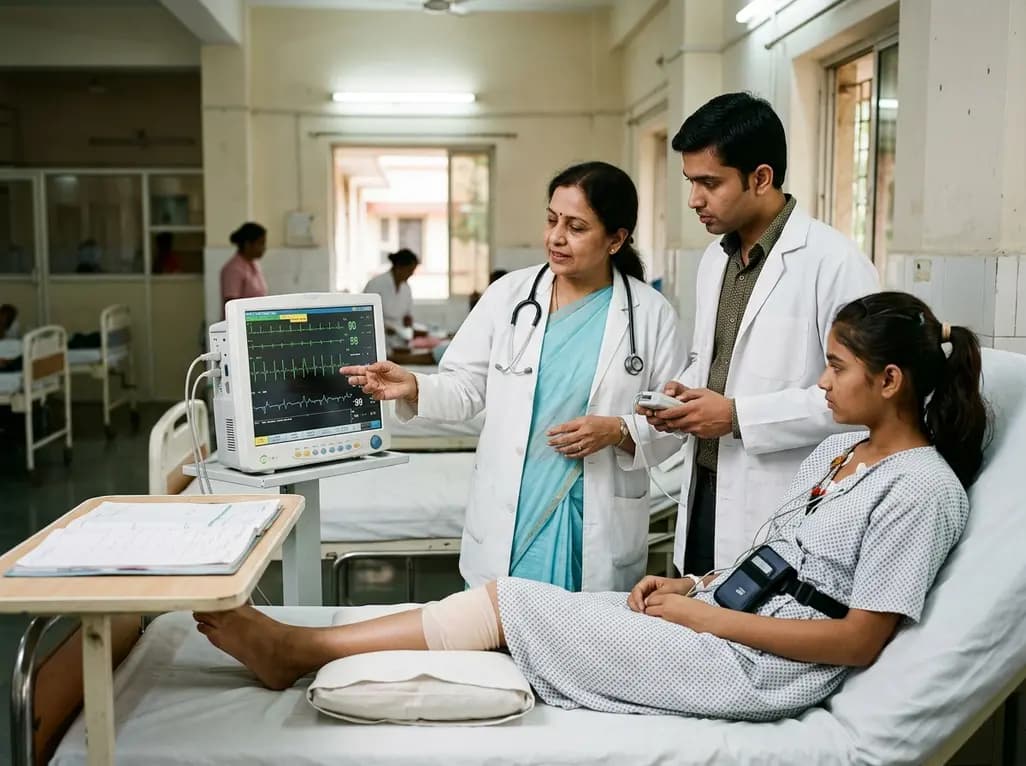
A 15-year-old patient presented with knee arthralgia and acute rheumatic fever, exhibiting complex arrhythmias including AV blocks and non-sustained ventricular tachycardia despite lacking severe valvulitis. This highlights the importance of extended Holter monitoring in pediatric rheumatic carditis.
Today
A breakthrough AND-gate CRISPR/Cas13a colorimetric assay enables ultrasensitive dual microRNA monitoring in cervical spondylosis, providing equipment-free prognosis and objective evaluation of auricular acupressure therapy.
Today

Discover essential clinical insights into AGLP1-type amyloidosis, a rare localized complication of glucagon-like peptide-1 analog injections. Learn how histopathology and mass spectrometry differentiate benign iatrogenic amyloidomas from systemic disease, preventing misdiagnosis and unwarranted therapies.
Today
