.webp&w=384&q=75)

Loading, please wait...
Loading, please wait...
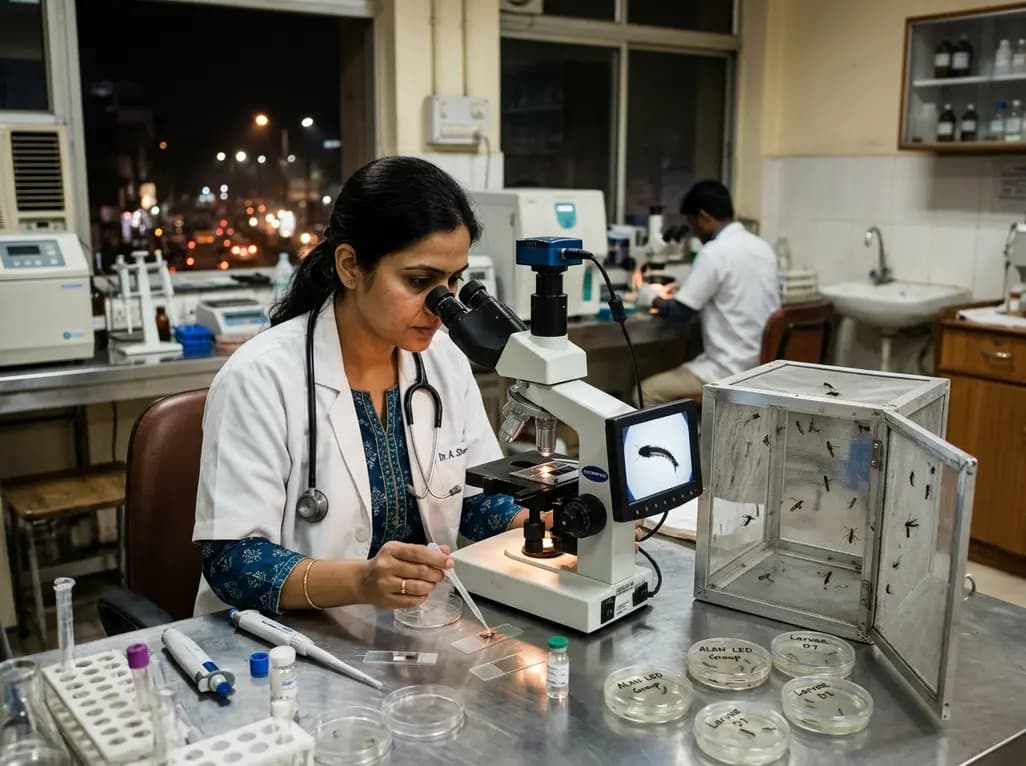
Rapid urban growth across tropical and subtropical regions has fundamentally transformed ecological landscapes. Consequently, artificial light at night has emerged as an omnipresent environmental stressor that alters vector dynamics. Among diverse arthropods, the Asian tiger mosquito (Aedes albopictus) represents a major threat to global public health. This invasive vector efficiently transmits several debilitating arboviruses, including dengue, chikungunya, and Zika. While researchers have extensively examined adult mosquito behaviors under nocturnal illumination, the biological impact on immature aquatic stages has remained ambiguous. Therefore, understanding how artificial illumination influences tiger mosquito development is vital for predicting seasonal transmission patterns in rapidly expanding cities. Anthropogenic lighting alters natural photoperiods, which normally regulate circadian rhythms and diapause in insects. In many aquatic arthropods, continuous light exposure accelerates metabolic expenditure or disrupts developmental pacing. However, vector species frequently exhibit remarkable phenotypic plasticity that allows them to thrive in human-dominated environments. By analyzing developmental timelines from newly hatched larvae to adult emergence, epidemiologists can better evaluate whether streetlights inadvertently amplify vector populations. Consequently, evaluating larval physiology under realistic urban lighting conditions provides critical baseline evidence for modern vector surveillance and clinical risk assessment.
To understand these environmental interactions, investigators designed a rigorous semi-natural field trial evaluating larval biology. The study exposed newly hatched Aedes albopictus larvae to diverse lighting regimens mimicking urban lighting infrastructure. Specifically, researchers tested two widespread light spectra: high-pressure sodium (HPS) lamps and modern light-emitting diode (LED) fixtures. In addition, they evaluated five distinct intensity levels spanning 10, 30, 60, 100, and 200 lux alongside an unlit control cohort. These light levels realistically mirror the nocturnal illumination produced by residential porch lights and municipal streetlamps. Throughout the experimental period, researchers monitored temperature and water quality to maintain consistent baseline conditions. Furthermore, the semi-natural field setting ensured that larvae experienced natural ambient fluctuations rather than artificial laboratory constraints. By isolating light type and intensity as independent variables, the authors systematically measured developmental milestones and sex-specific responses. High-pressure sodium fixtures emit a warm amber light, whereas LED systems produce intense, blue-enriched light that frequently disrupts circadian clocks. Therefore, testing both spectra across multiple intensities allowed researchers to evaluate whether modern urban lighting transitions inadvertently enhance vector fitness.
The experimental evaluation yielded intriguing insights into the physiological robustness of immature mosquitoes. Remarkably, the findings indicated no statistically significant differences in average time to pupation or adult emergence across any light spectrum or intensity. Larvae exposed to high-intensity LED or HPS lamps reached the pupal stage at rates comparable to unlit control cohorts. Similarly, the transition from pupae to functional adults showed uniform progression across both male and female specimens. However, researchers observed greater phenotypic variation within certain specific light type and intensity combinations. This intra-group variation suggests subtle biological adjustments that group averages might partially mask. For instance, specific micro-environmental light gradients may slightly alter larval feeding rhythms without shifting overall developmental duration. Nevertheless, the aggregate developmental timeline remained fundamentally stable across all experimental cohorts. Consequently, these observations demonstrate that immature tiger mosquitoes possess substantial resilience against photoperiod alterations. Unlike certain non-vector aquatic insects that experience developmental delays under artificial lighting, Aedes albopictus maintains steady maturation schedules. Thus, municipal street lighting neither accelerates nor impedes the aquatic lifecycle of this vector.
Beyond developmental speed, immature mortality serves as a crucial determinant of overall vector population density. In diverse terrestrial and aquatic organisms, artificial lighting elevates physiological stress, which often triggers premature mortality. However, this study demonstrated that mortality rates remained consistently low across all experimental treatments and control groups. Neither high-intensity 200-lux LED illumination nor ambient HPS exposure caused significant larval die-offs. In fact, both male and female larvae exhibited excellent survivorship through pupation into adulthood. Consequently, artificial illumination under typical urban conditions does not impair immature survival in Aedes albopictus. This physiological tolerance underscores why tiger mosquitoes thrive in densely built human settlements with pervasive light pollution. In addition, the lack of excess mortality indicates that energy allocation toward photoprotection does not compromise basic vital functions. Therefore, municipal transitions toward brighter LED fixtures will not create an ecological barrier for mosquito larvae in open water containers. Instead, urban drainage basins, discarded tires, and domestic water receptacles under streetlights remain highly productive breeding sites. Public health authorities must recognize that artificial light will not naturally suppress immature vector numbers.
These entomological findings carry substantial epidemiological implications for healthcare systems managing endemic arboviruses. Because larval development and survival remain unhindered by nocturnal illumination, mosquito productivity in illuminated metropolitan centers will remain consistently robust. Furthermore, existing literature indicates that artificial light at night significantly increases nocturnal host-seeking and biting frequency in adult female Aedes mosquitoes. While adult tiger mosquitoes traditionally exhibit diurnal biting activity, artificial light extends their operational foraging window well into the night. Consequently, the combination of unimpaired immature emergence and extended adult biting behavior increases overall human-vector contact rates. In densely populated urban areas across India, such behavioural shifts may lengthen disease transmission seasons and increase clinical dengue or chikungunya incidence. Primary care physicians and infectious disease specialists must account for these environmental dynamics when evaluating community fever clusters. Moreover, residential areas with heavy night lighting may experience prolonged seasonal transmission, extending arboviral risk beyond daytime hours. Therefore, integrating vector biology insights into regional health planning helps clinicians anticipate localized surges in mosquito-borne illnesses.
Given the physiological resilience of immature vectors, comprehensive vector control strategies must adapt to illuminated urban environments. Relying on ecological stressors like light pollution to curb mosquito populations is ineffective. Instead, municipal public health authorities should strengthen integrated vector management programs that emphasize source reduction and targeted larviciding. Community education should urge residents to eliminate stagnant water containers around illuminated perimeters, balconies, and public parks. Additionally, public health teams should implement biological control agents, such as Bacillus thuringiensis israelensis, in municipal storm drains and water storage tanks. Furthermore, urban planners and entomologists must collaborate to evaluate how modern LED streetlighting influences local mosquito flight corridors. Clinicians can also actively support public health by advising patients about personal protective measures during evening hours. Recommending insect repellents, window screening, and protective clothing ensures community safety against opportunistic vectors biting under artificial lighting. Ultimately, addressing vector-borne diseases requires a multidimensional approach that combines rigorous vector biology research, proactive civic sanitation, and robust primary healthcare responses.
Recent semi-natural field trials show that artificial light at night, across both LED and high-pressure sodium spectra, does not significantly alter the developmental timelines of Aedes albopictus larvae. Newly hatched larvae reach pupation and adult emergence at rates comparable to unlit cohorts. Although individual variation exists within certain lighting intensities, average developmental speed remains stable, showing that light pollution neither accelerates nor halts vector maturation.
These findings demonstrate that artificial lighting does not reduce mosquito survival or disrupt aquatic maturation in urban environments. Because immature vectors survive effectively under diverse light spectra and intensities, municipal streetlights do not create natural ecological barriers against vector breeding. Consequently, vector control programs cannot rely on environmental lighting stressors and must continue prioritizing source reduction, container management, and proactive larviciding in cities.
Clinicians play a vital role by recognizing changing vector behavioral patterns in brightly lit urban settings. Because artificial light extends adult mosquito biting activity into nocturnal hours without reducing larval emergence, transmission windows for dengue and chikungunya expand. Physicians should maintain high diagnostic suspicion for arboviruses during unusual hours and advise patients to use topical repellents and protective netting both day and night.
Disclaimer: This content is for informational and educational purposes only and does not constitute medical advice, diagnosis, or treatment. Healthcare professionals should rely on their clinical judgment and refer to the latest local and national guidelines for clinical practice.
References

Read summarized clinical updates, watch expert medical content, and earn CME certifications right from your smartphone.
Open your smartphone camera to scan and install.





A study reveals that artificial light at night, including LED and sodium spectra, does not hinder tiger mosquito larval development or survival, underscoring urban vector resilience.
last month

Explore the emerging role of glucose metabolic reprogramming in exercise-attenuated osteoporosis, examining how physical activity influences osteoblast glycolysis, osteoclast bioenergetics, and skeletal remodeling pathways to improve bone mineral density.
Today

A systematic review and transcriptomic cross-study consensus analysis illuminates the role of necroptosis in cervical cancer. By promoting anti-tumor immunogenicity and resolving apoptosis resistance, necroptotic pathways offer actionable prognostic signatures and promising avenues for combination immunotherapy.
Today
A systematic review and meta-analysis of 33 studies evaluates the effectiveness of LDL apheresis techniques in familial hypercholesterolemia. Double-filtration plasmapheresis demonstrated the greatest reductions in total cholesterol and LDL-C, while safety and clinical feasibility guide individual therapy.
Today

A scoping review of 964 studies on warm-up in athletes reveals that research heavily emphasizes acute performance proxies while significant gaps remain in injury prevention, dosage parameters, and real-world implementation.
Today

In severe acute pancreatitis, initial normal calcium levels can mask primary hyperparathyroidism due to saponification. This case report highlights how serial calcium monitoring unmasked severe hypercalcemia, guiding life-saving emergency medical therapy and curative parathyroidectomy.
Today
