

Loading, please wait...
Loading, please wait...

Modern healthcare systems increasingly deploy artificial intelligence to assist physicians with critical clinical decisions. Consequently, medical teams must master effective human-AI delegation to improve patient outcomes while mitigating systemic hazards. Recent cognitive science research indicates that machine integration is not simply a technical upgrade. Instead, delegation functions as an interdependent cognitive ecosystem requiring balanced human judgment and algorithmic transparency. Therefore, healthcare leaders must evaluate how medical professionals interact with computational assistants across daily institutional workflows. Understanding these collaborative dynamics protects patient safety and ensures sustainable clinical efficiency.
Successful algorithmic collaboration in clinical practice relies on four foundational conditions. First, clinicians require an accurate assessment of machine capabilities and boundaries. Second, algorithmic tools must deliver well-calibrated communication regarding their internal diagnostic uncertainty. Third, healthcare professionals must retain sustained monitoring capacity during intensive working shifts. Fourth, medical organizations must design compatible task structures that harmonize digital speed with human reflection. When hospitals implement artificial intelligence, administrators often treat these components as isolated engineering challenges. However, cognitive scientists demonstrate that these conditions operate as a deeply linked, bidirectional network. If one element deteriorates, the entire diagnostic collaboration suffers immediate functional decline. For example, deploying a highly accurate deep learning model fails if overworked doctors lack sufficient time to inspect ambiguous predictions. Furthermore, clinicians quickly lose confidence in digital tools when algorithmic confidence scores misrepresent underlying clinical risks. Therefore, medical directors must analyze human-machine partnerships holistically rather than upgrading individual software modules in isolation.
Physicians must understand what an algorithmic model can accomplish and where its clinical acumen falters. However, establishing this mental model requires calibrated uncertainty feedback from the digital platform. If an AI platform displays false overconfidence during complex case presentations, doctors develop an inflated perception of machine competence. Consequently, clinicians begin to accept erroneous differential diagnoses without questioning underlying biases. In contrast, appropriate uncertainty metrics signal clinicians when human scrutiny becomes essential. When software highlights its own diagnostic ambiguities, practitioners inspect raw laboratory data and imaging slices thoroughly. Moreover, transparent error metrics prevent both automation complacency and premature technological rejection. In busy outpatient departments, high patient volumes intensify the need for accurate probability indicators. Clinicians cannot spend precious consultation minutes deciphering obscure statistical probabilities. Instead, visual probability bands and clear confidence intervals enable rapid, reliable medical decisions. As a result, bidirectional calibration creates durable trust and sharpens clinical judgment over time.
Delegating medical documentation or image analysis to machines saves valuable clinical time. Nevertheless, automation introduces severe human cognitive vulnerabilities, especially vigilance fatigue. When automated systems operate with high baseline reliability, human monitors inevitably become passive observers. Over time, clinicians lose their sharp diagnostic instincts and fail to detect rare algorithmic anomalies. Furthermore, heavy clinical workloads exacerbate attention lapses during monotonous verification tasks. For instance, a radiologist reviewing hundreds of AI-annotated scans may unconsciously confirm incorrect automated bounding boxes. Sustaining active clinical oversight therefore requires deliberate cognitive friction within the software interface. Systems must prompt physicians to articulate their diagnostic rationale before revealing automated suggestions. In addition, hospitals should limit continuous monitoring intervals to prevent cognitive exhaustion among medical personnel. Protecting human alertness ensures that clinical specialists remain decisive arbiters of patient care. Ultimately, genuine medical accountability demands that human vigilance never yields entirely to automated convenience.
Even superior diagnostic algorithms fail if the surrounding clinical task structure remains incompatible. Traditional hospital workflows segment responsibilities according to human communication rhythms and administrative hierarchies. Therefore, inserting autonomous computational agents into outpatient clinics or intensive care units demands thorough procedural redesign. For example, delegating triage decisions requires immediate synchronization between algorithmic severity rankings and physical bed availability. If the task structure isolates the algorithm from bed management staff, systemic delays persist despite rapid computing. Similarly, diagnostic support tools must align with standard clinical documentation protocols. When software generates recommendations that contradict hospital reporting formats, doctors experience acute cognitive burden. Consequently, healthcare staff frequently bypass digital tools to maintain operational velocity. Successful workflow engineering actively partitions tasks according to complementary computational and human cognitive strengths. Machines excel at high-speed data parsing, whereas physicians excel at nuanced clinical empathy and holistic context synthesis. Thus, compatible task design bridges technical potential and bedside clinical reality.
The four conditions of delegation do not function as static, isolated checkpoints. Instead, they interact dynamically over time, generating self-reinforcing behavioral spirals. In optimal settings, accurate capability assessment and calibrated uncertainty foster appropriate monitoring and smooth workflow integration. This balanced alignment triggers a virtuous cycle of institutional learning, elevated diagnostic accuracy, and clinician satisfaction. Conversely, a failure in any single condition initiates cascading degradation across the entire clinical system. For example, poor uncertainty communication degrades clinician trust, leading doctors to either ignore valuable suggestions or monitor outputs carelessly. As clinical monitoring becomes inconsistent, diagnostic errors multiply, further distorting perceptions of algorithmic utility. Improving one condition in isolation often shifts systemic bottlenecks rather than resolving core vulnerabilities. As clinical AI evolves from passive advisory software toward fully autonomous agentic systems, these feedback loops will intensify exponentially. Therefore, healthcare systems must continuously measure cognitive strain, delegation patterns, and collaborative diagnostic outcomes. Proactive oversight safeguards patient health against sudden systemic failure.
Calibrated uncertainty enables artificial intelligence to communicate its diagnostic confidence levels accurately. When algorithms clearly signal diagnostic ambiguity, clinicians immediately recognize when automated outputs demand rigorous manual verification. Consequently, this transparency prevents clinicians from developing false reassurance during complex cases. Moreover, it encourages physicians to inspect raw clinical data rather than passively trusting automated findings. Ultimately, calibrated uncertainty maintains physician vigilance, mitigates diagnostic errors, and protects patient safety across diverse clinical environments.
Clinical delegation functions as an interdependent network rather than a series of independent steps. Consequently, enhancing one condition in isolation often shifts operational bottlenecks instead of eliminating diagnostic failures. For example, deploying a highly accurate model fails if physicians remain too fatigued to monitor ambiguous recommendations. Similarly, training doctors to evaluate software cannot compensate for poor interface integration or misaligned hospital workflows. Therefore, clinical administrators must address all four psychological and structural conditions simultaneously to ensure measurable systemic success.
Indian hospitals can sustain human monitoring by implementing structured shift rotations and cognitive forcing functions. Because high patient volumes frequently cause mental fatigue, institutions must limit continuous monitoring periods for diagnostic algorithms. Furthermore, user interfaces should require clinicians to record independent initial impressions before viewing automated conclusions. In addition, hospitals must provide continuous education regarding software limitations and common failure patterns. These measures preserve clinician alertness, maintain legal accountability, and prevent dangerous automation complacency during busy medical shifts.
Disclaimer: This content is for informational and educational purposes only... Refer to the latest local and national guidelines for clinical practice.
References

Read summarized clinical updates, watch expert medical content, and earn CME certifications right from your smartphone.
Open your smartphone camera to scan and install.





A cognitive framework outlines four interdependent conditions for effective human-AI delegation in healthcare: capability assessment, uncertainty communication, monitoring capacity, and task structure. Understanding these dynamics prevents cascading clinical failures as AI transitions toward autonomous agency.
Today

A pilot study evaluated WearDOXXN, a capillary microfluidic sweat patch, for noninvasive breast cancer monitoring by comparing sweat and serum CEA and PIP/GCDFP-15 levels.
Yesterday

A large-scale retrospective cohort study demonstrates that GLP-1 receptor agonists significantly reduce all-cause hospitalizations, alcohol-related admissions, major cardiovascular events, and mortality in patients with overweight or obesity and alcohol use disorder, providing profound clinical insights.
Today
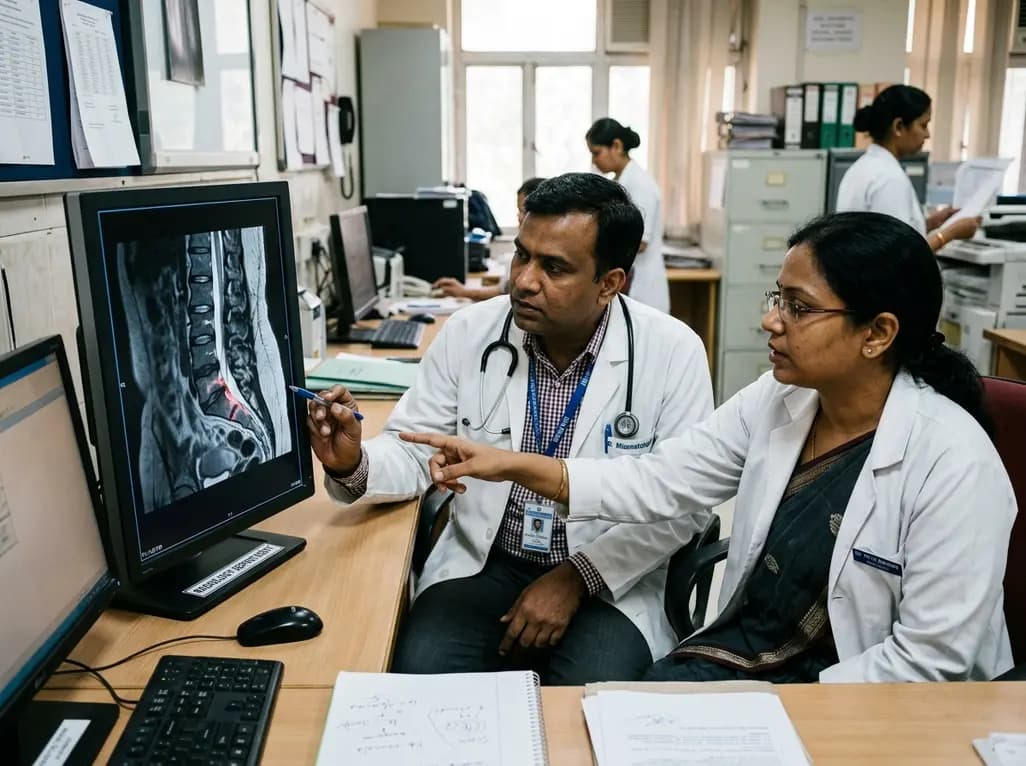
A qualitative study highlights the clinical role of MRI in axial spondyloarthritis, exposing disparities in access, reporting gaps in private healthcare, and the urgent need for standardized imaging protocols and multidisciplinary collaboration between rheumatologists and radiologists.
Today

A breakthrough 3D-printed piezoelectric collagen hydrogel activated by ultrasound accelerates diabetic wound repair, demonstrating 98.5% wound closure, robust antibacterial action, and enhanced vascularization without toxic chemical crosslinkers.
Yesterday
