.webp&w=384&q=75)

Loading, please wait...
Loading, please wait...
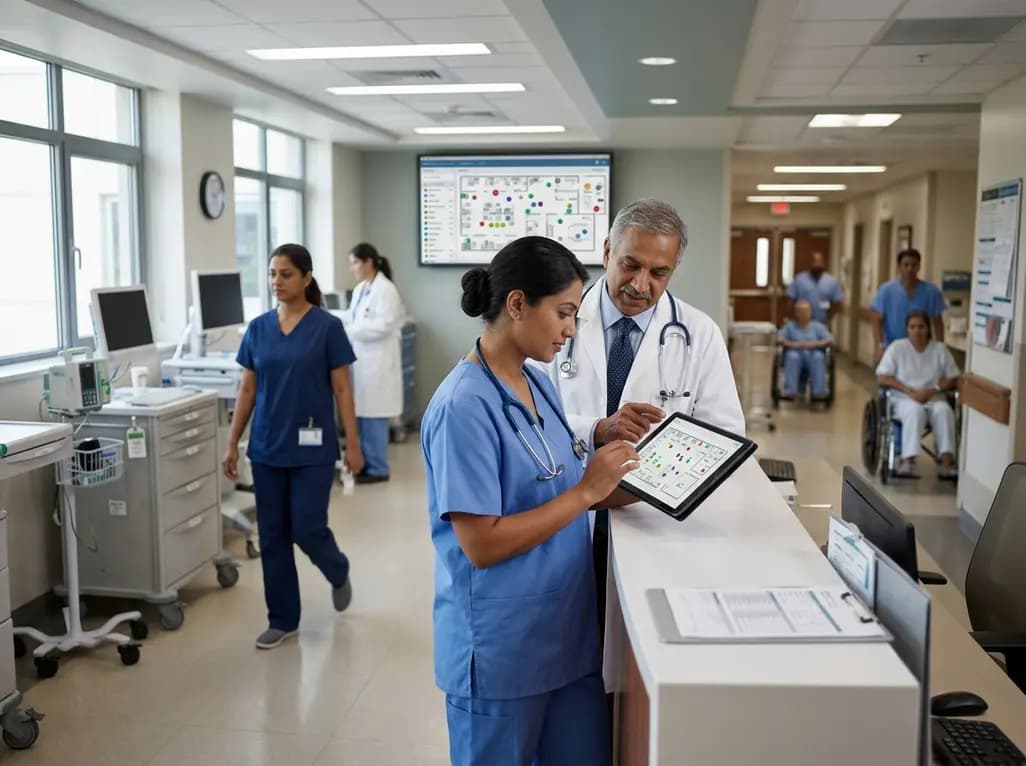
Indian hospitals currently face a critical, silent crisis that heavily compromises clinical workflows and patient care. Nurses routinely pause essential tasks to search for missing equipment, which severely reduces direct patient care time. Fortunately, the emergence of hospital RTLS technology offers a viable solution to track critical assets in real time. This innovation is transforming indoor navigation and operations in healthcare facilities across India. Consequently, healthcare administrators are adopting these systems to ensure seamless operations. By digitizing workflows, medical institutions can significantly reduce administrative burdens and focus on delivering high-quality healthcare.
Medical equipment often goes missing in large hospital wards, causing severe operational delays and rising financial losses. Specifically, devices like infusion pumps, wheelchairs, ECG monitors, and crash carts are frequently misplaced across multiple floors. Consequently, nurses waste valuable hours during their shifts merely searching for these items. This search decreases their direct contact time with critical patients and increases their workplace fatigue. Furthermore, research indicates that hospitals in India lose approximately ₹1.8 crore annually due to asset mismanagement. To prevent these massive losses, hospitals frequently over-purchase devices they already own but cannot immediately find. However, implementing real-time location systems allows administrators to locate any critical asset within seconds. Consequently, this technology helps prevent unnecessary capital expenditures and improves equipment utilization rates. Ultimately, clinical teams can access required devices without making frantic phone calls or conducting manual searches. Therefore, hospitals achieve greater efficiency and maintain high patient safety standards. Additionally, because the systems record historical usage patterns, biomedical departments can schedule preventive maintenance more accurately. Consequently, devices remain in optimal condition, which minimizes sudden equipment failures during emergency situations. Furthermore, these data-driven insights empower procurement managers to make informed purchasing decisions based on actual asset usage rather than guesswork.
Traditional GPS technology cannot function effectively inside hospital buildings because physical concrete walls block external satellite signals. Therefore, facilities require specialized indoor tracking networks to maintain continuous coverage. To achieve this, engineers install compact access points inside ceilings at regular intervals of ten to fifteen meters. Furthermore, these access points continuously listen for signals emitted by active tags attached to assets or personnel. These smart tags utilize transmission standards like Bluetooth Low Energy, Ultra-Wideband, or enterprise Wi-Fi. Subsequently, when a tagged item moves, the nearest access points receive its wireless signals immediately. This location data then travels to a central software engine that calculates coordinates with extreme precision. Consequently, the software updates a digital floor map in real time, showing the exact location of every tracked asset. Additionally, this seamless data flow enables administrators to monitor movement patterns and identify operational bottlenecks instantly. Thus, the hospital gains absolute visibility over its indoor environment without requiring manual intervention from busy staff members. Ultimately, this robust infrastructure forms the foundation for advanced healthcare automation and safety monitoring.
Continuous location data streams dramatically improve every dimension of healthcare facility operations. First, patient flow benefits immensely because the system tracks patient movements from admission to discharge automatically. Consequently, once a doctor signs a discharge order, the software automatically notifies housekeeping to clean the vacant room. Thus, this automation minimizes waiting times for incoming patients and optimizes bed utilization. Second, internal transport systems become highly efficient. By mapping live porter positions, coordinators allocate nearby transport staff to patients without making repeated phone calls. Furthermore, this immediate dispatch significantly reduces transfer delays between wards, operating rooms, and diagnostic laboratories. Additionally, the technology plays a critical role in clinical compliance and standard operating procedures. Each tagged asset records its own path, creating automated audit trails that simplify NABH accreditation processes. Moreover, security personnel receive instant alerts if a high-risk patient attempts to leave a restricted unit unauthorized. Ultimately, these integrated improvements turn a chaotic clinical environment into a highly structured, responsive facility. As a result, patients experience shorter wait times, and hospitals maximize their overall throughput without expanding their physical footprint.
India has long suffered from a persistent shortage of skilled nursing staff across most states. Specifically, many healthcare facilities fall far short of the World Health Organization benchmark of four nurses per thousand people. When staffing is so severely stretched, every single minute counts toward patient outcomes. However, a nurse who spends an hour searching for an infusion pump is unavailable to her patients. Therefore, technology designed to recover this wasted time is not a luxury, but an absolute clinical necessity. By adopting modern location systems, hospitals effectively return these lost hours to direct, bedside care. Consequently, nurses can focus on monitoring vital signs, administering medications, and comforting patients rather than hunting for medical devices. Additionally, reducing these administrative frustrations directly improves nursing job satisfaction and mitigates professional burnout. Moreover, the system can protect frontline staff through wearable panic buttons. Consequently, if a nurse faces a threatening situation, she can trigger an immediate security alert showing her exact indoor coordinates. When nurses have reliable tools to locate equipment instantly, they experience less stress during their shifts. Furthermore, this positive work environment helps hospitals retain skilled nursing talent in a highly competitive market. Ultimately, saving nursing hours translates directly into superior clinical outcomes and elevated patient satisfaction levels.
The adoption of real-time location systems is accelerating rapidly across the global healthcare landscape. According to market research, the global RTLS market is projected to reach fifty-one billion dollars by 2030. While developed nations led initial adoption, India is catching up at an extraordinary pace. Specifically, the Indian healthcare RTLS segment is expected to reach over three hundred and seventy million dollars by 2033. This impressive growth represents a compound annual growth rate of over nineteen percent. Consequently, major healthcare chains in India are actively investing in these smart tracking solutions to optimize their multi-building campuses. Furthermore, this shift is driven by tightening accreditation requirements from national bodies like the NABH. In addition, the rising demand for medical tourism in India requires hospitals to demonstrate international standards of clinical safety. Therefore, implementing location intelligence is no longer just an optional upgrade for elite facilities. Ultimately, hospitals that adopt this technology quickly will achieve significant competitive advantages, while slower adapters may face operational bottlenecks. Thus, the transition to automated tracking represents a critical step in modernizing India's medical infrastructure.
Q1: Why is traditional GPS technology unsuitable for indoor hospital environments?
Traditional GPS signals are designed for outdoor operations because they require an unobstructed line of sight to orbiting satellites. Consequently, thick concrete hospital walls and multi-level ceiling structures completely block these weak satellite signals. Therefore, healthcare facilities must implement indoor real-time location systems. These systems utilize specialized access points and local wireless technologies like Bluetooth or Ultra-Wideband to calculate precise coordinates inside buildings.
Q2: How does hospital RTLS technology assist in achieving NABH compliance?
National Accreditation Board for Hospitals and Healthcare Providers standards require strict tracking of equipment maintenance and safety. By utilizing active tracking tags, hospitals automatically log every piece of equipment's physical path and utilization history. Furthermore, these digital records establish clear, automated audit trails showing that clinical devices undergo regular preventive maintenance. Consequently, this documentation simplifies the preparation process for NABH accreditation audits.
Q3: In what ways can RTLS improve the safety of hospital staff members?
Healthcare professionals often face high-stress scenarios where immediate security intervention is absolutely critical. By integrating miniature panic buttons into staff badges or lanyards, the system enables employees to signal for help silently. Furthermore, when a nurse activates the alert, the tracking software immediately identifies her precise location on the digital floor map. Consequently, security personnel can dispatch assistance to the exact room within seconds, preventing potential injuries.
Disclaimer: This content is for informational and educational purposes only. It does not constitute medical advice or replace professional judgment. Refer to the latest local and national guidelines for clinical practice.
References

Read summarized clinical updates, watch expert medical content, and earn CME certifications right from your smartphone.
Open your smartphone camera to scan and install.





Real-Time Location Systems (RTLS) are transforming healthcare operations across India by solving equipment tracking crises, optimizing patient workflows, and mitigating nurse burnout under NABH guidelines.
3 months ago

A retrospective cohort study of 7,716 ICU patients from the MIMIC-IV database demonstrates that Gradient Boosting Decision Trees significantly outperform traditional SOFA scores in predicting in-hospital mortality among patients with sepsis and diabetes, with SHAP analysis providing clinical interpretability.
Today

A prenatal case highlights severe glutaric acidemia type II presenting as bilateral hyperechoic cystic kidneys at 18 weeks. Whole-exome sequencing revealed a novel homozygous ETFDH frameshift variant, demonstrating the power of rapid genetic testing in fetal renal anomalies.
Today
This article reviews the forensic and clinical complexities of acute myocarditis arising on left ventricular hypertrophy in children, highlighting early diagnostic red flags and multidisciplinary postmortem autopsy protocols.
Today

This comparative study evaluates posterior labral tears with and without glenohumeral instability, highlighting distinct demographic patterns, MRI underestimation in stable shoulders, and successful arthroscopic repair outcomes.
Yesterday

A clinical study demonstrates that early intervention with tocilizumab, either as monotherapy or bridged with corticosteroids, achieves significant proptosis reduction and resolves active inflammation in treatment-naive thyroid eye disease.
Yesterday
