.webp&w=384&q=75)

Loading, please wait...
Loading, please wait...

Effective health research communication plays a vital role in building public trust and improving community health outcomes worldwide. However, modern researchers and healthcare professionals frequently encounter severe communication dilemmas in polarized media environments. When disseminating complex scientific findings to broader public audiences, experts must balance total transparency against potential societal harms. A nationwide survey of health services professionals highlights how experts navigate these difficult ethical boundaries. Consequently, understanding when and why professionals justify omitting selective research details is crucial for modern clinical leadership, medical practice, and health policy.
Modern healthcare systems face rising misinformation, deep political polarization, and eroding institutional confidence. Because scientific literature is easily accessible to non-expert audiences online, nuanced statistical findings can undergo rapid misinterpretation. Medical communicators frequently worry that preliminary data or secondary outcomes might trigger unwarranted public alarm. Furthermore, bad actors can weaponize raw clinical data against vulnerable populations or socially marginalized communities. Therefore, scientific experts must continually assess the societal impacts and unintended consequences of their communication strategies.
Navigating these communication hurdles demands extraordinary care from healthcare authors and institutional leaders alike. Complete disclosure represents the foundational bedrock of scientific integrity, peer review, and academic advancement. Nevertheless, unconditional transparency occasionally generates real-world confusion when the general public lacks necessary methodological context. For instance, nuanced observational associations may get sensationalized as direct causation by commercial news platforms. As a result, health communicators must weigh the risk of public misunderstanding against standard disclosure norms. Consequently, the research community is re-evaluating whether selective omission ever serves a legitimate public good. Health professionals increasingly recognize that communication is not merely technical disclosure, but also an active social intervention.
Recent survey data from health services professionals provide clear empirical insights into professional consensus and division. Specifically, researchers surveyed health specialists across diverse institutions to examine their attitudes toward communicating sensitive scientific evidence. Interestingly, the respondents drew a sharp line between altruistic intentions and self-serving motivations. Health professionals overwhelmingly rejected any omissions designed to advance political agendas, shield institutional reputations, or protect individual careers. Thus, self-preservation and political maneuvering remain universally unacceptable justifications for withholding study data.
In contrast, respondents expressed substantial support for omitting specific research findings under strictly defined, protective circumstances. Specifically, professionals endorsed omissions when disclosure could cause severe public confusion or exacerbate medical noncompliance. Moreover, respondents supported withholding details that could directly stigmatize marginalized groups or provoke discrimination against vulnerable patient populations. Health experts evidently distinguish between malicious concealment and benevolent message framing. Consequently, these findings demonstrate that ethical reasoning in public communication prioritizes public welfare over unconditional disclosure. However, this ethical distinction creates significant operational challenges for scientific organizations seeking uniform communication guidelines across disciplines.
Although broad ethical agreements exist, meaningful demographic and professional divisions persist among healthcare experts. Weighted regression models indicate that professional training, political orientation, and primary employment settings substantially influence communication ethics. For example, researchers holding doctoral degrees consistently exhibited stronger support for absolute transparency than non-doctoral professionals. Similarly, experts working outside university environments, including government agencies and non-academic clinical institutions, rejected omissions far more frequently than university-based scholars.
Ideological viewpoints also shape how health specialists perceive their ethical obligations to the public. Conservative professionals showed significantly lower tolerance for withholding research details compared to liberal or moderate peers. Furthermore, university researchers proved more willing to accept paternalistic framing to prevent societal harms. These divergent viewpoints highlight the absence of a universal professional standard across the scientific enterprise. Therefore, bridging these differences requires transparent academic dialogue and multidisciplinary consensus panels. As health policy evolves, recognizing these baseline demographic differences helps organizations establish balanced, widely accepted reporting frameworks that withstand public scrutiny.
Protecting vulnerable populations remains a central concern in modern health services research and epidemiology. When research teams analyze health disparities, underlying socioeconomic inequalities or sensitive subgroup comparisons can easily trigger stigmatizing narratives. For example, biased commentators might misinterpret complex clinical disparities as inherent biological flaws or behavioral failures. Consequently, health services professionals express genuine concern that uncontextualized data release may harm historically disenfranchised communities.
However, withholding research information carries profound risks for institutional credibility over time. When external critics discover omitted findings, public suspicion inevitably increases, fueling allegations of scientific censorship and bias. Furthermore, paternalistic communication strategies can backfire by undermining the democratic right of citizens to access public health evidence. Therefore, public health leaders must establish nuanced framing techniques rather than relying on outright omission. Communicators must pair sensitive subgroup findings with robust contextual explanations, structural determinants, and explicit health equity framing. By doing so, healthcare organizations can protect marginalized groups without compromising fundamental scientific transparency or institutional honesty.
To resolve ongoing communication dilemmas, medical institutions must establish clear, standardized communication protocols. First, health organizations should create multidisciplinary communication committees comprising clinicians, biostatisticians, ethicists, and patient advocates. These specialized teams can evaluate whether forthcoming research releases carry substantial risks of public confusion or group stigmatization. Additionally, institutions must invest in professional science communication training for all primary investigators and clinical faculty.
Second, healthcare communicators should emphasize context and plain-language interpretation rather than resorting to selective omissions. By explaining methodological limitations, absolute risks, and confounding variables clearly, experts can prevent public misunderstanding while preserving full data transparency. Furthermore, researchers must engage directly with affected community stakeholders prior to publishing sensitive subgroup evaluations. This collaborative approach ensures that disseminated messages respect community dignity while maintaining rigorous scientific precision. Ultimately, structured institutional guidance empowers health professionals to communicate complex evidence responsibly, ethically, and effectively in an increasingly skeptical world.
Health professionals primarily endorse selective omission to prevent severe public confusion and protect vulnerable demographic groups. When uncontextualized statistical associations risk being weaponized against marginalized populations or triggering dangerous health behaviors, experts may withhold specific details. However, professionals universally reject omissions intended to protect personal reputations, boost institutional prestige, or advance partisan political agendas during public health crises.
Survey findings reveal significant divisions across educational attainment, workplace settings, and political ideology. Doctoral degree holders, conservative professionals, and individuals employed in government or non-academic institutions demonstrate significantly stronger commitments to unconditional transparency. Conversely, liberal researchers and university-based scholars appear more willing to justify selective omissions if withholding information prevents public misunderstanding or protects marginalized communities from stigmatization.
Rather than omitting sensitive research findings, health experts should utilize proactive contextual framing and plain-language summaries. Researchers can collaborate closely with ethicists, communication specialists, and affected community representatives to explain complex statistical variables accurately. Additionally, providing robust background on social determinants of health helps prevent misinterpretation and stigmatization while maintaining complete transparency and preserving long-term public trust in science.
Disclaimer: This content is for informational and educational purposes only and does not constitute medical advice. Consult a qualified healthcare provider for specific clinical decisions. Refer to the latest local and national guidelines for clinical practice.
References

Read summarized clinical updates, watch expert medical content, and earn CME certifications right from your smartphone.
Open your smartphone camera to scan and install.





A national survey reveals health services professionals may support omitting select research findings to prevent public confusion or harm to vulnerable communities. However, researchers firmly reject omissions intended for political or self-protective reasons, highlighting key professional divisions.
last month
A landmark study demonstrates that RIPK1 activation in the subacute phase of intracerebral hemorrhage drives inflammation, blood-brain barrier leakage, and cognitive impairment in males but not females, highlighting essential sex differences for precision neuroprotective clinical trials.
Today

A pharmacometric and machine learning study reveals that specific vaginal bacteria alter cervical antiretroviral exposure, highlighting the need for precision HIV PrEP strategies.
Today
New clinical evidence demonstrates a shift away from strict exercise restrictions in genetic heart disease. While patients with channelopathies engage in more vigorous activity than those with cardiomyopathies, shared decision-making and individualized risk assessments ensure safe, beneficial exercise participation.
Today
Sarcopenia significantly impairs functional independence and amplifies fracture risks in patients with osteoarthritis and osteoporosis. Learn about modern diagnostic strategies, GLP-1 therapy considerations, and evidence-based non-pharmacological management across multidisciplinary clinical settings.
Today
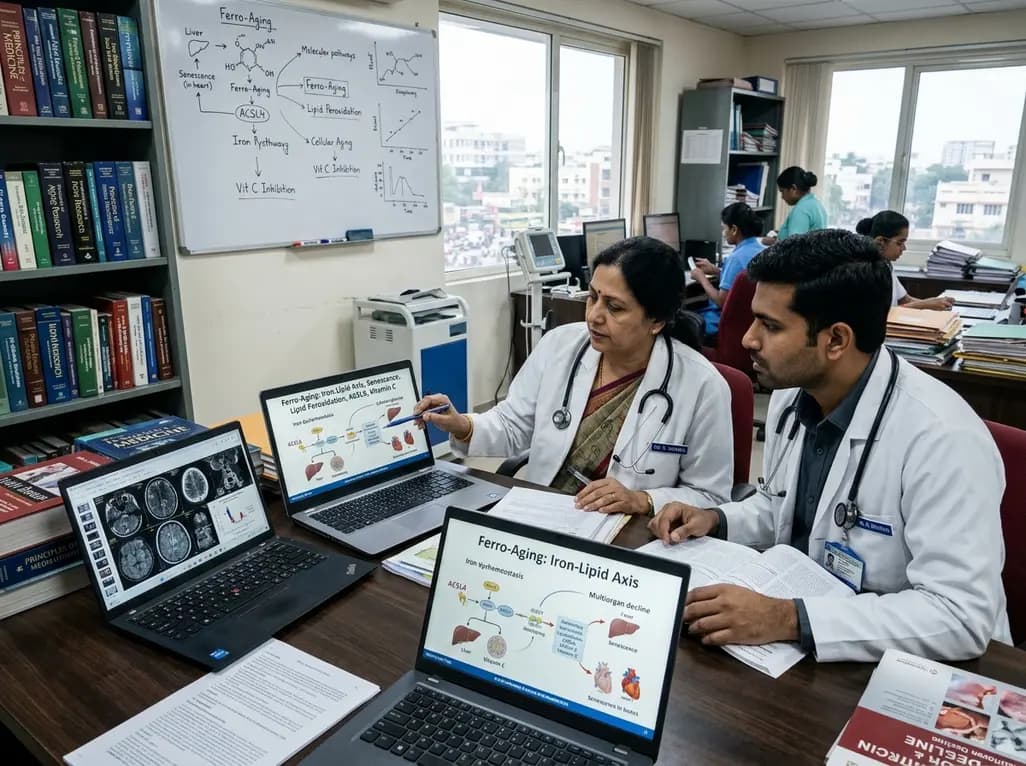
Recent research defines ferro-aging as a conserved iron-lipid axis driving organ decline across primates. Age-related iron dyshomeostasis stimulates ACSL4-mediated lipid peroxidation, promoting cellular senescence. Notably, vitamin C directly inhibits ACSL4, suppressing phospholipid oxidation and multi-organ decay.
Today
