

Loading, please wait...
Loading, please wait...

Surgeons frequently perform first TMTJ arthrodesis to correct severe hallux valgus, midfoot instability, and degenerative joint disease. Furthermore, achieving reliable bony fusion requires rigid mechanical stability and consistent interfragmentary compression across the joint. Traditional fixation techniques rely heavily on crossed cannulated screws. However, prominent screw heads often irritate overlying soft tissues and tendons. Consequently, many foot and ankle specialists now choose headless compression screws to minimize hardware irritation. A recent cadaveric investigation evaluated whether headless screws match the mechanical strength of conventional headed screws. Understanding these biomechanical differences helps orthopedic clinicians optimize hardware selection.
The first tarsometatarsal articulation experiences significant cyclic forces during normal human walking. Therefore, any surgical arthrodesis construct must resist continuous ground reaction forces and prevent dorsal displacement. When primary stability fails, nonunion or malunion inevitably occurs. Historically, two crossed compression screws served as the reference standard for the modified Lapidus procedure. These implants generate excellent interfragmentary compression across prepared cancellous surfaces. In addition, crossed screw fixation provides robust resistance against multiplanar deformities. However, the dorsal cortex of the medial cuneiform offers minimal soft tissue coverage. Consequently, conventional screws with prominent heads frequently cause painful impingement against the tibialis anterior tendon. Many patients report persistent discomfort directly over the hardware site. Because of this issue, secondary hardware removal remains a frequent postoperative complication. Low-profile headless screws offer an attractive alternative because they countersink beneath the bone surface. Nevertheless, surgeons must ensure that eliminating the screw head does not compromise construct rigidity.
To compare these fixation techniques, researchers conducted a biomechanical investigation using ten matched pairs of human lower extremities. First, the investigators measured bone mineral density across all specimens to ensure structural comparability. Next, they performed a modified Lapidus procedure across each paired first tarsometatarsal joint. One foot received two crossed 4.0-millimeter cannulated headed compression screws. Meanwhile, the contralateral matched foot received two crossed 4.0-millimeter cannulated headless compression screws. Afterward, the authors mounted each reconstructed foot into a specialized testing machine. The protocol subjected every construct to physiological cyclic loading from 0 to 31 Newtons for 1000 continuous cycles. In addition, optical sensors continuously tracked joint movement, construct stiffness, and dorsal angulation. Following cyclic testing, the machine loaded each specimen until complete structural failure occurred. By utilizing matched cadaveric pairs, the researchers effectively controlled for individual anatomical variations. Therefore, the resulting data provide reliable insights into the relative mechanical behavior of both screw designs.
The experimental results demonstrated that both screw designs achieve comparable biomechanical stability under physiologic loading conditions. Specifically, the mean construct stiffness during ultimate load testing reached 58.91 Newtons per millimeter for headed screws. In comparison, headless compression screws achieved a mean stiffness of 68.36 Newtons per millimeter. This difference showed no statistical significance between cohorts. Furthermore, neither group exhibited significant differences in dorsal angulation during cyclic loading. These findings confirm that headless screws effectively resist sag and maintain joint alignment under repetitive stress. However, testing to structural failure revealed notable numerical differences between the two fixation methods. The headed screw construct sustained a mean yield load of 115.80 Newtons, whereas the headless construct yielded at 67.79 Newtons. Similarly, the mean ultimate failure load was 142.10 Newtons for headed screws compared to 83.02 Newtons for headless screws. Although this ultimate load difference approached significance, it did not achieve formal statistical significance. Thus, headed screws showed higher ultimate structural reserve.
Bone mineral density plays a pivotal role in the mechanical integrity of foot and ankle fixation constructs. In this study, the mean bone mineral density measured 0.547 grams per square centimeter in the headed group. Similarly, the headless group exhibited a mean bone mineral density of 0.533 grams per square centimeter. Statistical testing confirmed that bone quality did not differ significantly between experimental cohorts. Interestingly, the researchers identified a distinct relationship between bone mineral density and stiffness in the headless screw group. Specifically, higher bone mineral density positively correlated with construct stiffness across several cyclic loading intervals. In contrast, the headed screw group showed no significant correlation between bone density and stiffness. This finding suggests that headless screws rely more heavily on dense subcortical bone to establish rigid mechanical purchase. Neither group showed a significant correlation between bone mineral density and ultimate failure load. Therefore, surgeons must carefully evaluate patient bone quality before choosing headless screws.
These biomechanical observations provide practical clinical guidance for foot and ankle specialists managing complex forefoot disorders. Crossed headless screws successfully maintain primary construct stiffness and resist cyclical dorsal displacement. Moreover, their countersunk profile eliminates prominent screw heads, which significantly reduces the risk of soft tissue impingement. As a result, patients may experience less localized tendon irritation and lower rates of secondary hardware removal. However, surgeons must recognize the lower ultimate load threshold observed with headless designs. In patients with severe obesity or noncompliance, headed screws may offer greater structural margin against sudden fixation failure. Additionally, because headless screws correlate closely with bone mineral density, osteoporotic bone may compromise headless thread purchase. In such compromised environments, conventional headed screws or supplementary locking plates may provide superior security. Furthermore, preoperative surgical planning should carefully evaluate individual biomechanical demands and regional soft tissue envelopes. Therefore, clinicians should tailor their implant selection to patient anatomy, bone density, and compliance levels. Ultimately, both screw designs represent viable options for achieving stable primary fixation.
Headless compression screws provide a distinct clinical advantage by countersinking completely beneath the articular or cortical bone surface. Consequently, they substantially minimize hardware prominence and reduce painful friction against adjacent tendons, such as the tibialis anterior. Furthermore, eliminating prominent screw heads lowers the incidence of secondary surgical procedures for hardware removal. These low-profile implants also maintain primary construct stiffness and resist dorsal angulation during physiological cyclic loading comparable to conventional headed screws.
Headed screws achieved a higher mean ultimate load because their prominent screw head acts as a broad mechanical flange against the outer cortex. Therefore, this external cortical interface distributes tensile forces over a broader surface area before catastrophic bone pullout occurs. In contrast, headless compression screws rely entirely on thread pitch differentials within the cancellous matrix. Consequently, headed screws provide greater structural resistance when subjected to extreme peak loads or sudden construct failure testing.
Bone mineral density directly influences construct stiffness when utilizing headless compression screws during first tarsometatarsal joint fusion. Because headless screws depend heavily on cancellous bone engagement, poor bone quality compromises their mechanical rigidity and holding power. In contrast, headed screws distribute compressive forces directly across the dense outer cortex. Therefore, surgeons treating osteopenic or osteoporotic patients should exercise caution with headless designs and consider headed screws or supplementary locking plates instead.
Disclaimer: This content is for informational and educational purposes only. It is not intended to be a substitute for professional medical advice, diagnosis, or treatment. Always seek the advice of your physician or other qualified health provider with any questions you may have regarding a medical condition. Never disregard professional medical advice or delay in seeking it because of something you have read here. Refer to the latest local and national guidelines for clinical practice.
References
Ortmayr J et al. Biomechanical Evaluation of Crossed Screw Fixations With Different Head Designs for First Tarsometatarsal Joint Arthrodesis. Foot Ankle Spec. 2026 Nov 18. doi: 10.1177/19386400261499833. PMID: 43046926.
Prieto-Diaz C, Anderle MR, Brinker LZ, Allard R, Leasure J. Biomechanical Comparison of First Tarsometatarsal Arthrodesis Constructs Over Prolonged Cyclic Testing. Foot Ankle Orthop. 2019;4(4):2473011419892240.
Burchard R, Karpinski K, Sander F, et al. Biomechanics of common fixation devices for first tarsometatarsal joint fusion-a comparative study with synthetic bones. J Orthop Surg Res. 2018;13(1):173.

Read summarized clinical updates, watch expert medical content, and earn CME certifications right from your smartphone.
Open your smartphone camera to scan and install.





A biomechanical evaluation compares crossed headed versus headless compression screws in first TMTJ arthrodesis. Both constructs provide comparable stiffness and angular stability, while headless screws reduce hardware prominence and headed screws show higher ultimate load.
Today
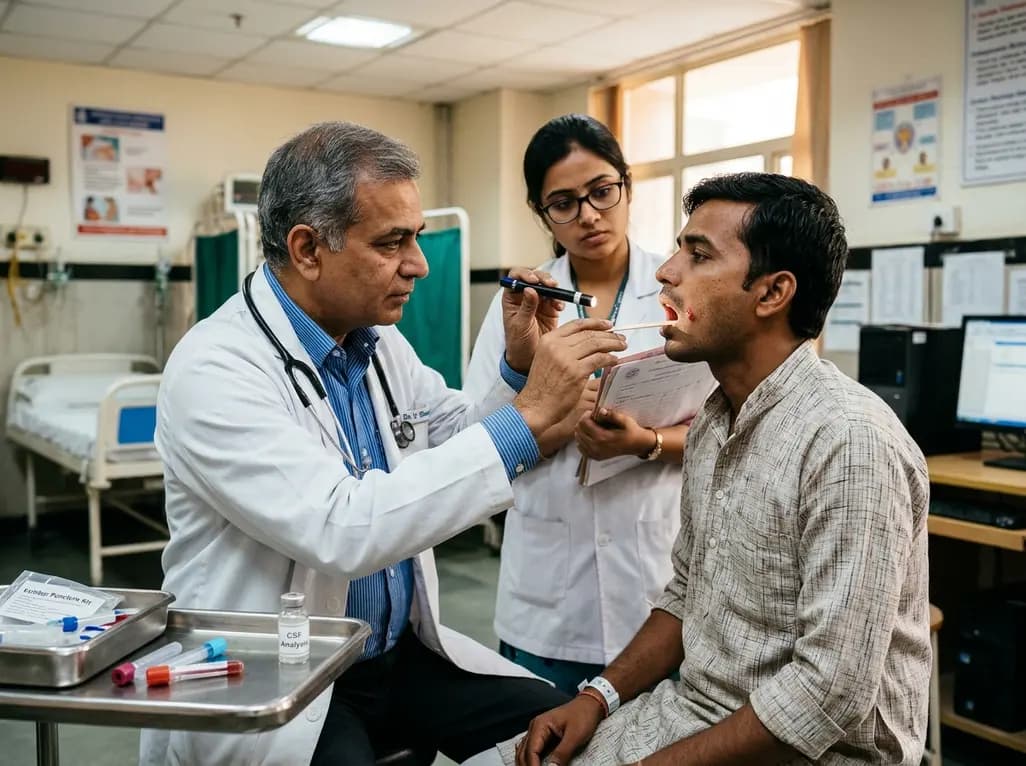
A routine oral sore can conceal severe treponemal central nervous system invasion. This case highlights how an isolated oral mucous patch in a newly diagnosed HIV patient revealed asymptomatic neurosyphilis, underscoring the urgent necessity of targeted cerebrospinal fluid analysis in high-risk individuals.
Today

A landmark SEER-Medicare study clarifies the breast cancer screening benefit in women aged 70 and 75. Life-years gained vary significantly based on comorbidity, frailty, and race, highlighting why physicians must personalize screening decisions rather than relying solely on arbitrary chronological age cutoffs.
Today

A new scoping review and expert consensus establish a concise 16-measure performance bundle for hospital cardiology services. Covering clinical processes, outcomes, patient-reported experiences, and structural factors, this framework advances value-based cardiovascular care under universal health coverage.
Today
A paired cadaveric study compared triple and quintuple percutaneous Achilles tendon lengthening. While quintuple hemisection showed numerically greater elongation, differences were not statistically significant.
Today

A secondary analysis of the Living Healthier with Diabetes trial reveals that positive baseline technology attitudes significantly improve engagement with digital diabetes self-management apps, leading to enhanced self-care behaviors and better long-term glycemic control in adults with type 2 diabetes.
Today
