.webp&w=384&q=75)

Loading, please wait...
Loading, please wait...

Aneurysmal subarachnoid hemorrhage (aSAH) represents a critical neurovascular emergency associated with substantial morbidity and mortality worldwide. Accurate early risk stratification is vital for tailoring intensive care, guiding surgical interventions, and discussing realistic prognoses with families. Clinicians traditionally rely on established grading systems such as the Hunt and Hess classification and the World Federation of Neurosurgical Societies (WFNS) scale. However, investigators recently developed the HATCH score to provide a more comprehensive prognostic assessment by integrating hemorrhage volume, age, treatment modality, clinical condition, and hydrocephalus. A newly published multicenter study from Argentina has evaluated the external validity and calibration of the HATCH score in a middle-income cohort, offering essential insights for global critical care and neurology teams.
Risk prediction in neurocritical care requires models that capture both physiological vulnerability and anatomical injury severity. The HATCH score addresses these complex dynamics by synthesizing five crucial prognostic determinants into a practical bedside tool. Specifically, the acronym represents Hemorrhage extent based on radiological grading, patient Age, aneurysm Treatment strategy (surgical clipping versus endovascular coiling), initial Clinical state measured by the Glasgow Coma Scale, and the presence of acute Hydrocephalus requiring cerebrospinal fluid diversion. Furthermore, each variable contributes weighted points to generate a cumulative risk profile. Therefore, clinicians obtain a multidimensional perspective that reflects acute neurological disruption alongside structural brain pathology. In contrast, traditional scoring systems frequently focus solely on admission consciousness or clinical symptoms, potentially overlooking radiographic nuances and therapeutic modifiers that heavily influence long-term functional recovery.
The external validation investigation involved a retrospective multicenter cohort study conducted across three tertiary hospitals in Argentina between 2011 and 2024. Researchers analyzed consecutive adult patients diagnosed with aSAH who required admission to the intensive care unit. Overall, the final analysis included 177 patients with documented baseline clinical and radiographic variables. The primary outcome was functional neurological status at 6 months, categorized using the modified Rankin Scale (mRS) into favorable recovery (mRS 0 to 3) versus poor outcome or severe disability (mRS 4 to 6). Additionally, the secondary endpoint evaluated all-cause mortality at 12 months post-ictus. Statistical analysis rigorously assessed both discrimination using the Area Under the Receiver Operating Characteristic curve (AUROC) via DeLong tests and calibration through calibration-in-the-large (CITL) and calibration slope metrics derived from the original development models.
In the primary analysis, 57% of patients achieved a favorable functional recovery at 6 months. When evaluating discrimination for 6-month functional status, the HATCH score demonstrated strong predictive ability with an AUROC of 0.80 (95% CI 0.73–0.86). This performance was statistically comparable to the Hunt-Hess scale (AUROC 0.79, 95% CI 0.72–0.86) and the WFNS scale (AUROC 0.81, 95% CI 0.74–0.87, p = 0.44). However, substantial differences emerged during calibration analysis across the models. The HATCH score displayed excellent agreement across risk probabilities with a calibration slope of 0.94 (95% CI 0.64–1.24) and mild underprediction (CITL 0.61). Conversely, the Hunt-Hess scale overpredicted poor outcomes (CITL -0.58) and suffered from poor risk agreement (slope 0.47). Meanwhile, WFNS maintained a robust slope (1.19) but demonstrated systematic underprediction (CITL 1.62). Consequently, the HATCH tool offered superior balance between discrimination and calibration for mid-term functional recovery.
Evaluating secondary endpoints revealed distinct predictive characteristics when forecasting 12-month mortality. All three scoring tools exhibited moderate discriminative power, yielding an AUROC of 0.72 (95% CI 0.64–0.79) for the HATCH score, 0.69 (95% CI 0.61–0.77) for Hunt-Hess, and 0.73 (95% CI 0.66–0.81) for the WFNS scale without significant statistical divergence (p = 0.12). Nevertheless, calibration trajectories varied substantially among the models over this extended follow-up window. In this setting, WFNS demonstrated the most stable calibration performance, yielding a slope of 0.87 (95% CI 0.52–1.23) and a CITL of 0.74. In comparison, the HATCH score showed a calibration slope of 0.55 and a CITL of -0.36, while the Hunt-Hess scale demonstrated marked miscalibration. Therefore, while HATCH excels in functional forecasting, WFNS remains highly dependable for long-term survival estimation.
Applying validated predictive models is especially crucial in resource-constrained environments, including low- and middle-income healthcare systems. Clinical teams often face challenging decisions regarding intensive monitoring, mechanical ventilation duration, and timing of aggressive neurosurgical interventions. Because the HATCH score accounts for treatment modalities and acute hydrocephalus alongside neurological status, it equips intensivists with granular prognostic data. Moreover, accurate calibration prevents inappropriate therapeutic pessimism or unwarranted withdrawal of life-sustaining treatment in patients with salvageable functional potential. Clinicians should nevertheless remember that prognostic scores serve as supportive adjuncts rather than deterministic instruments. Incorporating multidisciplinary assessments, dynamic neurological tracking, and serial neuroimaging remains fundamental when managing acute aneurysmal subarachnoid hemorrhage.
The HATCH score incorporates five clinical and radiological variables: Hemorrhage volume determined by neuroimaging, patient Age, aneurysm Treatment modality, baseline Clinical status via the Glasgow Coma Scale, and acute Hydrocephalus. These variables combine to create an objective, multi-parameter risk profile for functional outcome forecasting.
The HATCH score demonstrates equivalent discrimination (AUROC 0.80) to Hunt-Hess and WFNS scales for 6-month functional outcomes. Crucially, however, HATCH offers superior calibration balance across probability spectrums, avoiding the severe overprediction observed with Hunt-Hess and the systematic underprediction seen with WFNS.
The HATCH score provides moderate discrimination for 12-month mortality (AUROC 0.72). However, for long-term mortality specifically, the WFNS scale demonstrates more stable calibration metrics. Clinicians often combine both scoring systems to optimize individual risk assessment across short-term functional recovery and extended survival.
Disclaimer: This content is for informational and educational purposes only and does not substitute professional medical advice, diagnosis, or treatment. Always consult qualified healthcare providers with any questions regarding medical conditions. Refer to the latest local and national guidelines for clinical practice.
References

Read summarized clinical updates, watch expert medical content, and earn CME certifications right from your smartphone.
Open your smartphone camera to scan and install.





A multicenter Latin American study validated the HATCH score against Hunt-Hess and WFNS scales in aneurysmal subarachnoid hemorrhage. The HATCH score demonstrated balanced discrimination and calibration for 6-month functional recovery, supporting risk stratification in intensive care units.
last month

Red blood cell transfusion is critical in sickle cell disease management but brings significant immunological complexity, including alloimmunisation and iron overload. Extended RBC phenotyping and tailored protocols optimize clinical safety.
Today
Discover the crucial distinctions between mesonephric and mesonephric-like proliferations of the female genital tract. Learn the key histomorphologic, immunohistochemical, and molecular differences essential for accurate diagnosis and clinical management.
Today
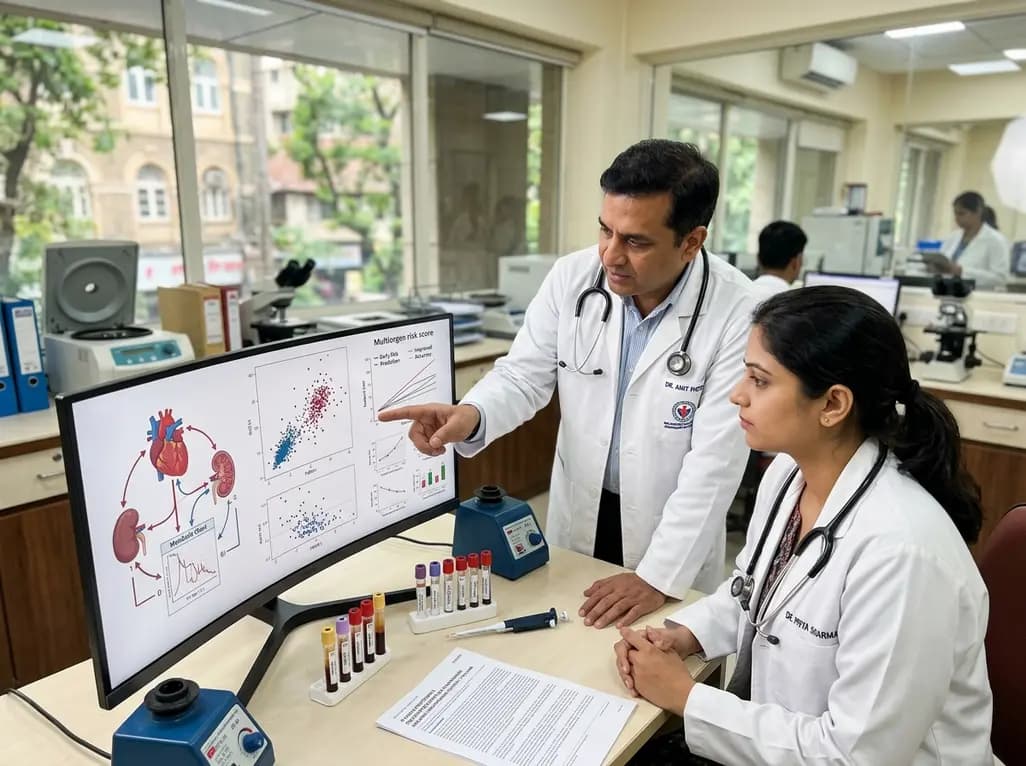
A large UK Biobank study reveals that plasma proteomic signatures capture preclinical organ damage and improve multiorgan risk prediction across early CKM syndrome stages 0 to 2 beyond traditional PREVENT clinical models.
Today

A retrospective CBCT study reveals that superior TMJ space asymmetry correlates moderately with occipital condyle-atlas-axis asymmetry in unilateral TMJ osteoarthritis, highlighting an imaging correlate between jaw biomechanics and upper cervical alignment rather than a standalone diagnostic marker.
Today

A Bayesian multilevel meta-analysis reveals that aerobic training combined with moderate carbohydrate restriction modestly lowers HbA1c in type 2 diabetes. However, sparse data and very low certainty leave incremental benefits over exercise or diet alone unproven, highlighting the need for individualized care.
Today
