.webp&w=384&q=75)

Loading, please wait...
Loading, please wait...
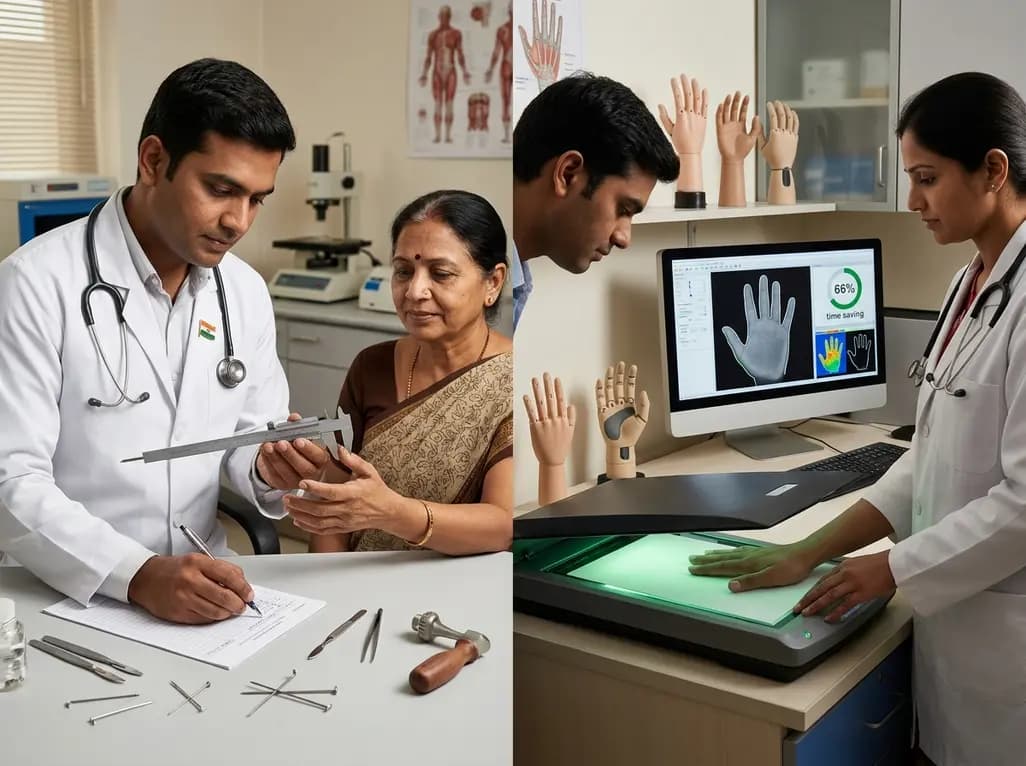
Understanding hand anthropometry methods is vital for orthopedic surgeons, ergonomists, and medical device designers. Consequently, choosing between traditional calipers and modern digital scanners requires a clear grasp of their relative accuracy. Hand anthropometry underpins the creation of surgical tools, patient-specific prosthetics, and protective gear. While direct measurement (DM) remains the gold standard for high precision, newer two-dimensional flatbed scanning (SC) offers significant efficiency improvements for clinical research and large-scale data collection.
A recent comparative study analyzed 56 hand dimensions across a cohort of 40 adults. Specifically, researchers evaluated lengths and breadths using both DM and SC techniques to determine agreement. The results indicated that 75% of the measurements satisfied strict reliability criteria, including a coefficient of reliability greater than or equal to 0.80. Therefore, most hand dimensions can be captured accurately via digital scanning. However, scanning showed higher error rates for finger breadths and inter-digital spaces. These discrepancies often stem from soft tissue compression against the scanner glass during the process, which distorts the natural anatomical profile.
Besides accuracy, the study quantified time efficiency for practitioners in busy clinical or research environments. Digital scanning reduced participant handling and technician time by approximately 66% compared to manual methods. This speed makes SC an excellent choice for large-scale anthropometric surveys and ergonomic workplace assessments. Nevertheless, clinicians should still favor manual calipers when surgical planning requires hyper-precise thumb measurements or web-space analysis. Ultimately, the choice of equipment should align with the specific anatomical landmarks required for the individual medical application.
The two main methods are direct measurement using calipers (manual) and digital scanning (2D or 3D). Manual methods are highly precise but time-consuming, while scanning offers rapid data collection for larger populations.
Manual calipers are preferred for measuring small anatomical landmarks, such as specific finger breadths and inter-digital web spaces, where scanners may lose accuracy due to soft tissue compression.
Disclaimer: This content is for informational and educational purposes only. It does not constitute medical advice or a substitute for professional clinical judgment. Always consult a qualified specialist for specific patient concerns. Refer to the latest local and national guidelines for clinical practice.
References
Inprom J et al. Comparative analysis of measurement discrepancy and reliability between direct and scanner-based methods in hand anthropometry. Work. 2026 Jun 11. doi: 10.1177/10519815261458341. PMID: 42277561.
Agnihotri AK, et al. Hand anthropometry: A review of its role in forensic and clinical identification. J Forensic Sci. 2024.
Sanchez-Margallo JA, et al. Comparative study of the use of different sizes of an ergonomic instrument handle for laparoscopic surgery. Appl Sci. 2020;10(4):1526.

Read summarized clinical updates, watch expert medical content, and earn CME certifications right from your smartphone.
Open your smartphone camera to scan and install.





This study evaluates 2D flatbed scanning as an alternative to direct caliper measurements in hand anthropometry. While scanning offers 66% time savings and 75% reliability, manual methods remain essential for precise finger and thumb breadth measurements required in surgery and ergonomic design.
4 months ago

Discover the crucial role of glymphatic dysfunction in stroke, where perivascular clearance failure and neuroinflammation exacerbate cerebral edema and post-stroke brain injury.
Today

A prenatal case highlights severe glutaric acidemia type II presenting as bilateral hyperechoic cystic kidneys at 18 weeks. Whole-exome sequencing revealed a novel homozygous ETFDH frameshift variant, demonstrating the power of rapid genetic testing in fetal renal anomalies.
Today

Review how tailored exercise programs benefit frail older patients with heart failure. Explore pathophysiological mechanisms, individualized training prescriptions, and strategies to overcome adherence barriers in clinical practice.
Yesterday

This comparative study evaluates posterior labral tears with and without glenohumeral instability, highlighting distinct demographic patterns, MRI underestimation in stable shoulders, and successful arthroscopic repair outcomes.
Yesterday

A clinical study demonstrates that early intervention with tocilizumab, either as monotherapy or bridged with corticosteroids, achieves significant proptosis reduction and resolves active inflammation in treatment-naive thyroid eye disease.
Yesterday
