.webp&w=384&q=75)

Loading, please wait...
Loading, please wait...
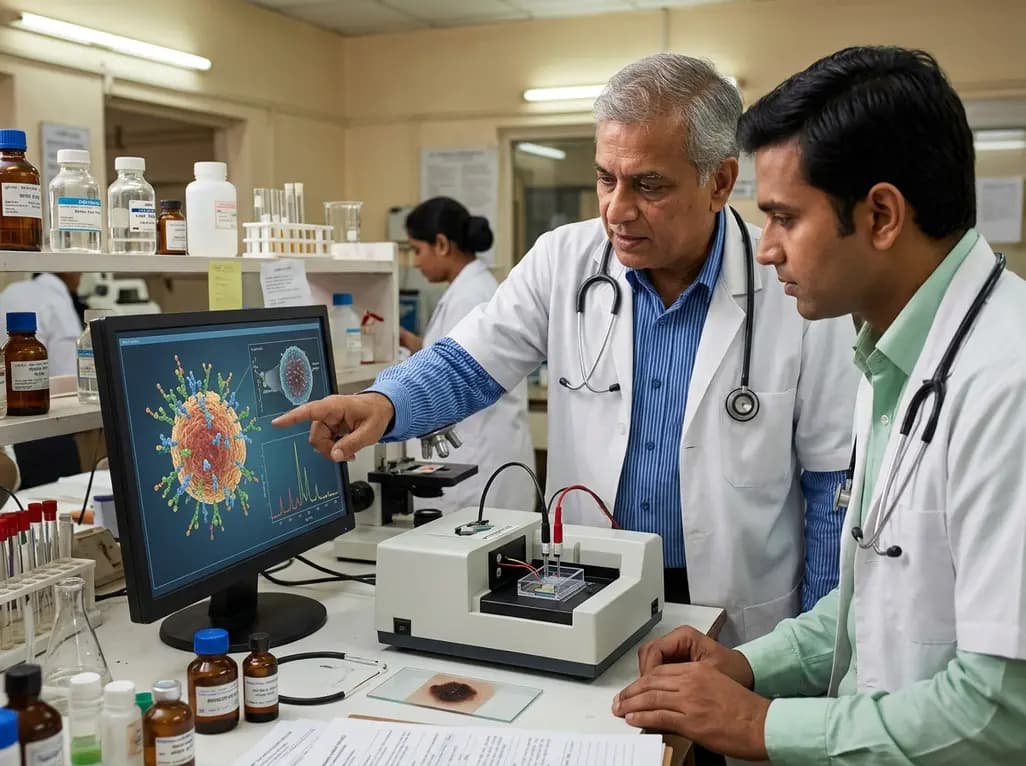
Glycophenotyping in melanoma diagnosis is advancing rapidly through the introduction of a new glycocalyx-mimetic electrochemical transducer. This innovative tool successfully addresses the historical challenges of biofouling and complex, multistep labeling. Consequently, researchers can now observe lectin-glycan binding in real-time. Moreover, this approach provides a clearer picture of living cell surfaces without requiring destructive preparation. However, traditional methods usually destroy the sample or require complex chemical tags. This new sensor avoids those pitfalls entirely. Furthermore, it uses gold electrodes coated with a self-assembled brush of lubricin (PRG4). Additionally, this brush presents tumor-associated glycans as precise linkers. Therefore, the device identifies specific oligosaccharide patterns with extremely high precision.
The system relies on a specialized lubricin coating that acts as an anti-biofouling agent. This mucin-domain protein naturally resists non-specific protein adsorption while displaying relevant glycans. Consequently, the sensor converts binding events directly into multiplex electrical signals. Researchers embedded six different lectins within the lubricin layer to enable orthogonal recognition of Gal-GalNAc-terminated structures. This configuration is particularly effective for identifying the aberrant glycosylation patterns common in malignant cells. Furthermore, the electrochemical culture-plate format allows for quantitative agreement with conventional microarrays. Consequently, clinicians can achieve faster results without sacrificing accuracy.
One of the primary benefits of this transducer is its ability to perform in situ profiling. Most diagnostic tools require cells to be removed from their natural environment. However, this technology supports monitoring directly within the culture plate. This capability is vital for understanding how tumor-associated glycans change during cancer progression. Moreover, the label-free nature of the detection ensures that the biological integrity of the melanoma cells remains intact. Consequently, this transducer serves as a robust platform for screening lectin-glycan interactions and profiling diagnostic biomarkers. This represents a significant step forward in the field of oncological diagnostics.
Lubricin (PRG4) serves as an anti-biofouling brush on the electrode surface. It prevents unwanted proteins from sticking to the sensor while presenting specific glycans that help identify melanoma-associated patterns.
This method provides real-time, label-free data and quantitative agreement with microarrays, but it is much faster and allows for in situ monitoring of living cells.
Glycophenotyping identifies specific sugar changes on the surface of cells. These changes often indicate whether a cell is cancerous and can help in the early detection and profiling of melanoma.
Disclaimer: This content is for informational and educational purposes only. It is not intended to be a substitute for professional medical advice, diagnosis, or treatment. Always seek the advice of your physician or other qualified health provider with any questions you may have regarding a medical condition. Refer to the latest local and national guidelines for clinical practice.
References
Coimbra Pimenta T et al. Label-Free and In Situ Glycophenotyping Using a Glycocalyx-Mimetic Electrochemical Transducer. ACS Appl Mater Interfaces. 2026 Jun 09. doi: 10.1021/acsami.6c04290. PMID: 42261736.
Pimenta TC, et al. Lubricin (PRG4) antifouling coating enables the development of an immunosensor for the detection of nerve growth factor in cell culture media. Talanta. 2025 Jan 01;128143. doi: 10.1016/j.talanta.2025.128143.
Sharko F, et al. Scanning Probe Microscopy Techniques for Studying the Cell Glycocalyx. PMC. 2023 Dec 06. Available at: https://www.ncbi.nlm.nih.gov/pmc/articles/PMC10710609/
"
Read summarized clinical updates, watch expert medical content, and earn CME certifications right from your smartphone.
Open your smartphone camera to scan and install.





A new glycocalyx-mimetic transducer using lubricin (PRG4) allows for rapid, label-free screening of tumor-associated glycans in melanoma cells....
4 months ago

A retrospective cohort study of 7,716 ICU patients from the MIMIC-IV database demonstrates that Gradient Boosting Decision Trees significantly outperform traditional SOFA scores in predicting in-hospital mortality among patients with sepsis and diabetes, with SHAP analysis providing clinical interpretability.
Today

A prenatal case highlights severe glutaric acidemia type II presenting as bilateral hyperechoic cystic kidneys at 18 weeks. Whole-exome sequencing revealed a novel homozygous ETFDH frameshift variant, demonstrating the power of rapid genetic testing in fetal renal anomalies.
Today
This article reviews the forensic and clinical complexities of acute myocarditis arising on left ventricular hypertrophy in children, highlighting early diagnostic red flags and multidisciplinary postmortem autopsy protocols.
Today

This comparative study evaluates posterior labral tears with and without glenohumeral instability, highlighting distinct demographic patterns, MRI underestimation in stable shoulders, and successful arthroscopic repair outcomes.
Yesterday

A clinical study demonstrates that early intervention with tocilizumab, either as monotherapy or bridged with corticosteroids, achieves significant proptosis reduction and resolves active inflammation in treatment-naive thyroid eye disease.
Yesterday
