

Loading, please wait...
Loading, please wait...

GLACF uses a triple-stream architecture instead of a single-stream design. This allows it to capture both global context and local semantic relationships more effectively, improving overall registration accuracy.
The framework employs a voxel-wise local attention module (VLFM). This specific component refines high-resolution features to generate the precise displacement fields required for accurate anatomical alignment.
Yes, experimental results on various datasets like LONI LBPA40 and OASIS show that GLACF is robust and accurate across diverse 3D brain MRI images.
Disclaimer: This content is for informational and educational purposes only and does not constitute medical advice. It is not intended to be a substitute for professional medical judgment, diagnosis, or treatment. Always seek the advice of your physician or other qualified health provider with any questions you may have regarding a medical condition. Refer to the latest local and national guidelines for clinical practice.
References
1. Deng H et al. Integrating Local Precision With Global Consistency for Unsupervised Magnetic Resonance Image Registration. Magn Reson Med. 2026 Mar 26. doi: 10.1002/mrm.70357. PMID: 41888047.
2. Fan J et al. Unsupervised deep learning-based medical image registration: a survey. Phys Med Biol. 2025 Jan 7;70(2). doi: 10.1088/1361-6560/ad9e69.
3. Hoffmann M. AI Enables Faster, More Precise Image Registration for Medical Image Analysis. Mass General Hospital. July 29, 2024.

Read summarized clinical updates, watch expert medical content, and earn CME certifications right from your smartphone.
Open your smartphone camera to scan and install.





Researchers introduce GLACF, a triple-stream attention framework for highly accurate and robust unsupervised deformable MR image registration in brain imagi...
6 months ago

A retrospective cohort study of 7,716 ICU patients from the MIMIC-IV database demonstrates that Gradient Boosting Decision Trees significantly outperform traditional SOFA scores in predicting in-hospital mortality among patients with sepsis and diabetes, with SHAP analysis providing clinical interpretability.
Today
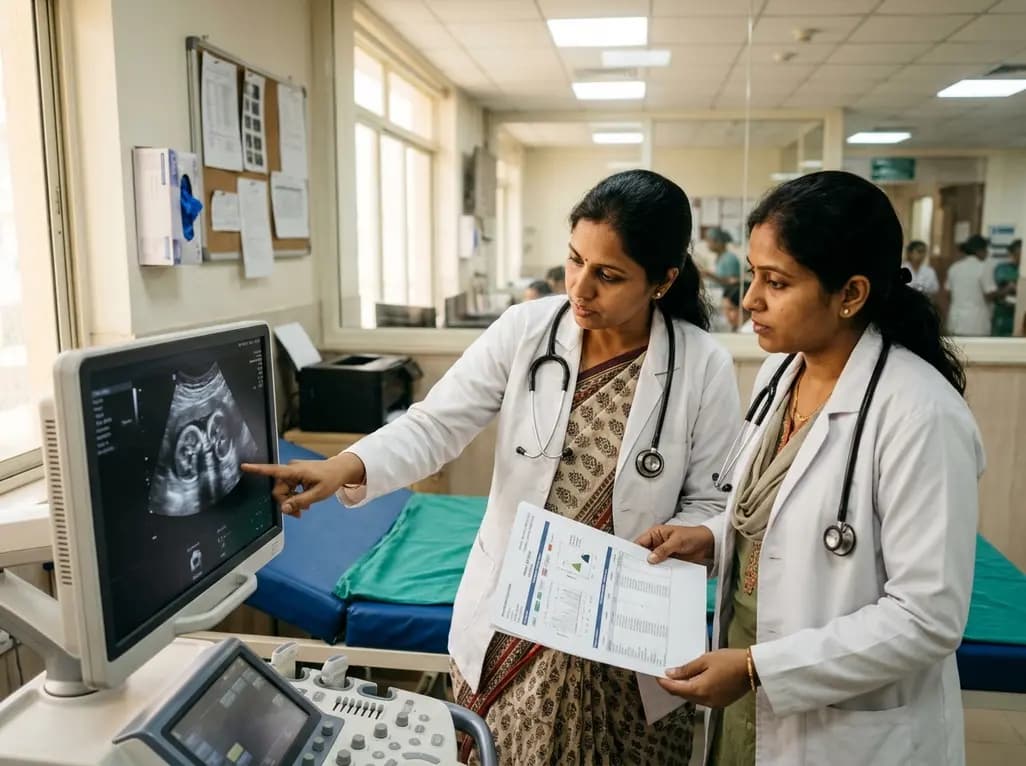
A prenatal case highlights severe glutaric acidemia type II presenting as bilateral hyperechoic cystic kidneys at 18 weeks. Whole-exome sequencing revealed a novel homozygous ETFDH frameshift variant, demonstrating the power of rapid genetic testing in fetal renal anomalies.
Today
This article reviews the forensic and clinical complexities of acute myocarditis arising on left ventricular hypertrophy in children, highlighting early diagnostic red flags and multidisciplinary postmortem autopsy protocols.
Today

This comparative study evaluates posterior labral tears with and without glenohumeral instability, highlighting distinct demographic patterns, MRI underestimation in stable shoulders, and successful arthroscopic repair outcomes.
Yesterday

A clinical study demonstrates that early intervention with tocilizumab, either as monotherapy or bridged with corticosteroids, achieves significant proptosis reduction and resolves active inflammation in treatment-naive thyroid eye disease.
Yesterday
