.webp&w=384&q=75)

Loading, please wait...
Loading, please wait...
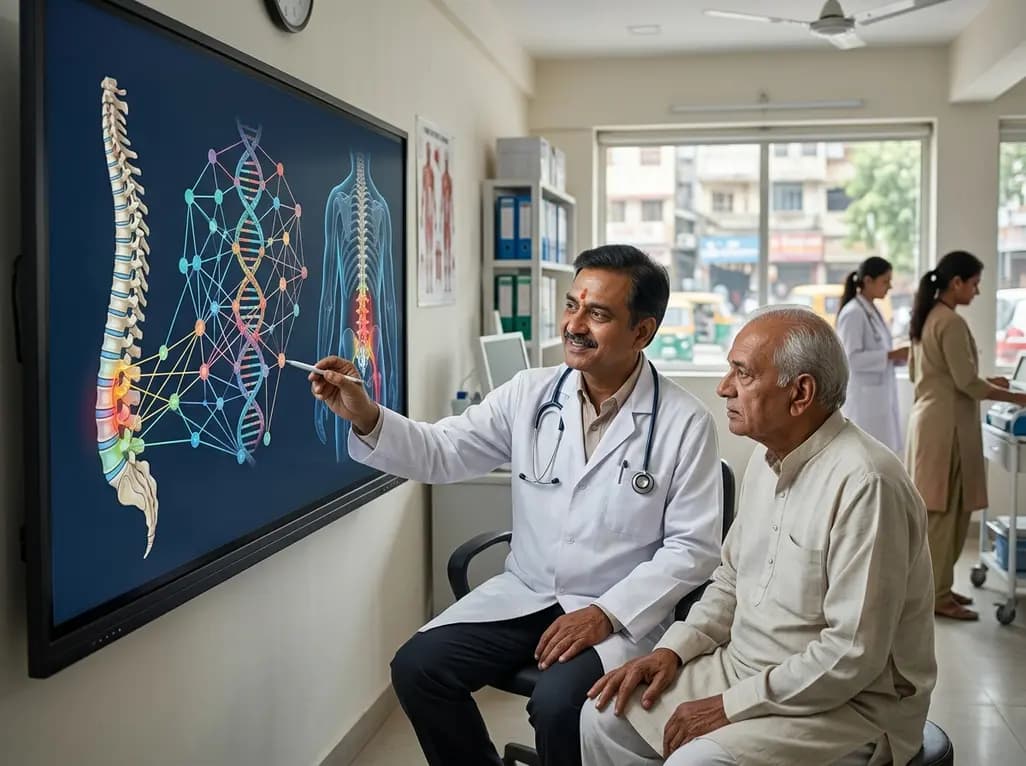
Clinical manifestations of spinal aging, such as lumbar spinal stenosis, intervertebral disc degeneration, and sciatica, often occur together in elderly patients. However, the exact shared genetic architecture of aging spine remained largely unknown until recently. Experts have long suspected that these conditions are not just isolated wear-and-tear events but are driven by a cohesive polygenic framework. This understanding is particularly vital for clinicians in India, where the burden of degenerative spinal diseases is rising alongside an aging population.
Recent research utilized Genomic Structural Equation Modelling (Genomic SEM) to analyze large-scale GWAS data. The study included traits such as telomere length, osteoporosis, and sciatica. By fitting a latent factor, researchers captured the common genetic liability across these conditions. Consequently, the results show that a single latent factor explains the strong correlation between lumbar stenosis and disc degeneration. This finding suggests that a patient with one condition may be genetically predisposed to others within the spectrum.
Identifying the specific genetic architecture of aging spine has led to the discovery of 273 independent lead variants. These variants are not scattered randomly but converge on specific susceptibility genes. Notably, genes like LRRC34, MYNN, SAMHD1, and EEF1A2 appear central to the aging process of the spine. These genes are involved in critical biological functions including telomere biology and chromosome maintenance. Furthermore, the analysis highlighted genomic stability as a primary pathway driving spinal deterioration.
Additionally, functional enrichment analysis confirms that these genetic markers influence cell types specifically related to spinal health. This discovery provides an initial map of the polygenic architecture that extends beyond single-trait studies. For healthcare providers, this means that spinal aging can be viewed as a biologically meaningful construct rather than a series of unrelated symptoms. Therefore, managing one aspect of the aging spine may eventually require a more holistic, genetically informed approach to patient care.
The shared genetic basis suggests that early screening for one degenerative trait could help predict the risk for others. For instance, a patient with early-onset intervertebral disc degeneration might require closer monitoring for lumbar spinal stenosis later in life. Moreover, understanding the role of genomic stability pathways opens new doors for potential therapeutic targets. Future treatments may focus on protecting chromosomal integrity to slow the progression of multi-trait spinal aging. This research marks a significant step toward precision medicine in the field of orthopedics and geriatrics.
Genetics provide a shared foundation for many aging spine conditions. A single latent genetic factor often links lumbar stenosis, disc degeneration, and sciatica, meaning they share common susceptibility genes and biological pathways.
Research has identified susceptibility genes such as LRRC34, MYNN, SAMHD1, and EEF1A2. These genes are primarily involved in telomere biology, chromosome maintenance, and maintaining genomic stability within spinal tissues.
Yes, by identifying shared genetic risks, doctors can better predict the progression of spinal diseases. In the future, targeting the specific pathways identified in this study might lead to more effective, personalized treatments for elderly patients.
Disclaimer: This content is for informational and educational purposes only. It is not intended as medical advice or as a substitute for professional healthcare consultation. Always seek the advice of your physician or other qualified health provider with any questions regarding a medical condition. Refer to the latest local and national guidelines for clinical practice.
References
1. Chen J et al. A genomic structural equation modelling analysis of the shared genetic architecture of the aging spine. Eur Spine J. 2026 Jun 04. doi: 10.1007/s00586-026-10039-7. PMID: 42237046.
2. Grotle M et al. Lumbar spinal stenosis is a highly genetic condition partly mediated by disc degeneration. Bone Joint J. 2015;97-B(10):1345-1351.
3. Puca AA et al. Association study on long-living individuals identifies CAMKIV gene regulating survival proteins. Rejuvenation Res. 2011;14(3):283-91.
"
Read summarized clinical updates, watch expert medical content, and earn CME certifications right from your smartphone.
Open your smartphone camera to scan and install.





A new genomic structural equation modelling analysis identifies the shared genetic basis of aging spine conditions like lumbar stenosis and sciatica....
4 months ago

An observational study from the NIH All of Us Research Program reveals that adding a multi-ancestry polygenic risk score to machine learning models provides only modest improvements in predicting adult weight gain, underscoring the enduring significance of routine clinical and lifestyle factors.
Today

A study in JAMIA Open shows lightweight open-source reasoning LLMs achieve up to 95% sensitivity and accelerate evidence synthesis screening by nearly twentyfold, presenting a cost-effective, scalable AI solution for biomedical research and systematic reviews.
Today

A landmark study details how an enterprise pediatric remote patient management model expanded from a single cardiology pilot to 16 diverse specialty programs by combining centralized digital operations with specialty clinical leadership.
Today
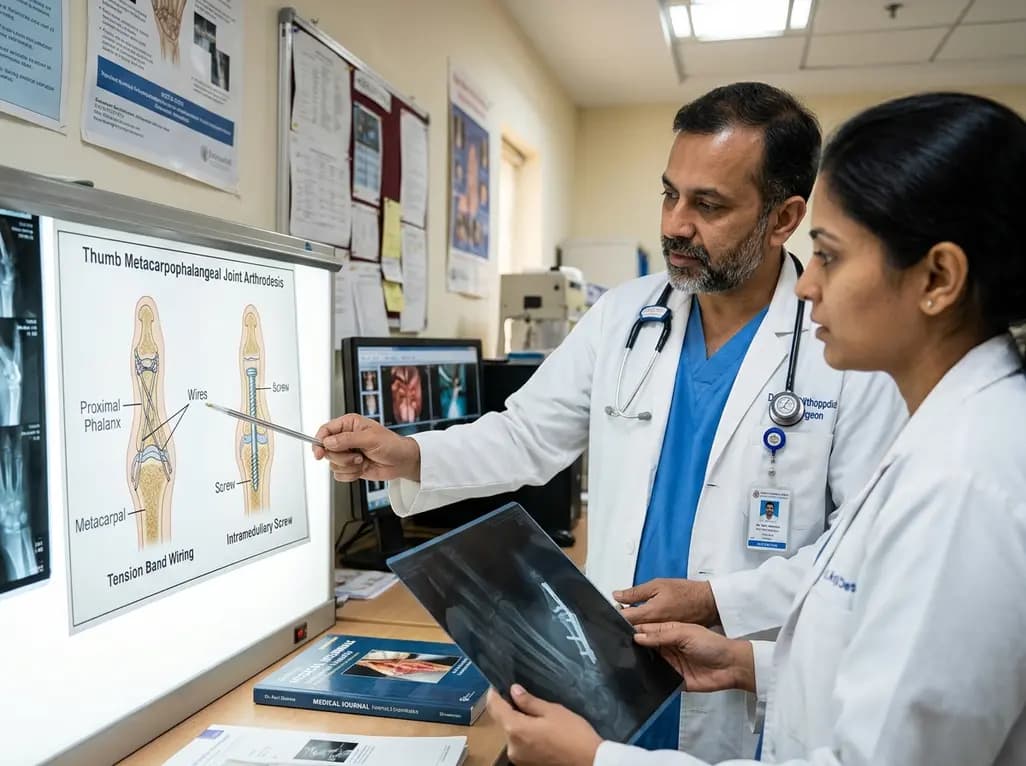
A comparative review of tension band wiring and intramedullary screw fixation in thumb metacarpophalangeal arthrodesis, evaluating union rates, hardware complications, and clinical outcomes.
Yesterday

A breakthrough ultrathin multimodal sensor decouples physical hemodynamic monitoring from disposable electrochemical calibration, achieving long-term wearable glucose prediction with 81.36% accuracy and a 9.12% MARD. This offers a robust, drift-free solution for outpatient metabolic surveillance.
Yesterday
