.webp&w=384&q=75)

Loading, please wait...
Loading, please wait...
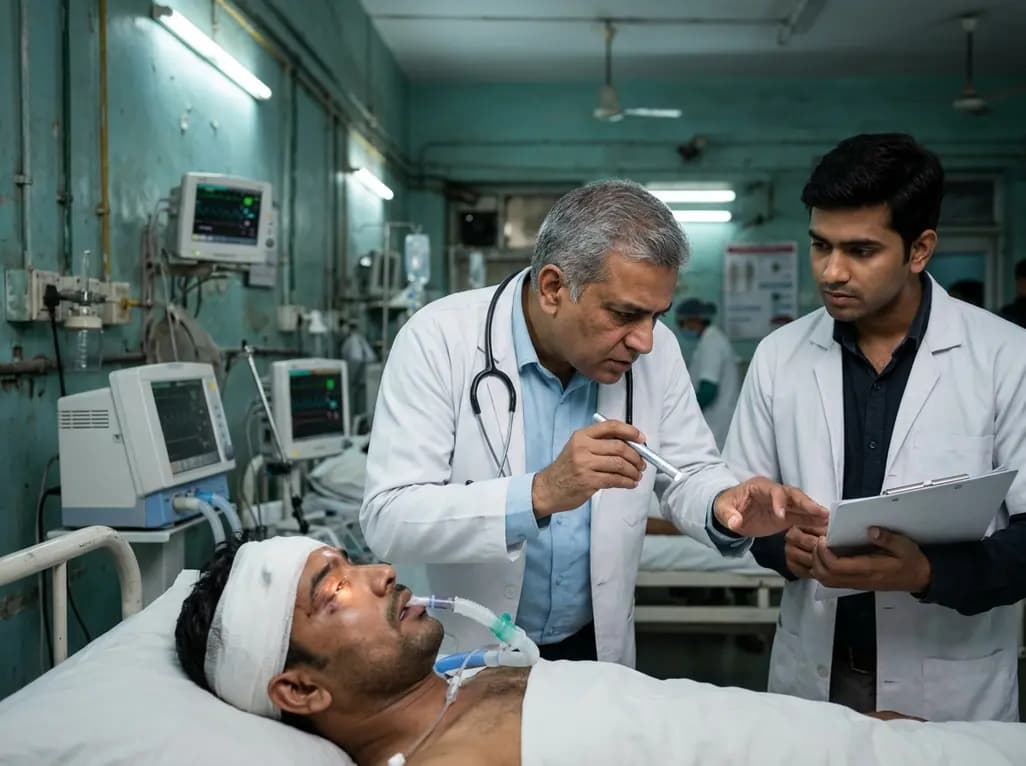
Managing acute head trauma effectively requires rapid, accurate, and objective assessment tools to guide life-saving interventions. Traditionally, the Glasgow Coma Scale (GCS) has remained the global gold standard for evaluating consciousness levels since its inception. Furthermore, clinicians in emergency departments across India rely on this metric to categorize the severity of brain injuries. However, recent evidence suggests that the GCS-P score for TBI provides a more comprehensive neurological picture by integrating pupillary reactivity into the standard assessment. Consequently, this combined approach addresses some of the limitations inherent in the motor, verbal, and eye-opening components of the traditional GCS. Therefore, understanding the nuances of this enhanced tool is vital for trauma surgeons and critical care specialists. Additionally, the increasing incidence of road traffic accidents in the Indian subcontinent necessitates more precise prognostic indicators. Notably, the integration of pupillary response adds a layer of brainstem assessment that the GCS alone might overlook. Specifically, non-reactive pupils often signal severe underlying intracranial pathology or impending herniation. Accordingly, this refined scoring system helps medical teams prioritize resource allocation in high-pressure trauma environments. Consequently, the transition from the GCS to the more robust GCS-P reflects a broader trend toward data-driven, precise clinical decision-making in neuro-trauma care.
The GCS-P score for TBI utilizes a simple yet powerful arithmetic adjustment to enhance its predictive power. Specifically, clinicians calculate the score by taking the total GCS (ranging from 3 to 15) and subtracting the number of non-reacting pupils. Therefore, if both pupils fail to react to light, two points are subtracted; if only one is non-reactive, one point is subtracted. Resultantly, this creates a score range of 1 to 15, providing a more granular view of the patient’s neurological status. Furthermore, this method maintains the familiarity of the original GCS while incorporating the high prognostic value of pupillary light reflex. Moreover, research consistently highlights that pupillary abnormalities are among the strongest independent predictors of poor functional recovery. Consequently, combining these two clinical observations reduces the variability often seen in subjective neurological exams. Additionally, because the pupillary exam is already a standard part of any trauma assessment, the GCS-P requires no additional equipment or complex training. Thus, it seamlessly integrates into existing clinical workflows in both urban trauma centers and rural emergency rooms. Importantly, this score allows for a more accurate stratification of patients who might otherwise receive the same GCS score but have vastly different survival probabilities. Hence, the GCS-P stands out as a highly accessible upgrade for trauma management.
A significant retrospective cohort study recently analyzed the effectiveness of the GCS-P in a level one trauma center. Specifically, researchers evaluated 392 patients with isolated traumatic brain injury over a three-year period. Notably, the study found an overall mortality rate of 15.2%, highlighting the severity of the cases included. Furthermore, the findings revealed a clear correlation between the GCS-P score and hospital mortality. For instance, patients with a GCS-P of 1 exhibited a staggering mortality rate of 79%. Conversely, those with a GCS-P of 15 showed a mortality rate of only 1.6%. Consequently, these results demonstrate the system's ability to identify high-risk patients with remarkable precision. Additionally, the researchers compared the GCS-P against the traditional GCS using advanced statistical models. Specifically, they utilized Nagelkerke’s R2 to measure how well the scores explained the variation in mortality. Moreover, the results indicated that the GCS-P provided a more accurate fit for the data than the GCS alone. Therefore, the evidence strongly supports the clinical adoption of the GCS-P to improve outcome predictions. Simultaneously, the study underscores that while both tools are useful, the added pupillary data significantly sharpens the prognostic lens. Resultantly, this study provides a robust empirical foundation for shifting toward the GCS-P in routine clinical practice.
To further validate the GCS-P score for TBI, the study employed the Area Under the Receiver Operating Characteristic (AUROC) curve analysis. Specifically, the AUROC for the GCS-P was 0.87, which was significantly higher than the 0.85 achieved by the GCS alone. Furthermore, this statistical difference suggests that the GCS-P is more reliable at distinguishing between patients who will survive and those who will not. Moreover, the 95% confidence intervals remained narrow, indicating high consistency in the results. Therefore, clinicians can have greater confidence in the GCS-P when making critical triage decisions or discussing prognosis with family members. Additionally, the study noted that pupillary response functions as a categorical variable that captures brainstem dysfunction more effectively than the motor component of the GCS. Consequently, the GCS-P captures a wider spectrum of neurological severity. Importantly, this statistical edge is particularly relevant in the initial hours following an injury when rapid stabilization is required. Furthermore, the use of Nagelkerke's R2 (0.486 for GCS-P vs. 0.427 for GCS) confirms the superior explanatory power of the combined score. Hence, the move toward GCS-P is not merely a theoretical preference but a statistically backed improvement in trauma care. Accordingly, these findings encourage the integration of GCS-P into national trauma registries and clinical protocols.
Implementing the GCS-P score in Indian medical facilities offers several distinct advantages. Firstly, because Indian trauma centers often face high patient volumes, having a streamlined, more accurate scoring system facilitates faster triage. Furthermore, the simplicity of the GCS-P calculation makes it ideal for use by paramedics and junior residents during the initial assessment. Additionally, the score provides a common language for communication between emergency physicians and neurosurgeons. Consequently, this clarity can lead to faster surgical interventions for those with the lowest GCS-P scores. Moreover, in resource-limited settings where advanced imaging like CT scans might be delayed, the GCS-P acts as a critical bedside tool for identifying severe intracranial hypertension. Therefore, it empowers clinicians to initiate life-saving medical therapies, such as hyperosmolar therapy, based on bedside clinical findings. Notably, the GCS-P also helps in setting realistic expectations for families, which is a crucial aspect of patient care in the Indian cultural context. Additionally, incorporating GCS-P into medical school curricula across India would ensure that the next generation of doctors is equipped with the best tools. Thus, the adoption of GCS-P represents a cost-effective and evidence-based strategy to improve neuro-trauma outcomes across the country. Resultantly, this transition can significantly enhance the quality of trauma care delivery.
In conclusion, the GCS-P score represents a significant advancement in the assessment and management of traumatic brain injury. Furthermore, by combining the well-established GCS with pupillary reactivity, clinicians gain a more accurate predictor of patient mortality. Consequently, this tool enables better-informed clinical decisions and more efficient resource management in busy emergency departments. Moreover, the statistical evidence clearly favors the GCS-P over traditional methods, particularly in predicting high-risk outcomes. Therefore, trauma teams should consider updating their protocols to include the GCS-P as a standard assessment metric. Additionally, continued education and training on the nuances of pupillary assessment will further enhance the reliability of this score. Importantly, while the GCS-P is a powerful tool, it should always be used as part of a comprehensive clinical evaluation. Specifically, physicians must also consider other factors such as hemodynamic stability and multi-organ injury. Nonetheless, the GCS-P provides a robust, evidence-based foundation for neurological monitoring. Finally, adopting this enhanced scoring system will ultimately lead to better patient care and improved survival rates for those suffering from traumatic brain injuries. Thus, the medical community must embrace this evolution in trauma assessment to achieve excellence in neuro-critical care.
To calculate the GCS-P, you first determine the patient’s total Glasgow Coma Scale score. Next, you assess pupillary reactivity. Subtract 2 points if both pupils are non-reactive, subtract 1 point if one pupil is non-reactive, and subtract 0 if both react. This simple arithmetic provides a score between 1 and 15.
The GCS-P is superior because it integrates pupillary response, which is a powerful indicator of brainstem function and intracranial pressure. Statistically, studies show it has a higher AUROC for predicting mortality than GCS alone. This allows for more precise triage and prognosis in patients with severe traumatic brain injury.
Yes, the GCS-P is highly suitable for pre-hospital care. Since it requires no special equipment beyond a penlight, paramedics can quickly calculate it at the scene. This information helps in making critical decisions regarding airway management and choosing the most appropriate trauma center for transport, potentially improving survival outcomes.
Disclaimer: This content is for informational and educational purposes only and does not constitute medical advice. It is not intended to be a substitute for professional medical advice, diagnosis, or treatment. Always seek the advice of your physician or other qualified health provider with any questions you may have regarding a medical condition. Refer to the latest local and national guidelines for clinical practice.
References
Ambesi V et al. The GCS-Pupils (GCS-P) score to assess outcomes after traumatic brain injury: a retrospective study. Br J Neurosurg. 2025 Oct. doi: 10.1080/02688697.2023.2301071. PMID: 38259200.
Brennan PM, Murray GD, Teasdale GM. Simplifying the prediction of outcome after traumatic brain injury: the GCS-P. J Neurosurg. 2018.
Teasdale G, Maas A, Lecky F, et al. The Glasgow Coma Scale at 40 years: standing the test of time. Lancet Neurol. 2014.
"
Read summarized clinical updates, watch expert medical content, and earn CME certifications right from your smartphone.
Open your smartphone camera to scan and install.





A retrospective study demonstrates that the GCS-P score, which combines the Glasgow Coma Scale with pupillary response, significantly outperforms the traditional GCS in predicting hospital mortality for patients with traumatic brain injury.
3 months ago

Novel diimide and hydrazone scaffolds, particularly compound #C4, synergistically reactivate latent HIV-1 when combined with JQ1 or PKC activators. Demonstrating donor-matched proviral transcription ex vivo and non-canonical signaling, these findings advance shock and kill strategies toward reservoir eradication.
Today

A cross-sectional study reveals that maternal RSV vaccination coverage reached only 43.7% in Argentina, with maternal vaccine knowledge being the sole independent predictor of uptake. Clinicians play a crucial role in eliminating informational and structural barriers to optimize infant health.
Today

Review how tailored exercise programs benefit frail older patients with heart failure. Explore pathophysiological mechanisms, individualized training prescriptions, and strategies to overcome adherence barriers in clinical practice.
Yesterday

This comparative study evaluates posterior labral tears with and without glenohumeral instability, highlighting distinct demographic patterns, MRI underestimation in stable shoulders, and successful arthroscopic repair outcomes.
Yesterday

A clinical study demonstrates that early intervention with tocilizumab, either as monotherapy or bridged with corticosteroids, achieves significant proptosis reduction and resolves active inflammation in treatment-naive thyroid eye disease.
Yesterday
