.webp&w=384&q=75)

Loading, please wait...
Loading, please wait...

Female soccer players sustain non-contact anterior cruciate ligament tears at alarmingly higher rates than male counterparts. During rapid change-of-direction tasks, the initial landing posture largely determines the joint moments transmitted along the lower extremity. Recent biomechanical investigations highlight that the foot-strike angle plays a pivotal role in modulating knee joint power during sudden, unanticipated cutting tasks in cleated footwear. When an athlete decelerates violently on the turf, the foot plants firmly to redirect momentum. Consequently, initial contact kinetics dictate how rapidly ground reaction forces travel upward through the ankle and knee. Furthermore, unanticipated maneuvers diminish the athlete's motor preparation time, which magnifies vulnerable movement patterns. Sports physicians and orthopedic surgeons frequently observe that knee valgus collapse and rapid deceleration coincide during these high-velocity events. Therefore, evaluating distal mechanics at the foot-ground interface provides critical clinical insights into proximal joint preservation. By analyzing how initial ground contact angle governs kinetic absorption, practitioners can better identify athletes at elevated injury risk. Ultimately, optimizing initial landing strategies may alleviate destructive joint moments without compromising competitive agility or multi-directional performance.
Sex-specific biomechanical strategies during cutting maneuvers reveal clear disparities in knee loading mechanisms. Recent motion capture analysis indicates that female athletes demonstrate significantly greater foot-strike angles at initial ground contact compared to male counterparts. Specifically, this kinematic difference correlates with a pronounced heel-first or flat-footed orientation rather than an elastic forefoot landing. In contrast, male players frequently adopt a more plantarflexed posture during initial touchdown. Furthermore, this distal positioning directly alters sagittal and frontal plane mechanics across the lower kinetic chain. When female players initiate ground contact with a larger angle, their knees experience altered mechanical demands. Researchers noted a significant difference in foot-strike angle between sexes, alongside corresponding variations in negative joint power. As a result, female players absorb deceleration forces with less ankle plantarflexion dampening. Clinicians must recognize that these disparate motor recruitment strategies develop during maturation and athletic conditioning. Therefore, targeted movement screening should evaluate sex-specific cut patterns. Understanding these distinct movement profiles enables sports specialists to formulate individualized corrective exercise regimens tailored to the unique biomechanics of female athletes.
Joint power reflects the dynamic interaction between internal moments and angular velocities during explosive movements. In cutting tasks, peak positive knee joint power represents active propulsive generation, whereas peak negative knee joint power denotes mechanical energy absorption. Notably, recent experimental data demonstrate that female athletes exhibit significantly greater peak negative knee joint power during unanticipated cuts. This elevated rate of negative work confirms that the female knee joint absorbs substantial mechanical loads during braking phases. Moreover, researchers established a moderate negative correlation between the foot-strike angle and peak negative knee power. Thus, landing with altered ankle alignment forces the knee musculature to absorb excessive kinetic energy in very brief time windows. Conversely, peak positive knee power showed no significant sex divergence, confirming that propulsive output remains comparable across sexes. However, approach velocity positively correlated with positive joint power generation, illustrating that faster sprinting naturally escalates force requirements. Consequently, high-speed unanticipated cutting poses substantial mechanical challenges to passive knee stabilizers. Orthopedic teams must appreciate that excessive energy absorption rates elevate anterior cruciate ligament strain during rapid decelerations.
Athletic performance protocols commonly assume that cumulative neuromuscular fatigue inevitably degrades cutting biomechanics and escalates injury rates. However, contemporary empirical investigations challenge this broad presumption during standardized cutting evaluations. Surprisingly, neither sex nor a rigorous fatigue protocol significantly altered peak positive knee joint power in cleated soccer athletes. Similarly, fatigue did not substantially modify the observed initial foot-strike angle across trials. Instead, approach speed remained the primary driver of positive joint power generation on the pitch. Furthermore, cleated footwear introduces rigid turf-surface interactions that constrain lower limb kinematics irrespective of momentary physical exhaustion. Nevertheless, repetitive deceleration forces under fatigued conditions can still impair proprioceptive response times during match play. Clinicians must realize that while isolated joint power output may appear resilient to fatigue, reactive decision-making suffers considerably. Therefore, injury susceptibility during late-game scenarios likely stems from neurocognitive deficits rather than purely mechanical failure of muscle power. Accordingly, conditioning regimens must integrate reactive decision-making drills under fatigue alongside standard cardiovascular and muscular endurance protocols.
Integrating biomechanical findings into clinical rehabilitation and prevention programs is essential for protecting young soccer athletes. Because a larger foot-strike angle links directly to elevated energy absorption at the knee, clinicians should teach athletes to modify initial touchdown angles. Specifically, neuromuscular training programs should encourage a slight forefoot-strike strategy during sudden cutting. This technique promotes ankle compliance, which allows the triceps surae and Achilles tendon complex to dissipate impact forces effectively. In addition, strengthening the eccentric capacity of the quadriceps and hamstrings enhances multi-planar stability during high-velocity directional changes. Physical therapists and athletic trainers can utilize real-time video feedback to retrain cutting mechanics on the field. Furthermore, sports medicine teams must collaborate with footwear designers to engineer cleat configurations that balance rotational traction with joint safety. Tailoring cleat traction specifically to female foot geometry may reduce excessive ground reaction forces during unanticipated cuts. Ultimately, combining neuromuscular re-education, technical change-of-direction training, and optimized footwear provides a comprehensive defense against catastrophic knee injuries.
The foot-strike angle at initial ground contact determines how braking forces transmit through the lower limb. When athletes land flat-footed or on their heels, ground reaction forces bypass the shock-absorbing capacity of the ankle joint. Consequently, the knee must rapidly absorb substantial negative joint power. This rapid mechanical energy absorption elevates knee abduction moments and anterior tibial shear, which substantially increases non-contact anterior cruciate ligament strain during high-speed cutting maneuvers.
Female soccer players often adopt a distinct cutting strategy characterized by a larger foot-strike angle and upright knee posture at touchdown. Because this kinematic alignment limits ankle compliance, the knee musculature undergoes rapid eccentric loading to decelerate the body. Therefore, female athletes display greater peak negative knee joint power, reflecting a higher rate of mechanical energy absorption at the joint. This loading pattern places elevated stress on passive stabilizers like the ACL.
Cleated footwear strongly influences athlete-turf traction, directly affecting multi-plane joint moments during unanticipated directional changes. Excessive rotational traction prevents natural foot release, thereby transmitting high rotational torque and abduction loads directly to the knee joint. By optimizing stud geometry and traction characteristics for female biomechanics, modern cleat designs can attenuate dangerous peak braking forces. Furthermore, pairing appropriate footwear with neuromuscular agility training substantially mitigates non-contact knee injury mechanisms on the field.
Disclaimer: This content is for informational and educational purposes only and is not intended to serve as medical advice, clinical diagnosis, or treatment. Always seek the advice of an orthopedic surgeon, sports physician, or other qualified healthcare provider regarding any athletic injury or physical condition. Refer to the latest local and national guidelines for clinical practice.
References

Read summarized clinical updates, watch expert medical content, and earn CME certifications right from your smartphone.
Open your smartphone camera to scan and install.





New biomechanical research reveals that foot-strike angle significantly influences knee energy absorption during cutting tasks in female soccer players. Understanding these kinematic patterns offers clinicians valuable pathways for targeted ACL injury prevention and athletic retraining.
Today

Left bundle branch pacing is an emerging physiological resynchronization strategy for heart failure. While observational data and some trials show benefits over biventricular pacing, divergent trial outcomes highlight the importance of confirmed conduction capture and specialized operator technique.
Today
Postoperative adhesions cause severe complications, including bowel obstruction and infertility. This review highlights functional biomaterials, evaluating polysaccharide films and hydrogels while addressing retention, tissue conformability, and translational hurdles in clinical surgery.
Today
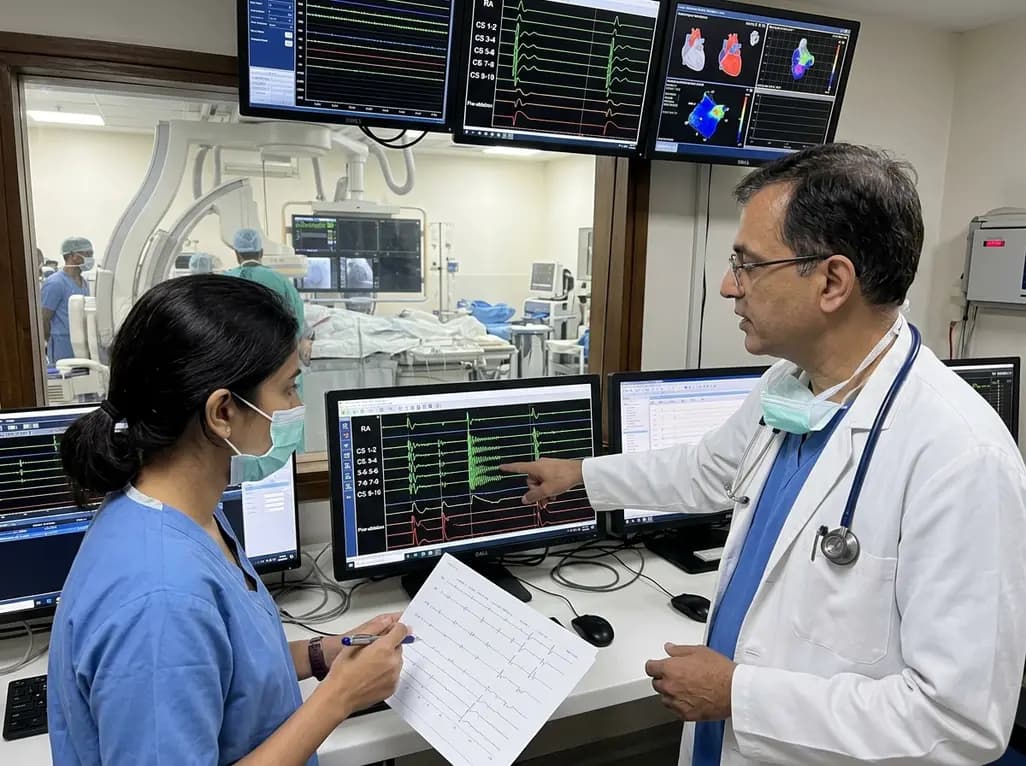
Radiofrequency catheter ablation of the cavotricuspid isthmus successfully terminates typical atrial flutter. This article reviews the mechanisms driving coronary sinus electrogram changes, wavefront activation pathways, and clinical criteria to verify bidirectional block during electrophysiology studies.
Today

A cross-sectional study demonstrates that increased BMI in adolescents significantly enhances mandibular length and alters salivary adipokines like adiponectin and resistin, providing novel insights into craniofacial growth and orthodontic planning.
Today
