.webp&w=384&q=75)

Loading, please wait...
Loading, please wait...
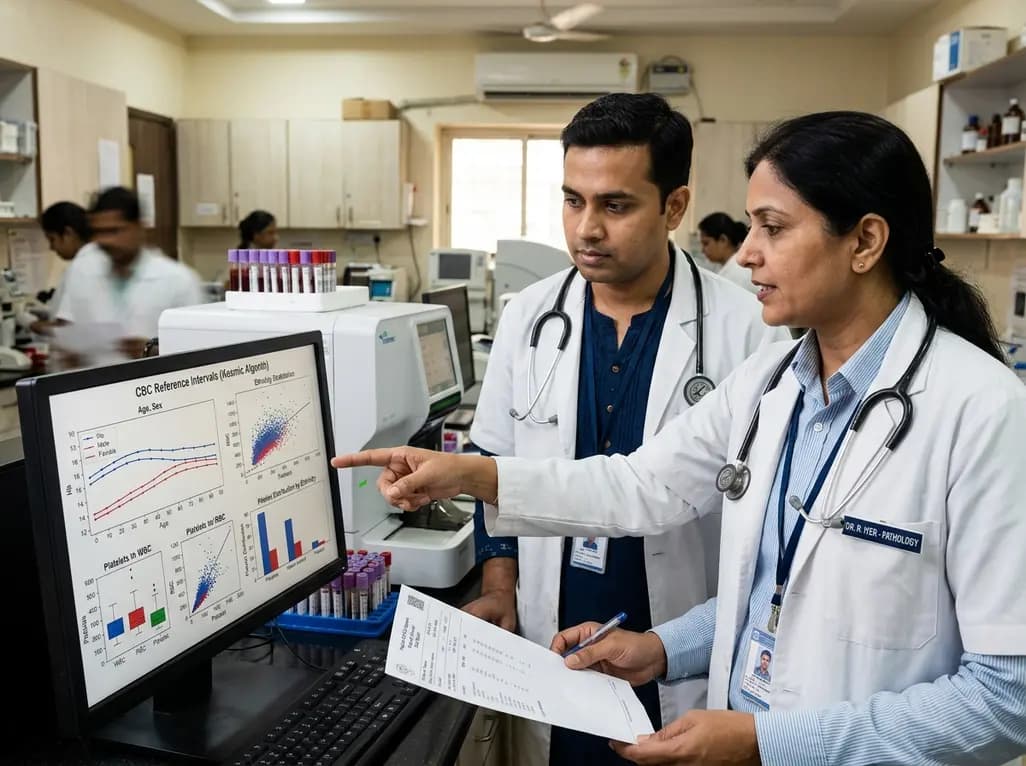
Accurate interpretation of routine diagnostic tests relies fundamentally on dependable population-specific laboratory norms. Clinicians routinely depend on CBC reference intervals to detect anemia, evaluate infection severity, and manage complex coagulation disorders. However, conventional reference intervals frequently fail to reflect regional, sexual, and ethnic biological variations present within diverse patient populations. Traditional direct methods require recruiting hundreds of healthy volunteers, which demands substantial financial, ethical, and logistical resources. Consequently, many clinical diagnostic centers still use uniform manufacturer ranges that may not accurately represent local patient demographics. To overcome these critical diagnostic challenges, modern laboratory medicine has embraced automated indirect computational methods, such as the Kosmic algorithm. By analyzing real-world electronic laboratory databases, these innovative algorithms enable the rapid establishment of personalized reference boundaries that significantly improve clinical decision-making.
Indirect methods for establishing biological reference ranges have gained tremendous momentum in clinical laboratory medicine. Traditional direct sampling methods require extensive health questionnaires, clinical examinations, and laboratory screenings to recruit disease-free reference cohorts. In contrast, indirect techniques extract test results directly from existing laboratory information systems, leveraging routine clinical data. The Kosmic algorithm specifically applies an advanced mathematical framework that models physiological test distributions from mixed real-world clinical datasets. It utilizes Box-Cox power transformations and evaluates truncated datasets using the Kolmogorov-Smirnov distance. As a result, the algorithm effectively isolates normal physiological distributions from pathological outliers and skewed diseased samples.
Furthermore, rigorous statistical outlier elimination remains an indispensable prerequisite before executing algorithmic modeling. Laboratory researchers typically utilize Tukey's fences and standard deviation ratio thresholds to filter extreme anomalies across distinct demographic subsets. This computational strategy enables laboratories to establish reliable normative intervals without subjecting healthy participants to invasive blood collections or unnecessary laboratory visits. Moreover, these automated indirect techniques significantly reduce laboratory operational expenses while generating massive, statistically robust sample sizes. Consequently, clinical laboratories can update their analytical thresholds regularly to reflect real-world patient dynamics and changes in diagnostic instrumentation.
Biological sex exerts a profound influence on red blood cell production and peripheral circulation kinetics. Recent investigative findings demonstrate that red blood cell counts and hemoglobin concentrations strictly require sex-specific stratification in routine clinical practice. Adult men consistently display significantly higher upper and lower reference limits for both parameters compared to adult women. This biological divergence primarily stems from the stimulatory effects of circulating androgens on renal erythropoietin secretion and bone marrow erythropoiesis. In addition, regular menstrual blood loss in reproductive-age females naturally influences systemic iron reserves and steady-state hemoglobin concentration.
Therefore, applying single, unstratified reference thresholds across sexes inevitably causes widespread diagnostic inaccuracies and clinical misinterpretations. For example, female patients might receive inappropriate investigations for polycythemia or secondary erythrocytosis if evaluated against male normative data. Conversely, clinicians might overlook mild anemia or incipient iron deficiency in male patients when using combined reference ranges. Modern laboratory information management systems must automatically incorporate sex-partitioned thresholds into automated reporting software. Consequently, practicing physicians can diagnose microcytic and macrocytic disorders earlier, initiate targeted nutritional or iron supplementation, and avoid superfluous diagnostic workups, thereby optimizing overall patient care.
Platelet production, peripheral turnover, and baseline counts demonstrate notable variation among distinct ethnic and racial populations. Recent laboratory analyses reveal that platelet counts require distinct stratification across different ethnic cohorts rather than uniform standard application. For example, investigative comparisons between Uyghur and Han Chinese populations demonstrated significantly higher upper limits among Uyghur individuals. Genetic variations, dietary habits, living altitudes, and baseline thrombopoietin dynamics collectively contribute to these measurable hematological differences across distinct ethnic communities.
Furthermore, recognizing ethnicity-specific platelet variations holds paramount importance for accurate clinical decision-making. When physicians evaluate patients using generic laboratory reference ranges, they risk misdiagnosing benign constitutional variations as thrombocytopenia or reactive thrombocytosis. In surgical planning, invasive procedures, and oncology management, an accurate baseline platelet threshold prevents unnecessary procedural delays or inappropriate platelet transfusions. Moreover, clinical hematologists managing multiethnic populations must understand that a normal thrombocyte count in one demographic might indicate mild thrombocytopenia in another. Therefore, healthcare systems must support customized, population-adjusted reference boundaries to maintain high diagnostic precision, enhance clinical risk stratification, and ensure optimal therapeutic safety.
In contrast to erythrocytic and thrombocytic parameters, total white blood cell counts demonstrate remarkable demographic stability. Algorithmic evaluations confirm that total leukocyte reference intervals do not require routine partitioning by biological sex or ethnic background in general adult cohorts. Although individual leukocyte sub-lineages like neutrophils and lymphocytes fluctuate during acute physiologic stress, overall circulating white cell concentrations remain uniform across baseline demographic groups.
However, clinical interpreters must still maintain diligent vigilance when assessing subtle white cell variations in routine practice. While total leukocyte count intervals remain stable across healthy populations, clinicians must interpret these counts alongside absolute differential counts and morphological findings. Furthermore, acute inflammatory triggers, subclinical infections, and metabolic shifts can transiently perturb leukocyte numbers without altering population-level baseline intervals. Therefore, indirect statistical models like Kosmic successfully isolate the baseline non-pathological leukocyte distribution by filtering out active acute-phase samples from hospital databases. This analytical consistency provides clinicians with a highly dependable baseline to identify true pathological leukocytosis, leukopenia, or occult bone marrow suppression across diverse patient cohorts.
The implementation of customized reference limits carries profound relevance for heterogeneous populations like India. The Indian subcontinent encompasses tremendous genetic diversity, distinct dietary habits, varied socioeconomic strata, and wide geographic topographies across different states. Currently, many Indian pathology laboratories still rely on standard reference ranges derived from Western textbooks or manufacturer package inserts. Consequently, subtle nutritional deficiencies, endemic hemoglobinopathies, and benign ethnic hematological traits frequently lead to diagnostic misclassification.
Moreover, establishing localized reference intervals through direct volunteer recruitment remains prohibitively expensive and logistically impractical for most Indian healthcare institutions. Therefore, adopting indirect data mining algorithms represents a pragmatic and cost-effective paradigm shift for Indian laboratory medicine. By harnessing archived laboratory information systems, tertiary hospitals and diagnostic chains can establish regional reference intervals for hemoglobin, platelets, and red cells. Furthermore, this approach aligns seamlessly with the ongoing digital transformation in Indian healthcare. As electronic health records expand, algorithmic reference intervals will empower Indian physicians to deliver personalized patient care, optimize anemia eradication strategies, and enhance diagnostic accuracy across diverse communities.
Direct methods require recruiting hundreds of strictly vetted healthy individuals, which is expensive, logistically complex, and ethically difficult in vulnerable groups. In contrast, the Kosmic algorithm uses indirect data mining to extract information from existing clinical laboratory databases. It applies sophisticated mathematical modeling to separate non-pathological distributions from pathological results. Consequently, laboratories obtain accurate, population-specific reference intervals rapidly without incurring high operational costs or imposing invasive tests on volunteers.
Hemoglobin and red blood cell counts differ fundamentally between sexes due to distinct physiological mechanisms. Circulating androgens in men stimulate erythropoietin production in the kidneys, leading to higher baseline erythrocyte counts and hemoglobin levels. In contrast, females experience cyclic menstrual blood loss and lower androgen levels. Therefore, unstratified reference ranges create significant diagnostic errors, leading to underdiagnosed anemia in men and overdiagnosed polycythemia in women during routine screening.
Indian diagnostic centers and hospital laboratories possess extensive repositories of archived routine test data. By implementing automated indirect algorithms like Kosmic, laboratory specialists can analyze these vast datasets while applying robust outlier filters. This methodology enables institutions to generate customized, region-specific reference intervals that reflect local genetic and dietary diversity. Consequently, Indian clinicians can interpret complete blood counts with higher diagnostic accuracy without relying on outdated Western manufacturer inserts.
Disclaimer: This content is for informational and educational purposes only. It is not intended to be a substitute for professional medical advice, diagnosis, or treatment. Always seek the advice of your physician or other qualified health provider with any questions you may have regarding a medical condition or clinical interpretation. Refer to the latest local and national guidelines for clinical practice.
References

Read summarized clinical updates, watch expert medical content, and earn CME certifications right from your smartphone.
Open your smartphone camera to scan and install.





New study reveals how indirect big data methods using the Kosmic algorithm establish personalized complete blood count reference intervals, highlighting necessary stratifications by sex for red cells and hemoglobin, and ethnicity for platelets.
4 weeks back

A systematic review of 41 preclinical studies reveals that baicalin dampens systemic inflammation, inhibits NF-κB and NLRP3 pathways, and improves organ preservation in sepsis models. However, substantial study heterogeneity and a complete lack of human clinical trials highlight the need for further translational research.
Today
Discover the crucial distinctions between mesonephric and mesonephric-like proliferations of the female genital tract. Learn the key histomorphologic, immunohistochemical, and molecular differences essential for accurate diagnosis and clinical management.
Today
A large UK Biobank study reveals that plasma proteomic signatures capture preclinical organ damage and improve multiorgan risk prediction across early CKM syndrome stages 0 to 2 beyond traditional PREVENT clinical models.
Today
A narrative review investigates whether the articularis genus muscle functions as an independent anatomical entity or blends with the vastus intermedius. We evaluate its morphology, role in retracting the suprapatellar bursa, and direct clinical significance in anterior knee pain and arthroplasty.
Today

A Bayesian multilevel meta-analysis reveals that aerobic training combined with moderate carbohydrate restriction modestly lowers HbA1c in type 2 diabetes. However, sparse data and very low certainty leave incremental benefits over exercise or diet alone unproven, highlighting the need for individualized care.
Today
