.webp&w=384&q=75)

Loading, please wait...
Loading, please wait...
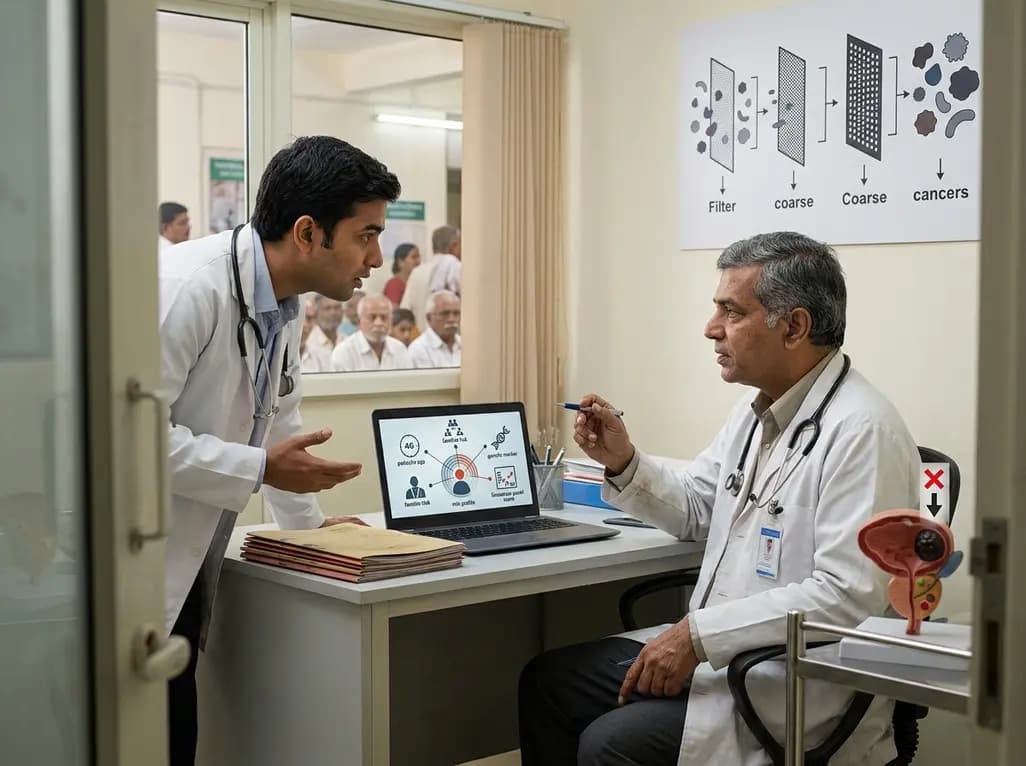
Prostate cancer screening remains a cornerstone of urological care, yet its implementation continues to spark debate among clinicians worldwide. Specifically, the European Randomised Study of Screening for Prostate Cancer (ERSPC) has provided pivotal data that shapes our current understanding of this intervention. The most recent findings emphasize the shifting dynamics of cancer detection rates over successive screening cycles. Therefore, evaluating ERSPC prostate cancer screening effectiveness requires a nuanced look at how different grades of cancer manifest during repeated testing rounds. This analysis is vital for doctors in India who must balance the risks of overdiagnosis with the benefits of early detection. Furthermore, understanding the longitudinal outcomes of such a massive trial helps in refining local clinical practices. Consequently, the study serves as a critical reference point for clinicians navigating the complexities of PSA-based screening. Ultimately, the goal is to improve survival while minimizing unnecessary interventions for low-risk disease.
Initially, the ERSPC trial was designed to evaluate the impact of PSA-based screening on mortality rates across multiple European centers. The trial centers focused on men aged 55 to 69 years to ensure a standardized demographic for analysis. Within this framework, researchers classified participants as either ever-attenders or non-attenders based on their participation in screening cycles. Furthermore, the methodology involved calculating Cancer Detection Rates (CDRs) categorized by age and specific center over three distinct cycles. By comparing these rates to incidence data from a control arm, the study aimed to illuminate the long-term trends of early diagnosis. Consequently, this large-scale longitudinal approach has allowed experts to distinguish between screen-detected cases and those diagnosed outside the established protocol. Moreover, the study provides a granular view of how age-specific variables influence the success of screening programs over two decades. Collectively, these efforts underscore the importance of consistent data collection in assessing the viability of population-wide interventions. Ultimately, the ERSPC results serve as a benchmark for refining clinical guidelines and improving diagnostic accuracy in diverse patient populations.
A critical aspect of the ERSPC findings involves the distinction between low-grade and high-grade cancer detection. Notably, the data consistently showed higher CDRs for low-grade cases compared to intermediate- and high-grade cases across all screening cycles. However, a significant trend emerged showing a decreasing detection rate for low-grade cancer over repeated screening rounds. This reduction suggests that initial screening cycles are highly effective at identifying prevalent indolent tumors, which leaves a different landscape for subsequent rounds. In contrast, the detection of high-grade cancers exhibited substantial variation between different centers. For instance, most centers reported a decrease in high-grade CDRs from the first to the second cycle, only to see an increase during the third cycle. Spanish centers, however, observed a steady increase in high-grade cancer detection with each successive round. Such variability highlights the complexity of tumor biology and the influence of local screening practices. Therefore, clinicians must recognize that a single screening result does not provide a complete picture of long-term risk. Additionally, these trends reinforce the need for ongoing surveillance to ensure that aggressive malignancies are not missed as low-grade detections decline.
One of the most concerning findings in the updated ERSPC analysis is the rising incidence of interval and non-attender cancers. Specifically, interval prostate cancers are those diagnosed in the screening arm but outside the formal protocol, often after a negative screening result. Consequently, the increasing prevalence of these cases suggests that uniform screening intervals may be losing their overall effectiveness. When men skip cycles or when aggressive tumors grow rapidly between tests, the screening program's ability to reduce mortality is compromised. Furthermore, the presence of non-attender cancers indicates a gap in patient engagement and participation over the long term. If men do not return for follow-up testing, the benefit of the initial screen is largely negated. Moreover, interval cancers often present at more advanced stages, which complicates treatment options and worsens outcomes. Thus, the data points to a diminishing return on fixed, one-size-fits-all schedules. To address this, healthcare systems must develop more robust methods for tracking participants and ensuring timely follow-up. Ultimately, reducing the burden of interval cancers is essential for maintaining the integrity of any national screening strategy.
These findings strongly support the transition toward personalized ERSPC prostate cancer screening approaches rather than traditional uniform schedules. Because of the variation in detection rates and the rise in interval cases, a tailored strategy based on individual risk factors is becoming necessary. Specifically, risk-based screening considers a patient's baseline PSA, family history, and genetic profile to determine the optimal interval between tests. Therefore, men at lower risk might safely undergo less frequent screening, while those at higher risk receive more intensive surveillance. Furthermore, such an approach helps to minimize the significant problem of overdiagnosis associated with low-grade cancers. By focusing resources on high-grade disease, clinicians can improve the benefit-to-harm ratio of the entire screening program. Additionally, personalized schedules may improve patient compliance by reducing the burden of unnecessary testing on low-risk individuals. Consequently, the medical community is moving away from age-based cutoffs alone in favor of a more dynamic and individualized model. This shift not only enhances the efficiency of healthcare delivery but also ensures that patients receive care that is appropriate for their specific risk level.
For the medical community in India, these results provide essential guidance on managing a growing burden of prostate malignancies. Although Western screening protocols offer a helpful baseline, the diverse genetic and socio-economic landscape in India necessitates a customized application of these findings. Specifically, the variation in high-grade detection seen in the ERSPC data suggests that local population characteristics can significantly alter screening outcomes. Furthermore, the challenge of maintaining long-term participation is particularly relevant in the Indian context, where follow-up can be hindered by logistical barriers. Therefore, implementing personalized screening could help optimize limited resources by focusing on high-risk cohorts. Moreover, the decrease in low-grade detection rates reinforces the importance of avoiding aggressive treatment for indolent disease, a practice that is gaining traction through active surveillance programs. By adopting these nuanced strategies, Indian urologists can better navigate the complexities of early detection while minimizing the socioeconomic impact of overtreatment. Ultimately, the lessons learned from the ERSPC study empower local practitioners to advocate for smarter screening policies. Consequently, these improvements will likely lead to better survival rates and a higher quality of life for men across the country.
Screen-detected cancers are identified through protocolized PSA testing, whereas interval cancers are diagnosed after a negative screen or between scheduled visits. Typically, interval cancers exhibit more aggressive behavior and present at more advanced stages compared to those found during regular cycles. Consequently, the rise in interval cases suggests that current fixed screening intervals may not be sufficient for high-risk individuals. Thus, identifying these cases is crucial for risk assessment.
The ERSPC data revealed that high-grade cancer detection rates are not uniform and can fluctuate significantly between screening rounds. In many centers, rates initially dropped during the second cycle but increased again by the third. This variability is often attributed to differences in tumor biology and local diagnostic practices across centers. Therefore, clinicians should not rely on a single negative result, as the risk of developing aggressive disease can change over time.
Personalized screening shifts the focus from rigid, age-based schedules to a dynamic model that accounts for an individual’s specific risk profile. This strategy uses baseline PSA levels and other clinical factors to determine how often a patient should be tested. By tailoring the intervals, doctors can improve the detection of lethal, high-grade cancers while reducing the overdiagnosis of indolent tumors. Ultimately, this approach maximizes the mortality benefits of screening.
Disclaimer: This content is for informational and educational purposes only and does not constitute professional medical advice, diagnosis, or treatment. Always seek the advice of your physician or other qualified health provider with any questions you may have regarding a medical condition. Refer to the latest local and national guidelines for clinical practice.
References
Pasanen N et al. Cancer detection in the European Randomised Study of Screening for Prostate Cancer (ERSPC). BJU Int. 2026 Jul 04. doi: 10.1111/bju.70380. PMID: 42400346.
Roobol MJ et al. European Study of Prostate Cancer Screening - 23-Year Follow-up. N Engl J Med. 2025;393(17):1669-1680.
Lippi G. Prostate cancer screening: revisiting evidence after 23 years of ERSPC follow-up. J Clin Med. 2026;15(3):442.

Read summarized clinical updates, watch expert medical content, and earn CME certifications right from your smartphone.
Open your smartphone camera to scan and install.





The ERSPC study provides a comprehensive analysis of repeated screening for prostate cancer, highlighting a decrease in low-grade cancer detection and the critical need for personalized approaches to maintain screening effectiveness and patient participation.
3 months ago
Following Nigeria's first recorded Ebola case linked to regional travel, the Africa CDC has convened an emergency ministerial summit. This alert underscores critical clinical priorities for healthcare professionals, including differentiating early viral infection from malaria, implementing barrier nursing, and triage.
Today

Leucine Rich Bio has introduced South Asia's first comprehensive vaginal microbiome test, BugSpeaks. By profiling microbial dysbiosis, pathogens, and antimicrobial resistance, this next-generation diagnostic platform provides clinicians with deeper insights into recurrent infections, fertility, and reproductive health.
Today

Review how tailored exercise programs benefit frail older patients with heart failure. Explore pathophysiological mechanisms, individualized training prescriptions, and strategies to overcome adherence barriers in clinical practice.
Today

This comparative study evaluates posterior labral tears with and without glenohumeral instability, highlighting distinct demographic patterns, MRI underestimation in stable shoulders, and successful arthroscopic repair outcomes.
Today

A clinical study demonstrates that early intervention with tocilizumab, either as monotherapy or bridged with corticosteroids, achieves significant proptosis reduction and resolves active inflammation in treatment-naive thyroid eye disease.
Today
