.webp&w=384&q=75)

Loading, please wait...
Loading, please wait...
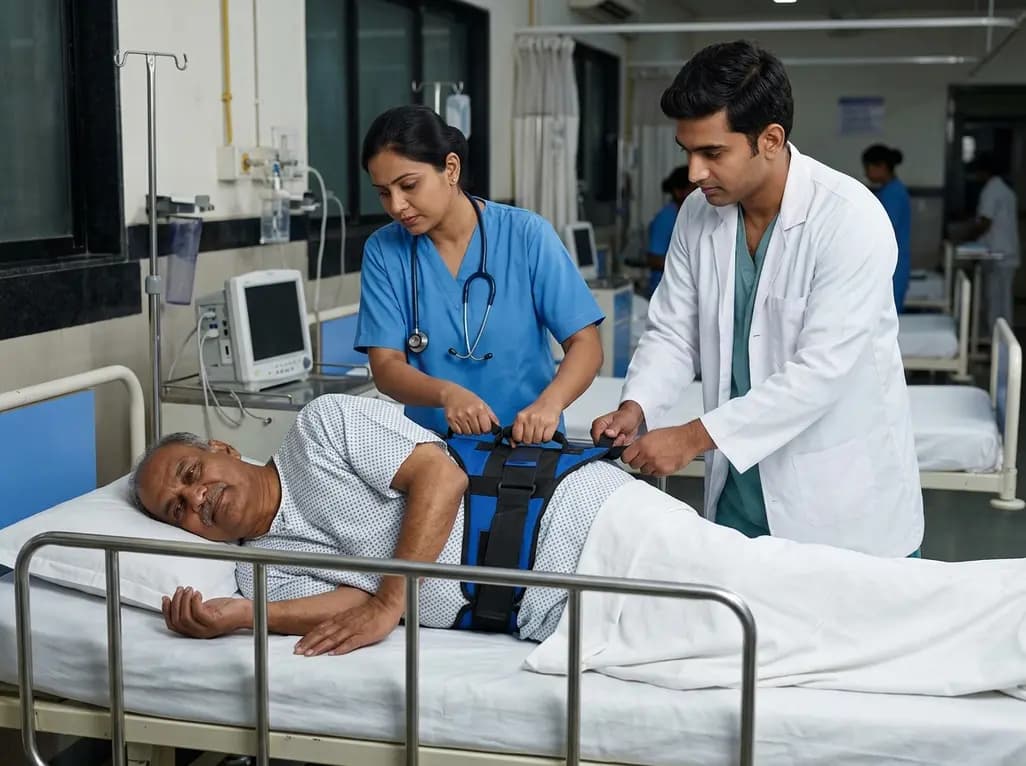
An ergonomic belt provides specialized grip points that redistribute the force required to turn a patient. This design reduces the peak contact pressure on the worker's hands and improves overall biomechanical efficiency.
Yes, but the belt remains effective across all categories. While the percentage of pressure reduction is highest for underweight patients (26%), it still provides a significant 19.3% reduction for obese class I patients.
By lowering both hand contact pressure and perceived exertion, these belts reduce the cumulative physical load on healthcare workers. Lowering this load is a primary strategy for preventing work-related musculoskeletal disorders.
Disclaimer: This content is for informational and educational purposes only. It does not constitute professional medical advice, diagnosis, or treatment. Always seek the advice of your physician or other qualified health provider with any questions you may have regarding a medical condition. Refer to the latest local and national guidelines for clinical practice.
References
Koubassi R et al. Biomechanical effects of an ergonomic belt on grip contact pressure during patient turning across BMI categories: A simulated patient repeated-measures study. Work. 2026 Jun 02. doi: 10.1177/10519815261455862. PMID: 42228389.
Azizpour Y et al. Determining the Efficiency of Ergonomic Belt During Patient Handling and its Effect on Reducing Musculoskeletal Disorders in Nurses. Journal of Clinical and Diagnostic Research. 2017. doi: 10.7860/JCDR/2017/29322.10642.
Richardson A et al. Effectiveness of Safe Patient Handling Equipment and Techniques: A Review of Biomechanical Studies. Workplace Health & Safety. 2019. doi: 10.1177/2165079918812480.

Read summarized clinical updates, watch expert medical content, and earn CME certifications right from your smartphone.
Open your smartphone camera to scan and install.





A study shows ergonomic belts reduce grip pressure by up to 26% during patient turning across all BMI categories, lowering the risk of musculoskeletal disor...
4 months ago

India is advancing preventive healthcare by integrating genomics, artificial intelligence, and quantum technologies. With the SANGAM programme sequencing one million Indian genomes, clinicians can unlock personalized therapies, detect cardiometabolic risks early, and curb the burden of diabetes and heart disease.
Today

Occult maternal malignancy accounts for 3.82% of persistent unreportable NIPT results with genomic noise. Multiple chromosomal aberrations, notably on chromosome 18, warrant thorough oncological evaluation and whole-body MRI to ensure timely maternal diagnosis while preserving fetal care.
Today

This article reviews the forensic and clinical complexities of acute myocarditis arising on left ventricular hypertrophy in children, highlighting early diagnostic red flags and multidisciplinary postmortem autopsy protocols.
Today

A randomized controlled trial demonstrates that an eight-week dual-task training intervention significantly improves static and dynamic postural control over standard balance exercises in individuals with chronic ankle instability, addressing critical neurocognitive deficits during athletic and daily activities.
Today

A retrospective cohort study of 7,716 ICU patients from the MIMIC-IV database demonstrates that Gradient Boosting Decision Trees significantly outperform traditional SOFA scores in predicting in-hospital mortality among patients with sepsis and diabetes, with SHAP analysis providing clinical interpretability.
Today
