.webp&w=384&q=75)

Loading, please wait...
Loading, please wait...
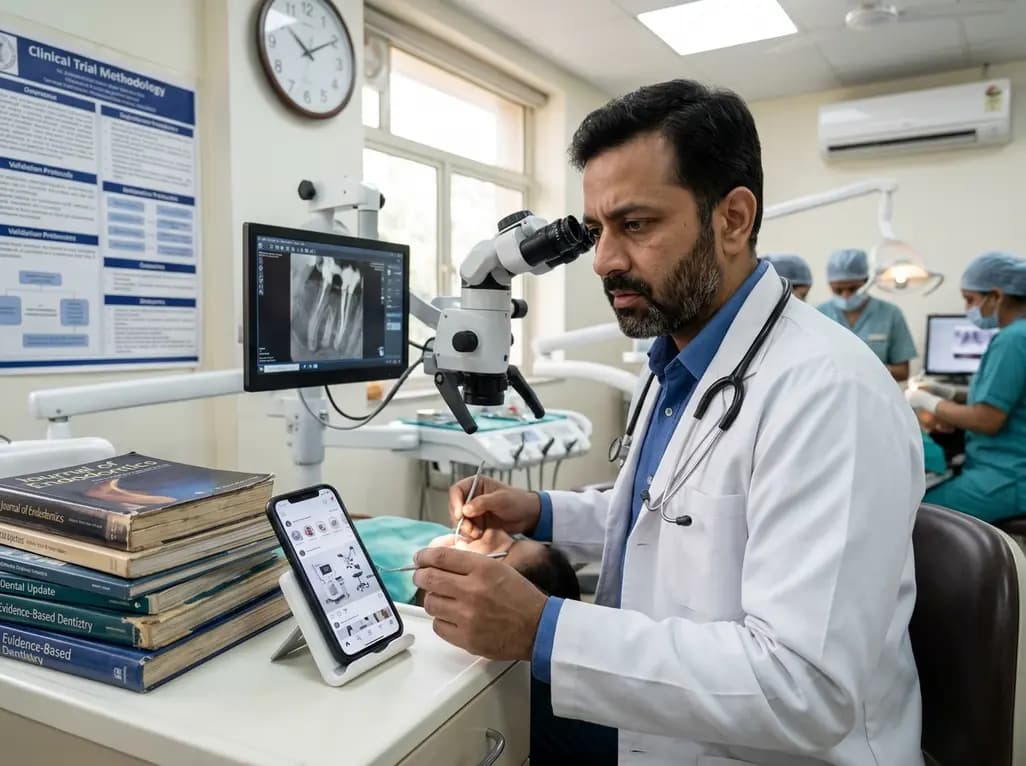
The endodontic innovation validation gap represents a growing divergence between the rapid introduction of new dental technologies and the rigorous scientific research required to prove their efficacy. In recent years, endodontics has witnessed a staggering acceleration in the development of new materials, such as advanced bioceramics and nickel-titanium rotary systems. Consequently, the traditional timeline for clinical validation, which often requires years of longitudinal data, is being bypassed in favor of immediate market entry. This trend creates a precarious situation where clinicians adopt tools before they fully understand their long-term biological consequences. Furthermore, the reliance on preliminary data rather than robust empirical evidence threatens to undermine the core tenets of evidence-based practice. While progress is essential for the evolution of the specialty, the current pace of adoption often prioritizes novelty over proven clinical safety. Notably, this gap is not merely a theoretical concern; it has direct implications for the predictability of root canal treatments and the overall standard of care in modern dentistry. Therefore, practitioners must recognize that the speed of innovation does not always correlate with an improvement in treatment success rates.
Modern digital platforms have significantly altered how clinical information is disseminated and consumed within the dental community. Platforms like Instagram and LinkedIn now serve as primary conduits for showcasing "groundbreaking" techniques, often before they appear in peer-reviewed journals. This shift has facilitated a culture where visual appeal and anecdotal success stories carry more weight than statistical significance. Moreover, industry-sponsored influencers frequently promote new devices with high-production videos, creating a sense of urgency for clinicians to upgrade their armamentarium. However, these digital endorsements often lack a critical discussion regarding the limitations or potential failures of the promoted technology. Consequently, many dentists feel pressured to adopt the latest trends to remain competitive or perceived as "cutting-edge" by their peers and patients. This commercial pressure effectively widens the endodontic innovation validation gap by encouraging the premature implementation of unverified protocols. Additionally, the lack of traditional gatekeepers on social media means that flawed clinical advice can spread globally within hours. Practitioners must therefore approach digital content with a high degree of professional reflexivity and skepticism, ensuring they prioritize biological principles over viral trends.
Adopting new technologies without adequate validation poses significant risks to patient safety and long-term treatment outcomes. For instance, the transition to minimally invasive endodontic access cavities was initially hailed as a revolutionary way to preserve tooth structure. Nevertheless, subsequent research suggested that overly restricted access might compromise the effectiveness of irrigation and disinfection protocols. This scenario exemplifies how an innovation can be adopted based on a logical premise—preserving dentin—while neglecting the biological imperative of eradicating microbial biofilms. Furthermore, the use of novel obturation materials that lack long-term clinical data may lead to unforeseen complications, such as material instability or inflammatory responses in the periapical tissues. Consequently, when clinicians participate in the uncritical adoption of new tools, they essentially turn their patient population into an experimental cohort. Notably, the legal and ethical accountability for any adverse outcomes rests solely on the practitioner, regardless of the marketing claims made by manufacturers. Therefore, it is vital to balance the desire for innovation with a commitment to established biological standards. Practitioners must ask whether a new tool truly solves an existing clinical problem or simply offers a faster, albeit less proven, alternative.
To address the endodontic innovation validation gap, the profession requires a more robust framework of anticipatory governance. Traditional regulatory models often react to problems only after they have manifested in widespread clinical practice. In contrast, anticipatory governance involves the proactive assessment of emerging technologies, considering their ethical, social, and biological impacts before they become standard care. This approach requires closer collaboration between academic institutions, regulatory bodies like the Dental Council of India, and industry leaders. Furthermore, dental schools must evolve their curricula to teach students how to critically appraise sales-driven data and identify potential biases in industry-funded research. By fostering a culture of professional reflexivity, the dental community can better navigate the complexities of modern innovation. Moreover, regulatory frameworks should demand more transparent reporting of clinical trials and mandate longer follow-up periods for high-risk dental materials. Consequently, such measures would ensure that advancements in the field are founded on a bedrock of robust scientific evidence rather than commercial enthusiasm. Strengthening these governance structures is essential to maintain the public's trust in the dental profession's commitment to safety and efficacy.
Individual practitioners play a pivotal role in closing the endodontic innovation validation gap by adhering to the hierarchy of evidence. While case reports and anecdotal evidence are useful for sparking discussion, they reside at the lowest level of scientific reliability. High-level evidence, such as randomized controlled trials and systematic reviews, remains the gold standard for clinical decision-making. However, many contemporary innovations enter the market with only laboratory or in-vitro data supporting their use. Notably, success in a bench-top study does not automatically translate to success in the complex environment of the human oral cavity. Therefore, clinicians must develop the skills to distinguish between biological plausibility and clinical proof. Furthermore, they should actively seek out independent research that is not funded by the manufacturer of the tool in question. Additionally, participating in professional study clubs that focus on critical appraisal can help dentists stay informed without falling prey to marketing hype. Ultimately, the responsibility of the clinician is to ensure that every treatment decision is grounded in a deep understanding of endodontic biology and proven clinical protocols. By prioritizing validation over pure speed, dentists can provide care that is both innovative and ethically sound.
In conclusion, the future of endodontics depends on our ability to integrate innovation with responsibility. While we should celebrate the technological advancements that make root canal therapy more efficient and comfortable, we cannot ignore the inherent dangers of the endodontic innovation validation gap. Moving forward, the emphasis must shift from the "newness" of a technology to its long-term biological accountability. This transition requires a collective effort from the entire endodontic community, including researchers who must prioritize longitudinal studies and clinicians who must demand higher standards of proof. Furthermore, the industry must be held to stricter standards regarding the transparency of their marketing claims and the quality of their clinical data. By adopting an approach of responsible innovation, we can ensure that the specialty continues to advance without compromising the safety of our patients. Consequently, this will strengthen the professional integrity of endodontics and preserve the trust that patients place in our hands. The challenge lies not in stopping innovation, but in ensuring that the speed of our validation finally catches up to the speed of our creativity. Only then can we truly say that we are practicing evidence-based dentistry in its highest form.
The rapid influx of new endodontic tools often creates a dilemma for clinicians regarding when to switch from established protocols. If a practitioner adopts a new system based solely on marketing or social media popularity, they risk encountering complications that were not documented in preliminary studies. Daily decisions should therefore be guided by a thorough search for independent, peer-reviewed evidence and a careful assessment of how the new technology aligns with biological principles.
Social media acts as an accelerator, allowing unvalidated techniques to reach thousands of practitioners instantly. Unlike traditional journals, these platforms lack a formal peer-review process, meaning that visual success often masks underlying procedural flaws or a lack of long-term follow-up. This creates a skewed perception of reality where clinical "trends" are prioritized over scientific rigor, significantly widening the gap between the introduction of an idea and its empirical validation.
Responsible innovation involves a disciplined approach to incorporating new technology. Clinicians should first evaluate if a new product addresses a specific clinical need that current methods cannot solve. They must then seek out high-level evidence, such as systematic reviews or multi-center trials, rather than relying on manufacturer-provided brochures. Finally, the practitioner should maintain meticulous records of outcomes when using new materials to identify any trends that may signal the need for protocol adjustments.
Disclaimer: This content is for informational and educational purposes only. It does not constitute medical advice or establish a doctor-patient relationship. Clinicians should use their professional judgment and cross-reference multiple scientific sources before adopting new technologies. Refer to the latest local and national guidelines for clinical practice.
References
Turky M et al. The speed of innovation versus the speed of validation: A growing governance gap in contemporary endodontics. Eur J Oral Sci. 2026 Jul 03. doi: 10.1111/eos.70119. PMID: 42396709.
Turky M, Dummer PMH. Innovation vs indication: Reassessing case selection in contemporary endodontics. J Am Dent Assoc. 2026 Jun 25. doi: 10.1016/j.adaj.2026.05.013. PMID: 42347730.
Turky M, Dummer PMH. Teaching Responsible Innovation in Endodontics: A Pedagogical Framework for Long-Term Clinical Success. Aust Endod J. 2026 Jun 12. doi: 10.1111/aej.70097. PMID: 42286443.
"
Read summarized clinical updates, watch expert medical content, and earn CME certifications right from your smartphone.
Open your smartphone camera to scan and install.





The rapid pace of innovation in endodontics is outpacing scientific validation. This article explores the 'speed of innovation versus speed of validation gap,' highlighting concerns for patient safety, the influence of social media, and the need for anticipatory governance in contemporary dental practice.
3 months ago

Novel diimide and hydrazone scaffolds, particularly compound #C4, synergistically reactivate latent HIV-1 when combined with JQ1 or PKC activators. Demonstrating donor-matched proviral transcription ex vivo and non-canonical signaling, these findings advance shock and kill strategies toward reservoir eradication.
Today

A cross-sectional study reveals that maternal RSV vaccination coverage reached only 43.7% in Argentina, with maternal vaccine knowledge being the sole independent predictor of uptake. Clinicians play a crucial role in eliminating informational and structural barriers to optimize infant health.
Today

Review how tailored exercise programs benefit frail older patients with heart failure. Explore pathophysiological mechanisms, individualized training prescriptions, and strategies to overcome adherence barriers in clinical practice.
Yesterday

This comparative study evaluates posterior labral tears with and without glenohumeral instability, highlighting distinct demographic patterns, MRI underestimation in stable shoulders, and successful arthroscopic repair outcomes.
Yesterday

A clinical study demonstrates that early intervention with tocilizumab, either as monotherapy or bridged with corticosteroids, achieves significant proptosis reduction and resolves active inflammation in treatment-naive thyroid eye disease.
Yesterday
