

Loading, please wait...
Loading, please wait...

Modern healthcare delivery requires rapid point-of-care access to reliable clinical evidence. In primary care practice, clinicians constantly utilize digital platforms to verify prescribing guidelines, clarify diagnostic criteria, and ensure patient safety. Recently, researchers investigated how general practice trainees interact with electronic information resources during live patient encounters. Trainees often face unique cognitive challenges because they must synthesize medical evidence while maintaining patient communication. Consequently, understanding how emerging clinicians utilize these digital systems provides crucial insights for primary care education.
Primary care clinicians handle complex, undifferentiated presentations across diverse patient groups every day. Therefore, doctors must access accurate therapeutic evidence within moments to make safe clinical decisions. In this context, electronic information resources have largely replaced traditional print formularies and bulky physical textbooks. Digital platforms now offer rapid drug dosing calculators, interaction checkers, and distilled guideline summaries directly on desktop monitors.
Furthermore, medical trainees rely on these digital repositories to validate diagnostic reasoning and bridge knowledge gaps. Junior doctors frequently encounter scenarios where local management protocols dictate specific empirical treatment pathways. Under these circumstances, accessible electronic tools serve as cognitive safety nets. However, the sheer volume of available medical information can quickly overwhelm early-career practitioners. When trainees face ambiguous clinical questions, they must rapidly evaluate the authority and relevance of digital sources. As a result, primary care trainees must balance thorough evidence gathering against the ticking clock of busy community clinics.
Time constraints represent one of the most formidable barriers to evidence retrieval during outpatient appointments. In community clinics, standard consultation slots rarely exceed ten to fifteen minutes. Consequently, trainees cannot conduct comprehensive literature searches or analyze primary trials while patients wait. Instead, clinicians must adopt pragmatic information-seeking strategies to identify actionable advice within seconds.
Moreover, perceived patient perception significantly shapes how trainees interact with computer screens. Many trainees worry that searching for information during an appointment might diminish patient trust. For instance, clinicians often fear that patients may view online searches as a sign of clinical uncertainty. Therefore, trainees frequently navigate digital platforms discreetly or delay queries until the physical examination begins.
In addition, clinicians must maintain empathetic interpersonal communication while scanning complex electronic interfaces. When digital tools feature clumsy navigation paths, they disrupt conversational flow. Thus, trainees frequently choose concise, familiar summaries over comprehensive but cumbersome evidence databases. Ultimately, usability and speed often outweigh depth during live primary care consultations.
To analyze real-time search behaviors, researchers utilized a novel combination of semistructured interviews and screen-recorded think-aloud protocols. Specifically, the study evaluated twenty general practice trainees during their final two years of vocational training. While navigating simulated clinical vignettes, participants vocalized internal thought processes and demonstrated actual desktop habits.
Interestingly, screen-capture recordings revealed consistent, stepped approaches to information retrieval among participants. Trainees universally bypassed primary literature databases like PubMed in favor of curated point-of-care tools. For example, participants regularly opened familiar therapeutic guidelines to confirm first-line antimicrobial selections and pediatric dosage calculations. Similarly, trainees used dedicated pharmacopeia tools to screen for adverse drug reactions and contraindications.
Furthermore, search navigation patterns demonstrated a pronounced reliance on bookmarked web pages and embedded search functions. Trainees rarely ventured into complex secondary resources unless primary portals failed to yield clear recommendations. When initial searches proved unsuccessful, participants experienced notable cognitive fatigue. As a result, trainees repeatedly emphasized that direct guidance provided superior clinical utility compared to lengthy reviews.
Although electronic tools offer immediate answers, rapid digital searches introduce distinct clinical vulnerabilities. During think-aloud task sessions, researchers observed that trainees occasionally made errors in information synthesis and judgment. For example, some clinicians misread contraindication tables or overlooked essential demographic caveats when skimming dense digital text. In fast-paced settings, superficial reading often leads clinicians to extract isolated facts while missing crucial clinical context.
Additionally, search friction quickly generates cognitive overload among developing clinicians. When digital repositories present ambiguous guidance or conflicting therapeutic choices, trainees must expend valuable mental energy resolving discrepancies. Consequently, search frustration can lead clinicians to abandon queries prematurely or rely on incomplete recollection. In complex cases involving multimorbid patients, scattered information fragments across multiple websites significantly heighten the risk of prescribing errors.
Furthermore, the pressure to maintain consultation pace often discourages trainees from verifying underlying research quality. Instead, clinicians place implicit trust in third-party summaries without scrutinizing methodology. Therefore, medical educators must recognize that digital access alone does not guarantee correct evidence translation.
The findings from this qualitative investigation carry profound implications for medical training programs and digital developers. First, educational curricula must adapt to teach practical point-of-care search strategies. Traditional evidence-based medicine instruction frequently focuses on epidemiological statistics and formal research methodology. However, postgraduate trainees also require explicit coaching on rapid search syntax, source triage, and patient-centered screen communication.
Moreover, software developers must redesign point-of-care platforms to reduce cognitive friction for busy practitioners. For instance, digital resources should prioritize modular layouts, high-contrast decision algorithms, and standardized prescribing summaries. Integrating reference tools directly within electronic medical records can eliminate redundant searches and improve patient safety.
Additionally, clinical supervisors should openly normalize point-of-care information seeking during consultations. When senior doctors model transparent digital searches, trainees learn how to communicate evidence gathering positively to their patients. For example, clinicians can explain that checking guidelines ensures optimal, up-to-date therapy. Ultimately, transforming electronic information resources into integrated clinical partners enhances diagnostic precision while supporting compassionate primary care.
General practice trainees operate under intense consultation time limits, typically managing complex patient issues within brief appointments. Consequently, trainees require immediate, actionable clinical answers rather than dense research methodology. Condensed clinical summaries provide clear drug dosages, contraindications, and stepped diagnostic protocols without demanding extensive literature appraisal. Therefore, trainees prioritize accessible, practical digital resources that directly support real-time clinical decisions while preserving valuable face-to-face communication during busy outpatient clinics.
Screen use during consultations can create interpersonal friction if clinicians focus excessively on computer monitors instead of patient dialogue. Specifically, patients may feel ignored or doubt a doctor's clinical competence if digital searches appear hesitant. However, when clinicians explain why they are consulting electronic guidelines, patient trust usually increases. Involving patients directly in the search process transforms electronic information resources into collaborative educational tools, thereby reinforcing transparency and therapeutic rapport.
Medical educators should incorporate simulated point-of-care digital search training into standard vocational curricula. Furthermore, clinical supervisors must teach effective search phrasing, rapid guideline appraisal, and error recognition within timed consultation scenarios. Emphasizing communication techniques alongside technical skills helps junior doctors maintain patient rapport during digital inquiries. By guiding trainees through realistic case scenarios, faculty can instill safe digital habits, reduce information synthesis errors, and optimize real-time evidence-based practice.
Disclaimer: This content is for informational and educational purposes only... Refer to the latest local and national guidelines for clinical practice.
References

Read summarized clinical updates, watch expert medical content, and earn CME certifications right from your smartphone.
Open your smartphone camera to scan and install.





A qualitative study explores how primary care trainees use electronic clinical information resources during consultations. Trainees balance rapid decision-making against complex evidence synthesis, highlighting the need for intuitive, point-of-care digital tools tailored to outpatient primary care workflows.
Today

A scoping review of 130 studies reveals that chronic preoperative benzodiazepine use is linked to increased postoperative opioid needs and delirium. Despite widespread use, inconsistent definitions highlight the need for standardized perioperative medication optimization protocols.
Today

An intracranial EWSR1::CREM fusion sarcoma in a 31-year-old female manifested as a paraneoplastic inflammatory syndrome with anemia and secondary infertility. The dural mass mimicked meningioma, but gross-total resection resolved her systemic inflammation and restored natural fertility within one month.
Today

The DOMINO study protocol presents a multidisciplinary implementation mapping approach to overcome provider, patient, and payer barriers to antiobesity medications, offering vital insights for Indian clinicians managing the growing diabesity burden.
Today

An age-matched cross-sectional study reveals that lower muscle quality and impaired lower-extremity function strongly correlate with an increased fear of falling in older women, highlighting the necessity of targeted resistance training and balance interventions in geriatric care.
Today
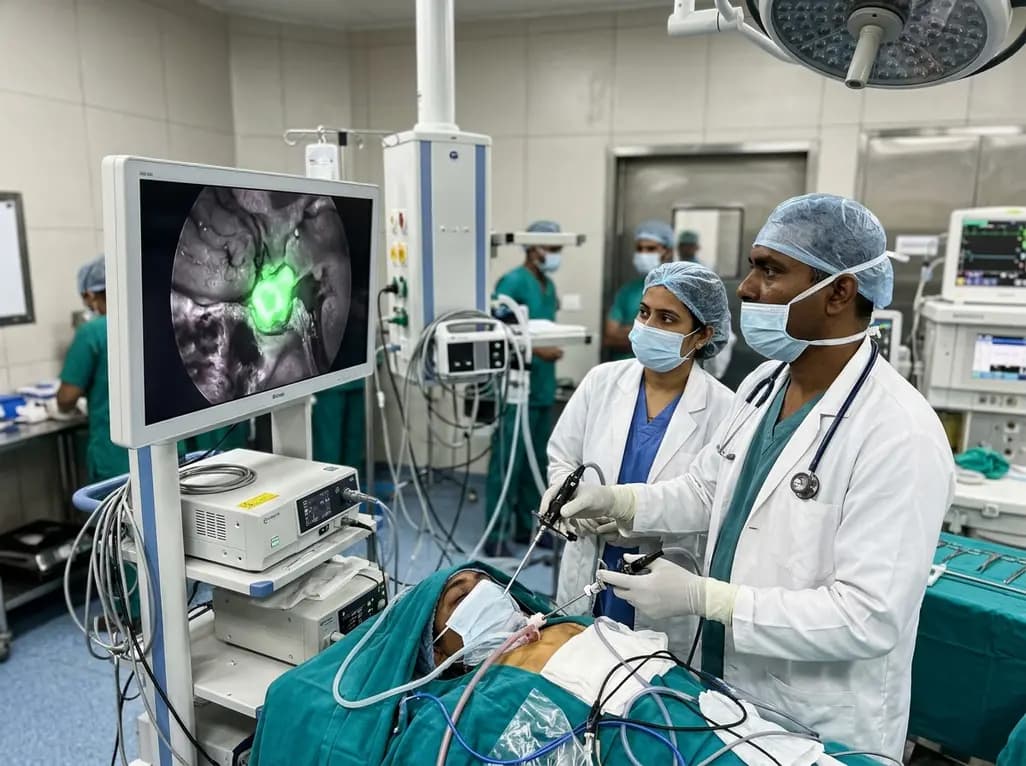
Near-infrared autofluorescence provides real-time label-free optical guidance during endoscopic transsphenoidal pituitary surgery. By highlighting stark signal contrasts between normal pituitary gland and adenomas, this technique aids gross-total tumor resection while safeguarding critical endocrine function.
Today
