.webp&w=384&q=75)

Loading, please wait...
Loading, please wait...

Suicide remains one of the most pressing global public health challenges, placing an immense burden on psychiatric care systems worldwide. Traditional suicide risk assessment relies almost entirely on retrospective questionnaires administered during infrequent outpatient visits. However, these conventional tools suffer from recall bias and fail to capture acute, dynamic fluctuations in patient distress. Clinicians often find that a patient who appears stable in the clinic may experience intense crises within hours of leaving the consultation room. To overcome these limitations, investigators increasingly utilize digital health tools to track mental states in real time. A landmark 6-month prospective investigation in Madrid, Spain, offers transformative insights into the temporal relationship between negative emotional states and suicidal thoughts.
Historically, clinicians evaluated psychiatric risk by asking patients to summarize emotions over previous weeks or months. Consequently, subtle warning signs were often overlooked because emotional states fluctuate rapidly within hours. To address this clinical challenge, researchers deployed smartphone-based ecological momentary assessment among high-risk psychiatric outpatients. The study recruited ninety-nine individuals receiving specialized care who completed daily smartphone prompts over six months. Furthermore, the investigators addressed survey fatigue by employing a smart sampling strategy. Instead of burdening patients with lengthy batteries, the digital platform randomly selected two to four questions daily from a pool of thirty-four validated items.
This micro-sampling approach achieved extraordinary long-term engagement, yielding nearly fourteen thousand individual observations across the follow-up period. Moreover, daily prompts captured critical clinical dimensions, including active suicidal thoughts, nonsuicidal self-injury, affective distress, interpersonal conflicts, appetite changes, and sleep disruptions. Therefore, the dataset offers an unprecedented window into daily life variations outside hospital settings. Clinicians can finally analyze how momentary shifts in emotional distress trigger sudden spikes in self-destructive urges.
The investigation revealed that negative affect serves as the most immediate and potent driver of momentary suicidal ideation. Statistical analyses showed a pronounced, statistically significant association between daily spikes in affective distress and the emergence of suicidal thinking. When patients reported feeling overwhelmed by sadness, anger, anxiety, or despair, their risk of experiencing self-harm urges escalated rapidly on that same day. Interestingly, while interpersonal friction, severe sleep disruption, and appetite disturbances correlated with psychological distress, negative emotional valence demonstrated the strongest statistical effect.
Additionally, the researchers observed striking within-person variability across all clinical domains. Rather than following a predictable downward or upward linear slope, patients moved through erratic cycles of psychological pain and temporary stabilization. This observation explains why static risk stratification tools often fail to predict acute suicidal crises. A patient may present without suicidal intention on Monday morning, yet an acute surge in negative affect on Tuesday evening can precipitate severe risk. Consequently, mental health professionals must shift their focus from static categorical labels toward monitoring dynamic, short-term affective fluctuations.
Beyond momentary assessments, the researchers investigated whether baseline clinical measures could predict long-term patterns of suicidal thinking. At the beginning of the study, participants completed standardized evaluations, including the Columbia Suicide Severity Rating Scale and the Inventory of Depressive Symptomatology. Moreover, clinicians quantified subjective psychological and physical pain using validated visual analog scales. The findings demonstrated that elevated baseline psychological pain and severe depressive symptoms strongly correlated with higher overall mean levels of negative affect throughout the six months.
Nevertheless, baseline scores showed limited ability to predict the acute daily volatility of suicidal ideation. Even patients who reported lower baseline depression occasionally experienced intense, transient suicidal episodes during periods of emotional upheaval. Therefore, comprehensive suicide risk assessment must integrate both baseline vulnerability metrics and ongoing dynamic monitoring. While standard baseline questionnaires successfully identify individuals with persistent emotional vulnerability, real-time digital monitoring captures the acute triggers that precede suicidal actions. Integrating these two distinct diagnostic modalities provides clinicians with a far more accurate and nuanced clinical picture.
These empirical findings carry profound implications for the routine management of high-risk psychiatric outpatients. First and foremost, psychiatrists and clinical psychologists must recognize that emotional volatility itself represents an independent danger signal. Traditional care models rely heavily on scheduled, monthly appointments that leave critical care gaps between visits. Consequently, clinicians remain unaware when an outpatient enters an acute emotional spiral at home. Implementing lightweight smartphone monitoring bridges this dangerous communication void by providing continuous visibility into the patient's daily emotional trajectory.
Furthermore, dynamic monitoring allows healthcare teams to transition from reactive crisis intervention to proactive preventive management. For instance, when automated algorithms detect three consecutive days of worsening negative affect, the clinical team can schedule an interim telehealth consultation. Alternatively, the smartphone system can trigger automated safety-planning prompts directly to the patient's device, reminding them of personalized coping strategies. Therefore, remote affective monitoring functions as a digital safety net, empowering patients to manage overwhelming emotions before self-destructive impulses become unmanageable. This approach directly reduces unnecessary emergency room visits and prevents psychiatric hospitalizations.
Implementing digital affective monitoring holds exceptional relevance for the Indian healthcare landscape, where mental health resources face severe strain. India experiences one of the highest numbers of suicides globally, yet the psychiatrist-to-patient ratio remains low. Most psychiatric departments in public and private medical colleges manage overwhelming outpatient caseloads. Under these demanding conditions, clinicians lack the time to conduct prolonged retrospective reviews during busy clinic hours. Digital micro-surveys offer a scalable, cost-effective solution that fits naturally into India's widespread smartphone penetration.
However, clinical teams must adapt digital monitoring protocols to local socio-cultural contexts to ensure compliance. For instance, questionnaires should be translated into regional languages, using culturally sensitive terms that accurately convey distress. In addition, healthcare providers must establish clear protocols regarding data privacy, emergency escalations, and technical support. Family members and primary caregivers often play a central role in psychiatric care across India. Consequently, integrating designated family contacts into crisis response workflows can substantially enhance patient safety. By adopting mobile digital tracking, Indian mental health professionals can deliver timely interventions even in resource-constrained settings.
Looking toward the future, the integration of ecological momentary assessment will transform digital psychiatry from passive observation into active therapeutic support. The next generation of clinical platforms will combine brief subjective self-reports with passive sensor data, including physical activity, sleep cycles, and social communication patterns. Furthermore, advanced machine learning models can detect subtle behavioral signatures that consistently precede severe emotional crises. When combined with real-time affective data, these predictive algorithms can deliver personalized just-in-time adaptive interventions directly to the user.
Moreover, clinicians must receive structured training to interpret longitudinal digital streams without feeling overwhelmed by data overload. Electronic medical record systems should automatically summarize daily affective fluctuations into concise clinical dashboards. As a result, busy doctors can quickly review longitudinal risk trajectories during brief consultations. Ultimately, the objective is not to replace the human clinical relationship with automated technology. Instead, digital monitoring strengthens the therapeutic alliance by making subjective distress visible, quantifiable, and actionable across daily life.
Ecological momentary assessment captures real-time emotional and behavioral data within a patient's natural environment. Traditional clinic assessments rely heavily on retrospective recall, which often obscures rapid daily fluctuations. By sending brief, randomized daily smartphone prompts, momentary tracking eliminates memory biases and identifies acute affective spikes immediately. Consequently, clinicians gain continuous insight into dynamic risk factors, enabling timely preventative interventions before crises escalate into fatal actions.
Negative affect encompasses intense subjective distress, including overwhelming sadness, acute anxiety, frustration, and psychological pain. Research confirms that sudden spikes in daily negative emotions directly trigger self-destructive urges and suicidal thoughts. While long-term interpersonal or biological factors create chronic vulnerability, acute negative affect acts as the immediate proximate catalyst. Therefore, tracking shifts in emotional valence allows clinicians to anticipate suicidal crises and deploy personalized therapeutic interventions rapidly.
Yes, smartphone-based monitoring can be successfully integrated when survey burden remains minimal. By asking only two to four brief questions daily, modern digital protocols achieve high compliance without exhausting patients. Furthermore, centralized clinical dashboards summarize longitudinal data, allowing psychiatrists to review patient trends rapidly during consultations. This proactive approach facilitates targeted medication adjustments, timely safety planning, and early outreach, substantially enhancing outpatient safety and clinical workflow efficiency.
Disclaimer: This content is for informational and educational purposes only... Refer to the latest local and national guidelines for clinical practice.
References

Read summarized clinical updates, watch expert medical content, and earn CME certifications right from your smartphone.
Open your smartphone camera to scan and install.





A 6-month ecological momentary assessment study reveals that daily spikes in negative affect strongly predict real-time suicidal ideation in high-risk psychiatric outpatients, highlighting the clinical necessity of dynamic suicide risk assessment.
Today

An FDA advisory committee has unanimously affirmed the safety of Grail's Galleri multi-cancer early detection blood test while offering split support on clinical efficacy. Here is an in-depth clinical analysis of the panel vote, trial evidence, diagnostic accuracy, and prospective implications for oncology practice.
Today

The ClinGen Prenatal Gene Curation Expert Panel evaluated 63 disease relationships across 61 genes, establishing clinical validity for severe fetal phenotypes like hydrops and stillbirth to enhance prenatal genomic interpretation and clinical care.
Today
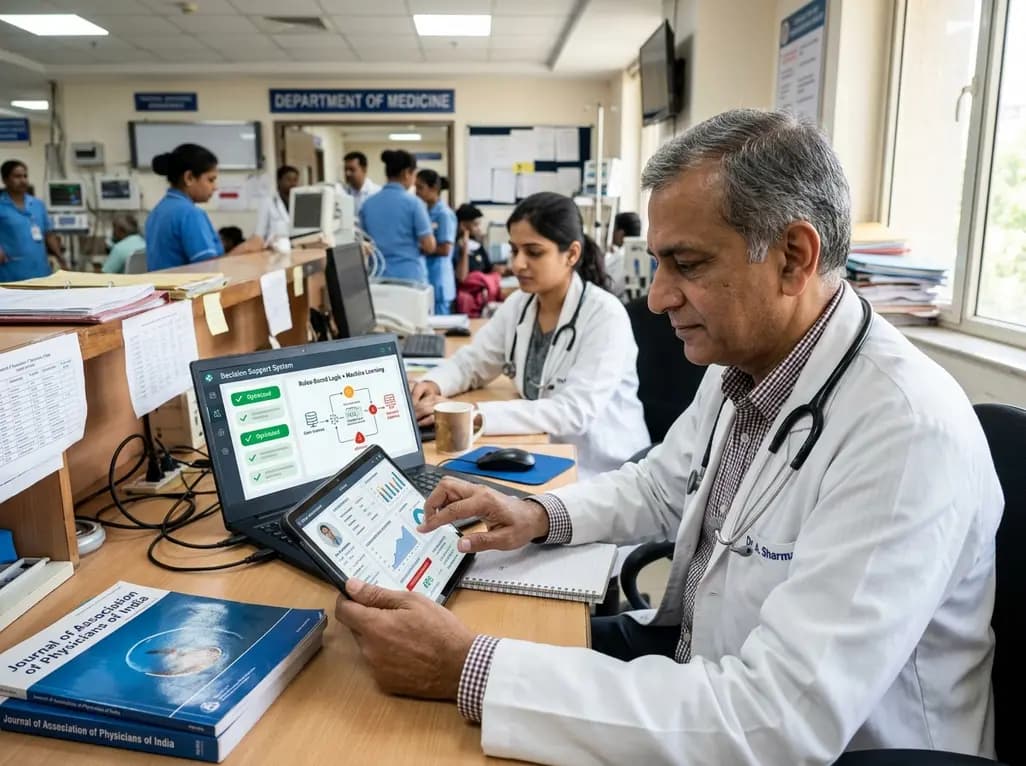
A multicenter study validates a hybrid clinical decision support system combining rule-based logic and machine learning to optimize anticoagulant prescription reviews, reducing alert fatigue and intercepting prescribing errors.
Today

Spine surgery missions in low-resource settings bridge global healthcare gaps when executed with ethical rigor, meticulous logistics, and sustained local partnerships. Learn key practical strategies for financial planning, equipment procurement, patient selection, and bilateral surgical education.
Today

Clinical guidelines rely heavily on isolated biomarkers like IGF-1 and HbA1c. However, portal insulin delivery fundamentally gates hepatic growth hormone sensitivity. This physiological continuum unites type 1 and type 2 diabetes, obesity, cirrhosis, and acromegaly, challenging conventional treatment strategies.
Today
