.webp&w=384&q=75)

Loading, please wait...
Loading, please wait...
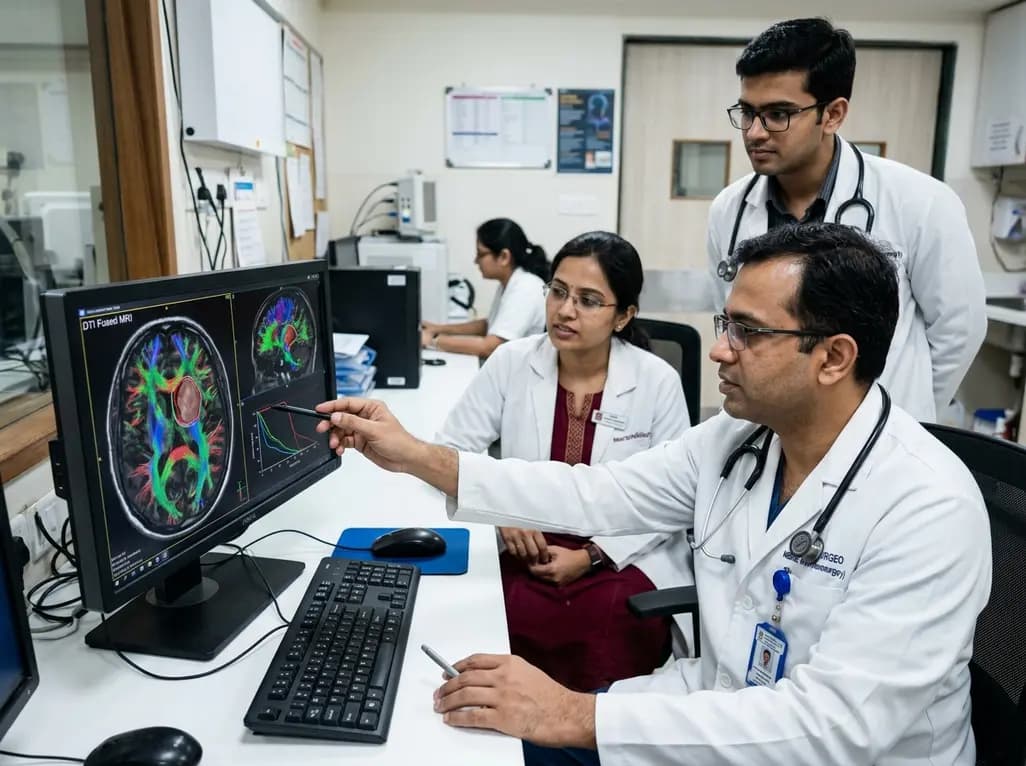
Stereotactic radiosurgery delivers ablative, highly focused ionizing radiation to intracranial lesions while minimizing exposure to adjacent normal brain tissue. However, conventional structural magnetic resonance imaging cannot reliably visualize subcortical white matter pathways. Consequently, adjacent eloquent pathways remain vulnerable to inadvertent radiation toxicity during dose planning. To address this critical limitation, neurosurgeons and radiation oncologists increasingly incorporate DTI in stereotactic radiosurgery protocols. Diffusion tensor imaging provides noninvasive tractography and quantitative diffusivity parameters, allowing clinicians to map critical fiber bundles directly onto volumetric radiation plans. A comprehensive systematic review and meta-analysis evaluated forty-two clinical studies comprising 1464 patients to synthesize the dosimetric, clinical, and prognostic value of this advanced technique across diverse intracranial indications.
Radiation-induced injury to major motor pathways can cause permanent functional impairment and compromise patient quality of life. Fortunately, tractography-guided treatment planning allows radiation oncologists to contour eloquent white matter tracts as distinct organs at risk. In dosimetric comparative studies, incorporating tractography significantly reduced the maximum radiation dose delivered to the corticospinal tract. Specifically, meta-analysis demonstrated a mean dose reduction of 3.35 Gy to the corticospinal tract without causing any significant loss of target prescription coverage. Therefore, clinicians can achieve steeper dose gradients near critical motor fibers while maintaining therapeutic dose delivery to intracranial neoplasms and vascular malformations. Furthermore, low statistical heterogeneity across analyzed dosimetric series confirms the consistency of these physical advantages across different stereotactic platforms.
Beyond theoretical physical advantages, tractography-guided inverse planning provides substantial clinical protection for neurological function. Meta-analysis of comparative clinical studies demonstrated a significant reduction in post-treatment motor deficits among patients managed with tractography-guided radiosurgery compared to conventional anatomical planning. Specifically, patients planned with tractography experienced a 69% lower risk of developing new or worsened motor deficits, yielding a risk ratio of 0.31 with zero statistical heterogeneity. Consequently, incorporating DTI in stereotactic radiosurgery transforms functional risk stratification for challenging peri-rolandic metastases, high-grade arteriovenous malformations, and deeply seated skull base lesions. Clinicians can confidently balance tumor control probability against functional preservation, thereby enhancing post-procedural functional independence.
In addition to tractography guidance, quantitative DTI metrics provide objective neuroimaging biomarkers of treatment response and radiation-induced tissue remodeling. In medically refractory trigeminal neuralgia, stereotactic radiosurgery targets the cisternal segment of the trigeminal nerve root to alleviate severe neuropathic pain. Meta-analysis revealed that patients achieving clinical pain relief exhibited significantly greater fractional anisotropy reduction than non-responders, showing a mean difference of -13.70%. This microstructural change reflects focal focal axonal modulation and therapeutic neurolysis within the irradiated nerve root. Therefore, post-radiosurgical diffusion metrics provide early, objective confirmation of biological responsiveness, which assists clinicians in long-term surveillance and patient counseling.
Implementing advanced diffusion imaging within routine stereotactic workflows requires robust data acquisition and seamless multi-modality image fusion. Among twenty-two studies specifically reporting technical implementation, successful fiber tract reconstruction was achieved in almost all cases, showing an overall failure rate of only 1.2%. Modern stereotactic software suites reliably coregister high-angular-resolution diffusion datasets with stereotactic thin-slice anatomical sequences. However, clinical teams must actively monitor susceptibility distortions and spatial eddy-current artifacts near skull base interfaces and surgical cavities. Applying standardized distortion correction algorithms ensures millimeter-level spatial fidelity during target delineation on linear accelerator, Gamma Knife, or robotic radiosurgery platforms.
The integration of functional and structural tractography represents a transformative paradigm shift toward personalized, pathway-preserving radiosurgery. Current high-level evidence confirms that pathway-guided planning improves critical structure avoidance, reduces adverse radiation effects, and predicts therapeutic response. Nevertheless, multi-institutional clinical trials and standardized imaging protocols are warranted to establish universal dose-volume constraints for specific white matter tracts. Furthermore, combining automated tractography algorithms with machine learning could streamline contouring workflows and eliminate inter-observer variability. As neuro-oncology continues to prioritize long-term survivorship and functional outcomes, diffusion-guided radiosurgery will become an essential component of modern precision radiation medicine.
Tractography-guided planning significantly reduces the risk of post-treatment motor deficits by nearly 69% compared to conventional planning. It allows clinicians to visualize eloquent white matter tracts, such as the corticospinal pathway, thereby reducing collateral radiation exposure while fully preserving therapeutic tumor coverage.
Quantitative diffusion metrics, particularly fractional anisotropy (FA), serve as early biomarkers of biological response following radiosurgery. Patients who achieve clinical pain relief demonstrate significantly greater FA reduction within the targeted nerve root compared to non-responders, confirming effective treatment-induced microstructural neurolysis.
DTI tractography demonstrates high clinical reliability in stereotactic planning, with an overall technical failure rate of only 1.2% across clinical studies. Modern distortion-correction algorithms and advanced image co-registration allow seamless integration into routine linear accelerator and Gamma Knife workflows.
Disclaimer: This content is for informational and educational purposes only. It is not intended to be a substitute for professional medical advice, diagnosis, or treatment. Always seek the advice of your physician or another qualified health provider with any questions you may have regarding a medical condition. Refer to the latest local and national guidelines for clinical practice.
References

Read summarized clinical updates, watch expert medical content, and earn CME certifications right from your smartphone.
Open your smartphone camera to scan and install.





A landmark meta-analysis demonstrates that incorporating diffusion tensor imaging (DTI) into stereotactic radiosurgery significantly reduces motor complications and radiation dose to critical tracts while offering valuable prognostic biomarkers.
last month

A landmark study demonstrates that RIPK1 activation in the subacute phase of intracerebral hemorrhage drives inflammation, blood-brain barrier leakage, and cognitive impairment in males but not females, highlighting essential sex differences for precision neuroprotective clinical trials.
Today

A pharmacometric and machine learning study reveals that specific vaginal bacteria alter cervical antiretroviral exposure, highlighting the need for precision HIV PrEP strategies.
Today

New clinical evidence demonstrates a shift away from strict exercise restrictions in genetic heart disease. While patients with channelopathies engage in more vigorous activity than those with cardiomyopathies, shared decision-making and individualized risk assessments ensure safe, beneficial exercise participation.
Today

Sarcopenia significantly impairs functional independence and amplifies fracture risks in patients with osteoarthritis and osteoporosis. Learn about modern diagnostic strategies, GLP-1 therapy considerations, and evidence-based non-pharmacological management across multidisciplinary clinical settings.
Today

Recent research defines ferro-aging as a conserved iron-lipid axis driving organ decline across primates. Age-related iron dyshomeostasis stimulates ACSL4-mediated lipid peroxidation, promoting cellular senescence. Notably, vitamin C directly inhibits ACSL4, suppressing phospholipid oxidation and multi-organ decay.
Today
