.webp&w=384&q=75)

Loading, please wait...
Loading, please wait...

Digital dentistry continues to revolutionize restorative workflows across clinical practices globally. Today, dental professionals routinely fabricate 3D printed dental casts to replace traditional stone models. This shift reduces chairside impression errors and accelerates diagnostic turnarounds. Furthermore, fused filament modeling provides a cost-effective manufacturing solution compared to industrial vat polymerization printers. Clinicians increasingly favor polylactic acid filaments because they provide biodegradable, rigid, and economical alternatives. However, practitioners must preserve high dimensional fidelity when fabricating diagnostic arches. Consequently, clinicians must understand how slicing parameters and filament selections alter anatomical accuracy. Minor dimensional distortions can compromise the fit of diagnostic wax-ups and orthodontic appliances. Therefore, researchers continuously evaluate how printing configurations influence spatial stability. In addition, dental teams need clear guidance regarding material performance over extended storage periods. As additive manufacturing expands across Indian dental clinics, cost-efficient desktop hardware gains significant traction. Thus, determining the physical stability of filament-based casts remains a high clinical priority. Ultimately, precise digital workflows enhance diagnostic reliability and elevate overall patient care standards. Specifically, rigorous benchmarking protocols establish reproducible quality control benchmarks for daily laboratory operations.
Material composition directly dictates the mechanical behavior of thermoplastic polymer models. For example, investigators evaluated four distinct polylactic acid formulations in a standardized maxillary model setup. Specifically, the team examined eSun PLA+, BambuLab PLA, Weiton 3D dental-grade PLA, and Filadental gypsum-reinforced PLA. Each material demonstrated unique physical characteristics and distinct shrinkage patterns during thermal extrusion. In addition, the mineral fillers within gypsum-reinforced filament altered the crystallization dynamics of the extruded layers. Consequently, filament selection produced statistically significant variations across anatomical regions. Commercial standard filaments frequently displayed comparable accuracy to specialized dental alternatives under specific print configurations. Furthermore, proper thermal management during extrusion prevented excessive internal residual stresses. Therefore, dental technicians must select filaments based on validated dimensional trueness rather than commercial marketing claims alone. Moreover, understanding polymer shrinkage ensures reliable margins during appliance fabrication. In particular, clinicians achieve predictable outcomes when they match filament behavior to intended clinical applications. Hence, thorough filament benchmarking remains essential for successful model manufacturing. Ultimately, selecting verified materials guarantees dependable clinical fit across complex restorations.
Base architecture significantly influences material consumption, total fabrication duration, and physical deformation. Traditionally, dental laboratories hollow cast bases to conserve expensive raw resins and reduce print duration. However, hollow geometries frequently introduce structural vulnerabilities during thermal cooling phases. In this recent investigation, researchers contrasted hollow base geometries against solid base designs across identical maxillary reference models. The findings revealed that solid bases provided superior structural rigidity against thermal warping forces. In contrast, hollow designs exhibited measurable regional deviations along the palate and posterior molars. Furthermore, uneven wall thicknesses in hollow models exacerbated asymmetrical contraction throughout the cooling process. As a result, the arch perimeter experienced subtle inward contractions over time. Therefore, practitioners should carefully consider structural trade-offs before choosing hollow configurations. While hollow models save filament, solid bases maintain superior geometric integrity for demanding diagnostic tasks. Consequently, clinicians must balance material savings against the necessity for uncompromised clinical accuracy. Thus, solid bases remain the gold standard for long-term diagnostic stability. In addition, solid designs withstand external laboratory handling forces far more effectively.
Infill density serves as a crucial parameter that balances print economy with mechanical rigidity. Slicing software allows operators to manipulate internal infill percentages to control weight and printing time. Specifically, the study evaluated three representative infill densities: five percent, twenty percent, and thirty-five percent. The data demonstrated that infill density exerted a statistically significant influence on overall cast trueness. For example, casts printed with five percent infill demonstrated greater susceptibility to localized post-extrusion warping. Conversely, increasing infill density to twenty percent or thirty-five percent substantially reinforced the internal scaffolding. This internal support resisted contraction forces as the extruded polylactic acid underwent secondary crystallization. Moreover, thirty-five percent infill provided the greatest volumetric consistency across anterior and posterior dental landmarks. However, higher infill densities noticeably increased print times and filament utilization. Therefore, technicians must determine the optimal threshold that guarantees stability without excessive resource consumption. In addition, twenty percent infill often provides an acceptable middle ground for short-term diagnostic models. Ultimately, precise infill selection ensures that diagnostic models retain clinical usefulness. Hence, standardized infill parameters safeguard restorative accuracy across diverse laboratory workflows.
Storage duration represents an often overlooked variable in digital dental model workflows. In clinical practice, technicians frequently store diagnostic casts for several weeks before fabricating final prostheses. In this investigation, researchers monitored dimensional deviations at one day, one week, two weeks, three weeks, and four weeks. Notably, storage duration significantly influenced spatial accuracy across all evaluated model regions. The greatest rate of volumetric change occurred during the initial seven days following fabrication. During this early window, post-polymerization relaxation and moisture equilibrium induced minor arch shifts. Furthermore, ambient environmental fluctuations gradually affected polymer stability over subsequent observation points. However, models fabricated with solid bases and higher infill maintained acceptable clinical tolerances throughout the entire month. In contrast, hollow models with low infill displayed cumulative dimensional drift that exceeded recommended thresholds. Therefore, dental teams must account for aging when storing diagnostic models for delayed treatment phases. Consequently, laboratories should fabricate appliances promptly or utilize reinforced printing strategies. Thus, proactive process control preserves model fidelity over extended treatment timelines. In conclusion, environmental control ensures maximum longevity for additively manufactured diagnostic records.
Solid bases maintain structural rigidity because continuous polymer layers resist contraction forces during cooling. In contrast, hollow designs feature thin walls that cool at uneven rates, creating internal thermal stresses. Furthermore, hollow arches lack central mechanical support, making them vulnerable to transverse arch collapse over time. Therefore, clinicians who prioritize long-term dimensional precision should utilize solid base architecture, particularly when storing models for several weeks before treatment.
Technicians generally recommend an infill density between twenty percent and thirty-five percent for diagnostic models. An infill of five percent saves material but compromises geometric stability against polymer shrinkage. Conversely, an infill of thirty-five percent offers maximum resistance against warping while preserving fine anatomical landmarks. Therefore, selecting twenty to thirty-five percent provides the optimal balance between manufacturing speed, material consumption, and long-term dimensional stability for routine diagnostic dental applications.
Extended storage induces progressive dimensional changes due to secondary polymer relaxation and environmental moisture absorption. The most pronounced dimensional drift occurs during the first week after printing. Furthermore, prolonged exposure to ambient heat and humidity accelerates distortion across the thin alveolar margins. Therefore, dental teams should store models in controlled, dry environments and complete diagnostic waxing or appliance fabrication within two weeks whenever possible to ensure optimal clinical outcomes.
Disclaimer: This content is for informational and educational purposes only... Refer to the latest local and national guidelines for clinical practice.
References
Schneuwly M et al. Dimensional stability of additively manufactured diagnostic maxillary casts: Influence of cast-base design, PLA filament type, infill density, and storage duration. J Prosthet Dent. 2026 Oct 09. doi: undefined. PMID: 42855391.
Donmez MB, et al. Dimensional stability of additively manufactured dental casts in bio-based resins: Influence of cast base design and storage conditions. J Dent. 2025;148:105218.
Vincze Z, et al. Evaluation of the dimensional stability of 3D-printed dental casts. J Dent. 2024;151:105431.

Read summarized clinical updates, watch expert medical content, and earn CME certifications right from your smartphone.
Open your smartphone camera to scan and install.





A recent in vitro study evaluated how PLA filament type, cast-base design, infill density, and 4-week storage duration affect the dimensional stability of 3D-printed maxillary diagnostic casts, highlighting key printing parameters required to preserve clinical accuracy in digital dentistry workflows.
Today
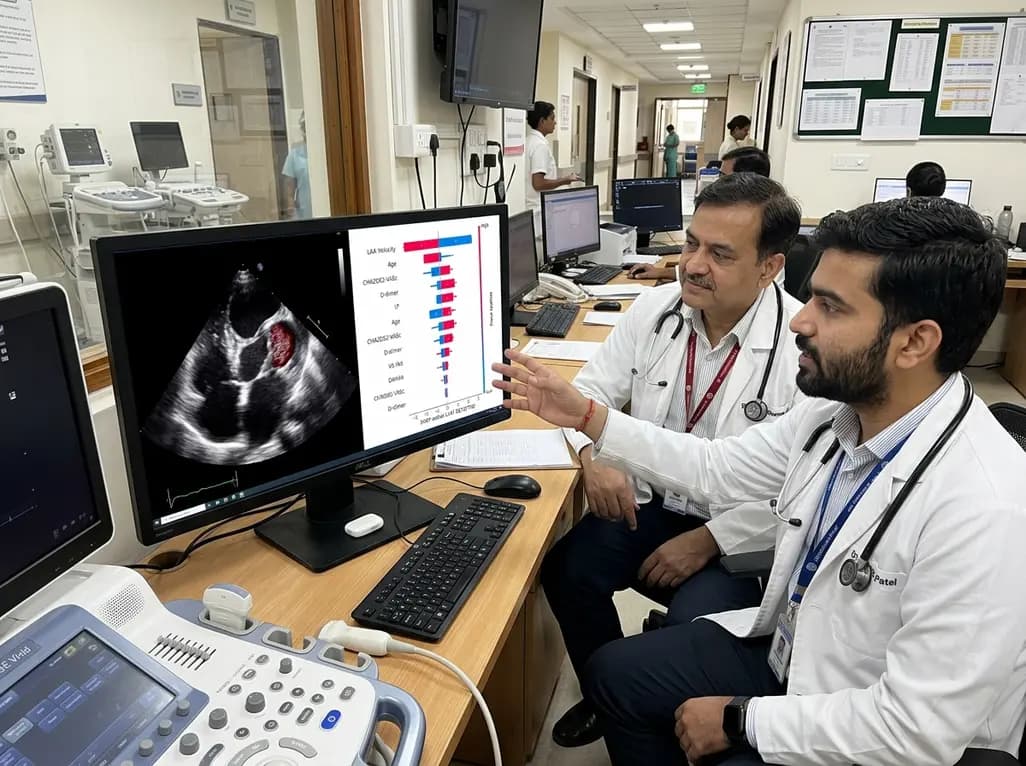
A study demonstrates an explainable machine learning framework integrating clinical and echocardiographic metrics to predict left atrial appendage thrombus in non-valvular atrial fibrillation, utilizing SHAP analysis for clinical interpretability.
Today

Maternal anaemia contributes to nearly half of pregnancy-related fatalities across India. To prevent complications, Uttar Pradesh has added single-dose parenteral iron to its essential medicines list. This clinical transition aims to restore haemoglobin rapidly and protect high-risk mothers across rural facilities.
Today

A landmark systematic review and meta-analysis establishes age-specific normative reference values for pediatric pulse wave velocity, revealing a nonlinear trajectory of arterial stiffness from early childhood through adolescence.
Today

A new systematic review evaluates lumbar facet arthroplasty, predominantly the Total Posterior Spine System (TOPS). Evidence shows significant reductions in back and leg pain and preserved segmental mobility, though revision rates and outcome heterogeneity highlight the need for careful patient selection.
Today

A landmark cross-sectional study in Asian adults with type 2 diabetes identifies novel urinary metabolites linked to mild cognitive impairment. Elevated urinary sucrose and altered metabolites highlight non-invasive pathways for early cognitive risk stratification and targeted metabolic management.
Today
