.webp&w=384&q=75)

Loading, please wait...
Loading, please wait...

Specifically, Diffusion Posterior Sampling MRI is transforming the landscape of medical diagnostics. However, traditional sampling methods frequently suffer from sluggish convergence and burdensome manual tuning. Furthermore, practitioners often find that these delays limit the practical utility of generative models in fast-paced clinical settings. Consequently, a team of researchers developed a robust sampling algorithm called the Preconditioned Unadjusted Langevin Algorithm (PULA) to solve these critical bottlenecks.
Notably, the researchers focused on the reverse diffusion process to enhance image fidelity. In addition, they multiplied the exact likelihood with the diffused prior across all noise scales. Moreover, they utilized preconditioning to specifically overcome slow convergence rates. Therefore, the algorithm facilitates rapid and reliable posterior sampling. Similarly, the method eliminates the need for tedious parameter tuning, which is a major advantage for radiologists. Thus, this approach ensures consistency across diverse reconstruction tasks. Indeed, testing on undersampled brain data demonstrated that this new technique significantly outperforms existing annealed sampling methods.
Moreover, the results confirmed superior performance in both Cartesian and non-Cartesian accelerated MRI. Accordingly, the quality of the reconstructed samples remained high while the processing time decreased. In fact, the model was trained on the extensive fastMRI dataset to ensure its robustness. Therefore, clinicians can expect highly accurate uncertainty estimations alongside the reconstructed images. Consequently, this innovation paves the way for more efficient MRI workflows in neurology and beyond. Ultimately, the integration of such advanced algorithms may lead to shorter scan times for patients without compromising diagnostic precision.
Specifically, preconditioning addresses the mathematical ill-conditioning of the sampling problem. Consequently, it accelerates the convergence of the Unadjusted Langevin Algorithm, allowing for faster image generation without losing detail.
No, the proposed exact likelihood with preconditioning enables reliable sampling across various tasks without parameter tuning. Therefore, it is more user-friendly for clinical application than previous iterative methods.
In fact, the method underwent training on the fastMRI dataset. Furthermore, researchers tested it on retrospectively undersampled brain data from healthy volunteers to prove its efficacy in real-world scenarios.
Disclaimer: This content is for informational and educational purposes only. It is not intended as medical advice or a substitute for professional healthcare. Always consult with a qualified medical professional for diagnosis and treatment. Refer to the latest local and national guidelines for clinical practice.
References
Blumenthal M et al. Fast and Robust Diffusion Posterior Sampling for MR Image Reconstruction Using the Preconditioned Unadjusted Langevin Algorithm. Magn Reson Med. 2026 May 10. doi: 10.1002/mrm.70416. PMID: 42108406.

Read summarized clinical updates, watch expert medical content, and earn CME certifications right from your smartphone.
Open your smartphone camera to scan and install.





New research introduces a preconditioned Langevin algorithm that dramatically speeds up Diffusion Posterior Sampling for high-quality MRI reconstructions....
5 months ago

A retrospective cohort study of 7,716 ICU patients from the MIMIC-IV database demonstrates that Gradient Boosting Decision Trees significantly outperform traditional SOFA scores in predicting in-hospital mortality among patients with sepsis and diabetes, with SHAP analysis providing clinical interpretability.
Today
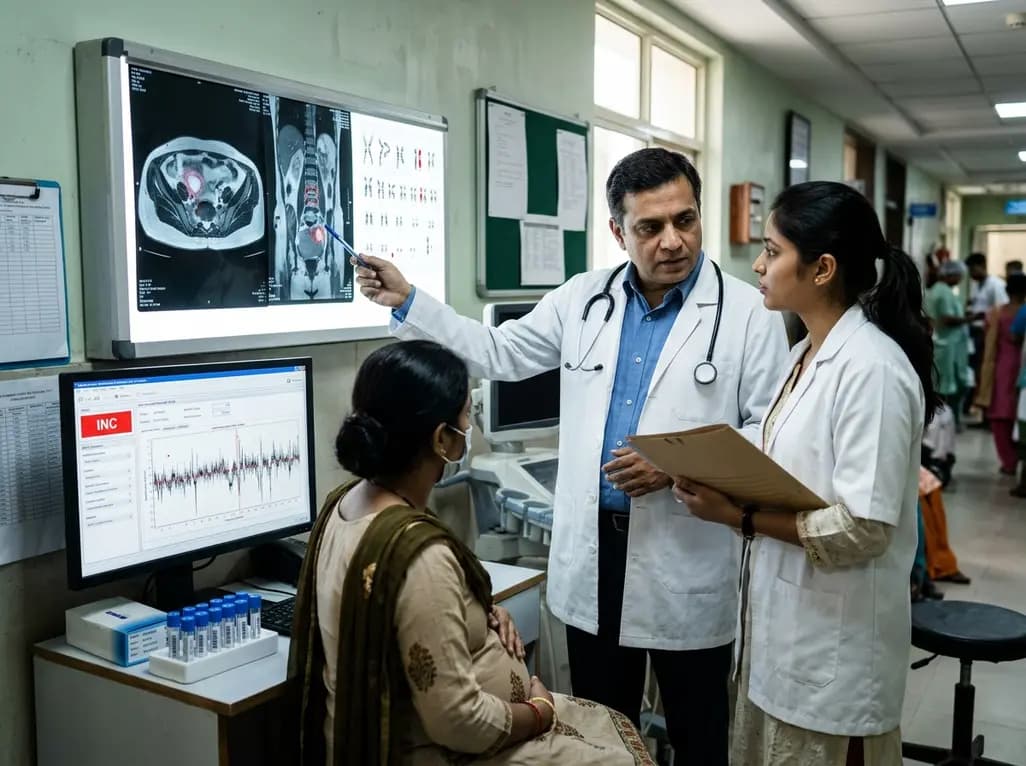
Occult maternal malignancy accounts for 3.82% of persistent unreportable NIPT results with genomic noise. Multiple chromosomal aberrations, notably on chromosome 18, warrant thorough oncological evaluation and whole-body MRI to ensure timely maternal diagnosis while preserving fetal care.
Today

This article reviews the forensic and clinical complexities of acute myocarditis arising on left ventricular hypertrophy in children, highlighting early diagnostic red flags and multidisciplinary postmortem autopsy protocols.
Today

This comparative study evaluates posterior labral tears with and without glenohumeral instability, highlighting distinct demographic patterns, MRI underestimation in stable shoulders, and successful arthroscopic repair outcomes.
Yesterday

A clinical study demonstrates that early intervention with tocilizumab, either as monotherapy or bridged with corticosteroids, achieves significant proptosis reduction and resolves active inflammation in treatment-naive thyroid eye disease.
Yesterday
