.webp&w=384&q=75)

Loading, please wait...
Loading, please wait...
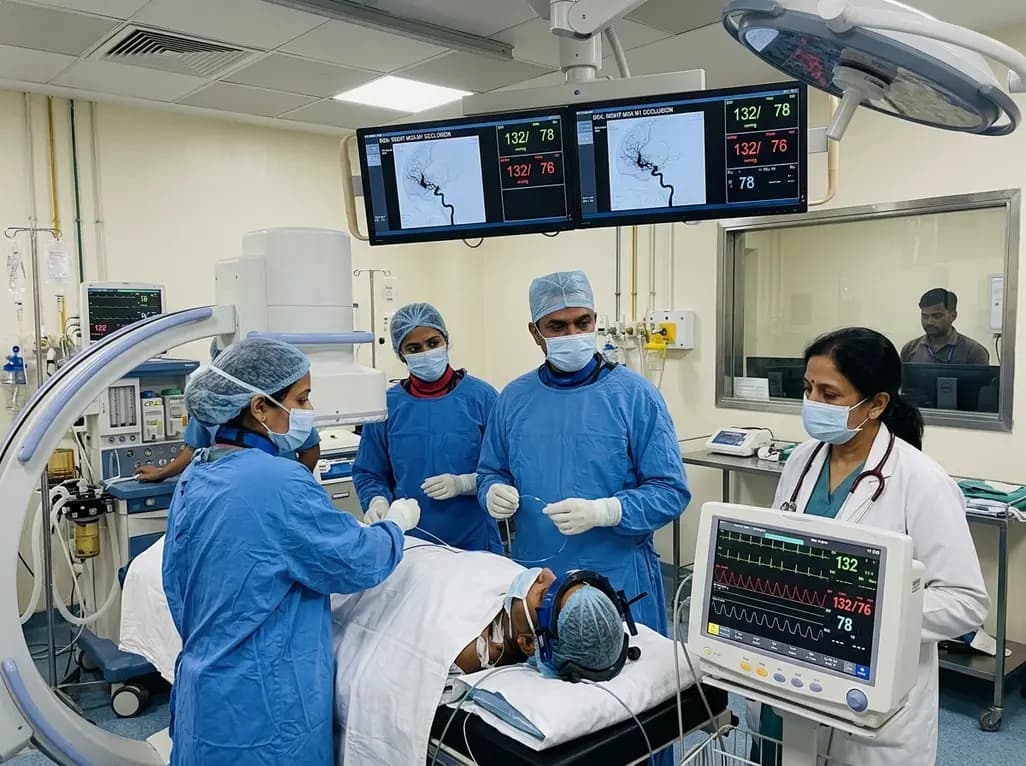
Managing hemodynamic stability during revascularization procedures represents a pivotal aspect of acute ischemic stroke care. Endovascular mechanical thrombectomy has established itself as the gold standard intervention for patients presenting with acute ischemic stroke secondary to large vessel occlusion in the anterior circulation. Despite achieving successful recanalization in a high proportion of cases, a substantial subset of patients fails to achieve functional independence at 90 days. Intraprocedural blood pressure control thrombectomy strategies have long been hypothesized to influence penumbral perfusion, final infarct volume, and clinical recovery. Historically, intraprocedural hemodynamic targets have followed uniform, standardized protocols designed primarily to avoid severe hypertension and minimize reperfusion injury. However, rigid blood pressure parameters may not account for individual variations in baseline cerebrovascular autoregulation, collateral flow, or pre-existing hypertensive adaptation. Consequently, clinicians frequently question whether personalizing intraprocedural mean arterial pressure targets relative to baseline baseline values offers superior neurological protection compared with standardized target ranges during endovascular procedures.
To address this clinical dilemma, researchers conducted the DETERMINE trial, a multicenter, open-label, randomized clinical trial with blinded endpoint evaluation across eight academic comprehensive stroke centers in France. Eligible participants included adult patients presenting with acute ischemic stroke due to anterior large vessel occlusion who had a clear indication for mechanical thrombectomy. Between March 2021 and September 2023, 433 patients were randomly assigned in a one-to-one ratio to receive either individualized or standard blood pressure control thrombectomy protocols. In the individualized management arm, clinicians aimed to maintain mean arterial pressure within 10% of the initial measurement obtained prior to the endovascular intervention. Conversely, the control group received standard intraprocedural care, which targeted systolic blood pressure strictly between 140 and 180 mmHg until reperfusion was established or the procedure concluded. The primary outcome was a favorable functional recovery, defined as a modified Rankin Scale score between 0 and 2 at 90 days post-procedure.
The trial findings revealed no significant statistical difference in functional recovery between the two treatment strategies. At the 90-day follow-up, favorable functional outcome occurred in 44.2% of patients in the individualized hemodynamic management group compared with 48.8% in the standard blood pressure target group. After adjusting for baseline confounders, the odds ratio for achieving favorable functional independence was 0.82, establishing that personalizing mean arterial pressure targets did not confer superior clinical benefit. Furthermore, intraprocedural monitoring demonstrated comparable mean blood pressure levels and blood pressure variability between both study cohorts during the thrombectomy procedure. All-cause mortality at 90 days was similarly comparable, recorded at 18.8% in the individualized group versus 16.4% in the standard therapy group. These primary and secondary endpoints suggest that targeting individualized mean arterial pressures offers no additional neuroprotective advantage over standard protocol-driven systolic blood pressure targets during emergency intraprocedural care.
Safety considerations are paramount when adjusting hemodynamic protocols during intraprocedural revascularization for acute ischemic stroke. Maintaining adequate cerebral perfusion must be balanced against the potential risk of inducing hemorrhagic transformation or hyperperfusion syndromes following recanalization. In the DETERMINE trial, safety outcomes specifically evaluated the incidence of symptomatic intracranial hemorrhage within 24 hours of treatment alongside overall 90-day mortality. The rate of symptomatic intracranial hemorrhage showed no statistically significant difference between patients managed with individualized blood pressure control thrombectomy protocols and those managed under standard systolic blood pressure guidelines. Furthermore, overall adverse event profiles remained balanced across both arms of the trial. These findings confirm that while individualized mean arterial pressure targeting does not improve 90-day functional independence, it also does not increase procedural harm or early hemorrhagic risk when executed in comprehensive stroke centers.
The conclusions of the DETERMINE trial provide essential clarity for clinical protocols governing emergency stroke care and neuroanesthesia management. Current international guidelines advocate for maintaining systolic blood pressures below 180 mmHg during endovascular therapy, primarily derived from observational data and historical thrombolysis trials. The evidence provided by this Class II trial indicates that complex, individualized blood pressure control thrombectomy algorithms offer no clinical superiority over straightforward, standard systolic blood pressure maintenance within the 140 to 180 mmHg range. From an operational perspective, attempting to calculate and continuously titrate blood pressure to a tight individualized baseline target adds procedural complexity without translating into tangible patient recovery benefits. Consequently, care teams can confidently maintain standard, simplified hemodynamic targets during thrombectomy procedures without compromising clinical outcomes, allowing clinicians to focus resources on rapid recanalization, which remains the single most critical determinant of functional recovery in acute ischemic stroke.
While the DETERMINE study demonstrates that targeting baseline mean arterial pressures during thrombectomy does not improve outcomes, questions remain regarding post-recanalization hemodynamic management. Cerebral autoregulation dynamic shifts following successful vessel recanalization may require distinct blood pressure thresholds compared to the pre-reperfusion phase. Emerging trials are currently evaluating whether tailoring blood pressure targets based on the final angiographic revascularization grade or non-invasive cerebral autoregulation monitoring can optimize microvascular perfusion and prevent reperfusion injury. Additionally, subgroup analyses focusing on collateral circulation status, baseline core-to-penumbra ratios, and specific anesthetic techniques may further clarify whether niche patient populations derive specific benefits from tailored intraprocedural blood pressure control thrombectomy paradigms in future clinical research.
Disclaimer: This content is for informational and educational purposes only and does not constitute medical advice, diagnosis, or treatment. Healthcare professionals should rely on their clinical judgment and refer to the latest local and national guidelines for clinical practice.
References
Maïer B et al. Individualized vs Standard Blood Pressure Control During Thrombectomy for Ischemic Stroke: The DETERMINE Randomized Clinical Trial. Neurology. 2026 Sep 08. doi: 10.1212/WNL.0000000000218420. PMID: 42585603.
The DETERMINE trial aimed to evaluate whether an individualized blood pressure strategy during mechanical thrombectomy improves 90-day functional outcomes in acute ischemic stroke patients compared with standard blood pressure control. The trial specifically assessed whether maintaining mean arterial pressure within 10% of pre-procedure baseline values superiorly enhanced functional recovery over standard systolic blood pressure targets between 140 and 180 mmHg.
No, individualized blood pressure management did not significantly improve functional independence at 90 days compared with standard management. Favorable functional outcomes occurred in 44.2% of patients in the individualized group and 48.8% in the standard group. Statistical analysis confirmed no significant difference between the two approaches, showing that maintaining tight individualized blood pressure targets offers no clear functional advantage.
No significant safety differences were observed between the individualized and standard blood pressure control groups. Rates of symptomatic intracranial hemorrhage at 24 hours post-procedure and all-cause mortality at 90 days were comparable across both arms. These findings demonstrate that while individualized blood pressure targeting does not enhance clinical efficacy, it maintains a safety profile similar to standard intraprocedural blood pressure management protocols.

Read summarized clinical updates, watch expert medical content, and earn CME certifications right from your smartphone.
Open your smartphone camera to scan and install.





The DETERMINE randomized trial evaluated whether individualized blood pressure control during mechanical thrombectomy improves 90-day functional outcomes in acute ischemic stroke compared with standard targets. Findings indicate similar functional recovery and safety profiles between both management strategies.
last month

A review examines how vagal neuroimmune circuits link the brain and immune system, sensing cytokine surges and dampening peripheral inflammation. Bioelectronic medicine harnesses these pathways to provide targeted, non-pharmacological therapies for chronic inflammatory and autoimmune diseases.
Today

Explore the crucial link between dietary protein and immunocompetence. This review examines how low-protein nutrition shifts metabolic resources away from pathogen defense toward early reproduction, compromising host survival and immunity against severe bacterial infections.
Today

A post hoc analysis of the PARM-T2D study shows pemafibrate exerts baseline-dependent effects on LDL-C and particle size in type 2 diabetes and hypertriglyceridemia. It lowers triglycerides and remnants while favorably remodeling atherogenic LDL particles based on initial lipid control status.
Today

A longitudinal study reveals that patients undergoing staged bilateral hip arthroscopy experience progressive contralateral labral deterioration during surgical intervals. However, structural degradation does not compromise 2-year postoperative clinical outcomes or patient-reported satisfaction scores.
Today

New immunological research reveals how PTPN22 forms a delayed inhibitory signaling complex to restrain T cell activation, explaining how the autoimmune-linked R620W variant disrupts feedback control and promotes persistent inflammation in conditions like rheumatoid arthritis and type 1 diabetes.
Today
