

Loading, please wait...
Loading, please wait...

Medical faculties across the globe frequently invoke practical exposure as the foundation of training, yet the core definition of experience in health education often remains vague and unexamined. While clinical curricula emphasize hands-on patient care and procedural volume, educators rarely dissect how meaningful understanding actually emerges from these events. Consequently, researchers and teachers risk misinterpreting how medical trainees construct knowledge during clinical encounters. By anchoring educational strategies in robust epistemological frameworks, clinical instructors can design intentional, reflective learning environments that optimize diagnostic acumen and professional maturation.
To grasp the true nature of experience in health education, educators must examine established philosophical traditions. Pragmatist, rationalist, and phenomenological philosophers provide clarifying perspectives. Specifically, John Dewey, Georges Canguilhem, and Maurice Merleau-Ponty framed human experience not as a passive reception of external stimuli, but as the significance emerging during dynamic interactions between a subject and the surrounding environment. In clinical medicine, a resident does not simply record sensory data when evaluating an unstable patient. Instead, the trainee creates meaning through real-time physiological observations, cognitive hypotheses, emotional tensions, and therapeutic interventions. Therefore, learning does not arise solely from physical presence on the hospital ward. Meaningful learning occurs when learners make deliberate sense of complex situations. When institutions treat clinical exposure merely as service delivery, they overlook these nuanced perceptual shifts. Furthermore, recognizing this relational definition enables faculty to structure debriefing sessions that explore how students perceive clinical dilemmas. Ultimately, understanding experience as an active meaning-making process transforms passive observational rotations into deliberate cognitive apprenticeships.
Philosophical frameworks distinguish clearly between two complementary facets: making an experience and acquiring experience. The episodic dimension describes an isolated, demarcated event that alters understanding. For instance, managing a catastrophic postpartum hemorrhage or diagnosing a rare presentation of vasculitis constitutes a transformative episodic milestone. During such moments, intense emotional engagement and focused clinical decisions crystallize knowledge into memory. In contrast, the cumulative dimension reflects the gradual synthesis of multiple clinical encounters over time. Trainees acquire cumulative experience through sustained clinical exposure, developing pattern recognition, refined physical examination nuances, and mature diagnostic instincts. However, merely accumulating episodic encounters does not automatically yield clinical expertise. If teachers fail to guide junior clinicians through structured reflection, repeated clinical exposures can reinforce biased assumptions or unexamined habits. As a result, educational supervisors must link distinct clinical episodes to broader professional trajectories. Faculty development initiatives should teach supervisors how to help trainees reconcile unexpected episodic complications with general clinical frameworks, thereby bridging the divide between episodic disruption and cumulative competence.
Simulation-based education offers an optimal laboratory for operationalizing these theoretical concepts. In traditional simulation models, trainers frequently prioritize technical choreography and procedural checklists over internal cognitive experiences. However, authentic clinical mastery demands that trainees interpret ambiguous physiological signals under pressure. By regarding simulation as a shared space of emergent meaning, educators can construct immersive scenarios that provoke critical decision points. In addition, debriefing models must shift from mechanical critique toward deep exploration of learner perception. Instead of asking why an intern omitted a lab test, mentors should investigate how the scenario unfolded within the intern's subjective viewpoint. Similarly, during bedside rounds, attending physicians must recognize that identical patient presentations provoke entirely different learning responses among team members. A junior clerk may perceive overwhelming anxiety, whereas an experienced fellow observes subtle therapeutic trade-offs. Therefore, clinical educators must adapt their instruction to match each learner's subjective stage of development. This intentional adaptation fosters cognitive flexibility and psychological safety across clinical teams.
Health education literature increasingly emphasizes the explicitation interview, an introspective interview methodology originally developed by Pierre Vermersch. This qualitative technique assists clinicians and trainees in accessing procedural awareness that typically remains implicit or unexpressed. Health professionals frequently execute intricate clinical maneuvers and rapid diagnostic decisions through automatic, tacit pathways. Consequently, junior students struggle to decipher the true cognitive processes of expert practitioners during bedside interactions. Through targeted sensory questioning and guided retrospective analysis, the explicitation interview prompts the clinician to re-enact a past clinical moment in memory. The interviewer focuses strictly on concrete actions, bodily sensations, and micro-decisions rather than retrospective rationalizations. Studies demonstrate that this method uncovers context-specific reasoning, hidden heuristic shortcuts, and the emotional triggers governing urgent clinical choices. Furthermore, medical educators can utilize explicitation sessions as supervised training tools after critical incidents. By walking residents through their granular operational choices, mentors illuminate unexamined assumptions and strengthen diagnostic resilience without imposing punitive judgments.
Implementing a rigorous definition of clinical experience necessitates substantial revisions to faculty development and competency assessments. Standard workplace-based assessments frequently record numeric competencies or procedural tallies, ignoring the qualitative depth of clinical comprehension. Instead of tallying completed procedures, educational bodies should measure how trainees synthesize real-world challenges. For example, portfolio assessments and reflective logs should require trainees to analyze both episodic dilemmas and cumulative development. Moreover, medical faculties must train clinical preceptors to conduct structured supervisory discussions that probe decision-making frameworks. When clinical supervisors understand the cognitive and environmental factors shaping performance, they deliver actionable, precise feedback. In addition, institutions should align faculty incentives with longitudinal mentorship rather than brief clinical oversight. Such systemic reforms cultivate resilient physicians who adapt seamlessly across disparate clinical settings. By prioritizing qualitative meaning-making alongside technical skills, health education programs fulfill their social mission of training genuinely observant, empathetic, and proficient healthcare professionals.
Episodic experience denotes a discrete, highly memorable event that fundamentally shifts how a clinician understands a specific clinical problem, such as managing an unexpected airway collapse. Cumulative experience, however, represents the progressive accrual and consolidation of knowledge gained across hundreds of everyday patient interactions. Both dimensions remain indispensable for developing mature, adaptable diagnostic mastery in clinical practice.
The explicitation interview guides healthcare professionals to recall the exact sensory cues, tacit choices, and bodily reactions experienced during a specific clinical episode. By verbalizing previously automatic mental processes, clinicians identify subconscious cognitive shortcuts, diagnostic blind spots, and the contextual factors that guided their real-time decisions, thereby transforming implicit clinical instincts into conscious, transferable strategies.
Defining experience clarifies that simulation involves subjective meaning-making rather than simple mechanical repetition of standardized technical checklists. When medical educators recognize how learners construct personal meaning from simulated stress, they can craft richer debriefings. This pedagogical approach targets underlying cognitive reasoning, emotional calibration, and perceptual framing, ensuring long-term retention and safer independent patient management.
Disclaimer: This content is for informational and educational purposes only. It is not intended to provide medical advice, clinical diagnosis, or treatment planning. Healthcare professionals should exercise their independent clinical judgment. Refer to the latest local and national guidelines for clinical practice.
References
1. Jaunay LB et al. Defining and Exploring Experience in Health Education. JMIR Med Educ. 2026 Nov 13. doi: 10.2196/85039. PMID: 43024875.
2. Yardley S, Teunissen PW, Dornan T. Experiential learning: AMEE Guide No. 63. Med Teach. 2012;34(2):e102-e115.
3. Vermersch P. L'entretien d'explicitation. Issy-les-Moulineaux: ESF éditeur; 1994.

Read summarized clinical updates, watch expert medical content, and earn CME certifications right from your smartphone.
Open your smartphone camera to scan and install.





Explore how defining experience in health education bridges philosophical theory and clinical training. Learn how episodic engagement, cumulative knowledge, and explicitation interviews refine bedside teaching and simulation-based assessment.
Today
Gastrointestinal smooth muscle cells rely on nanoscale membrane domains to integrate mechanosensitive currents. Recent insights show that nanodomain architecture, rather than channel properties alone, orchestrates motility, opening new therapeutic avenues for clinical dysmotility and gastrointestinal aging.
Today

A landmark study reveals that lipid-rich malignant ascites alters the T-cell metabolic transcriptome, causing cholesterol efflux and impaired fatty acid oxidation. This suppresses TCR signalling and blocks BiTE immunotherapy, while lipid depletion restores antitumour cytotoxicity in ovarian cancer.
Today
Novel clinical evidence demonstrates the feasibility of combining VA-ECMO with the NyokAssist self-expanding transvalvular pump for active left ventricular unloading in infarct-related cardiogenic shock, achieving successful stabilization and decannulation.
Today
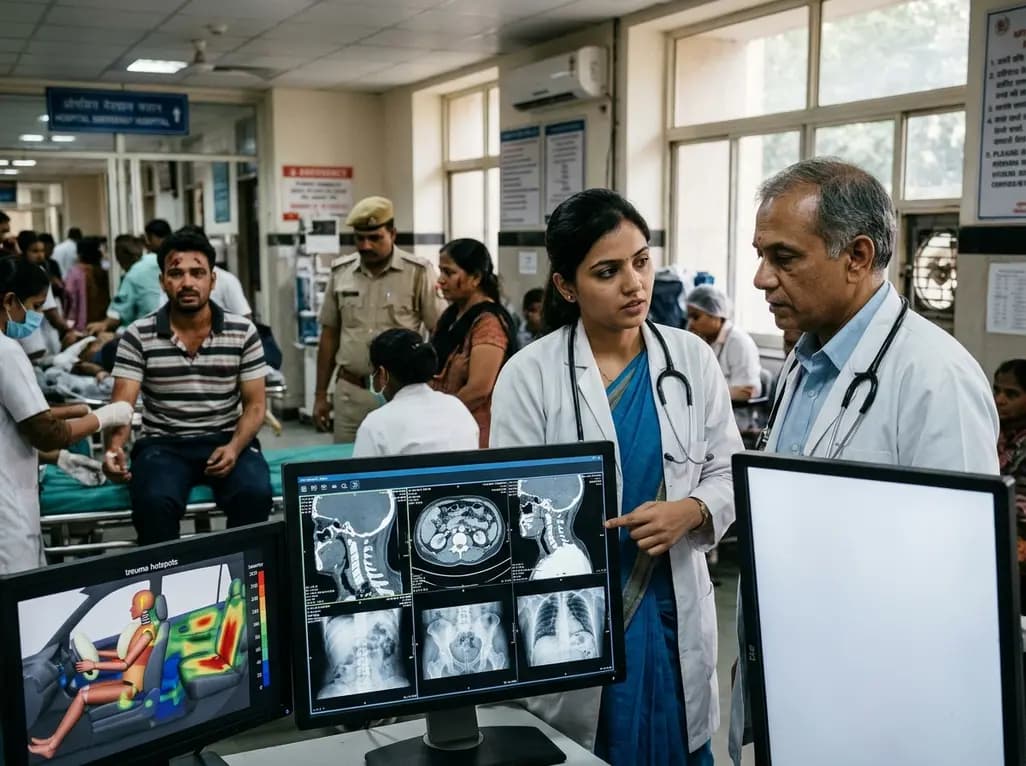
Recent crash analyses demonstrate significant variations in traffic injury severity across vehicle seating positions. Electric vehicle passengers face disproportionately higher trauma risks than drivers, particularly during airbag deployments, demanding adapted emergency assessment and clinical vigilance.
Today

Understand the causal role of Lipoprotein(a) in cardiovascular disease, why international guidelines recommend once-in-a-lifetime molar testing, and the clinical implications of recent phase 3 RNA outcome trials.
Today
