.webp&w=384&q=75)

Loading, please wait...
Loading, please wait...
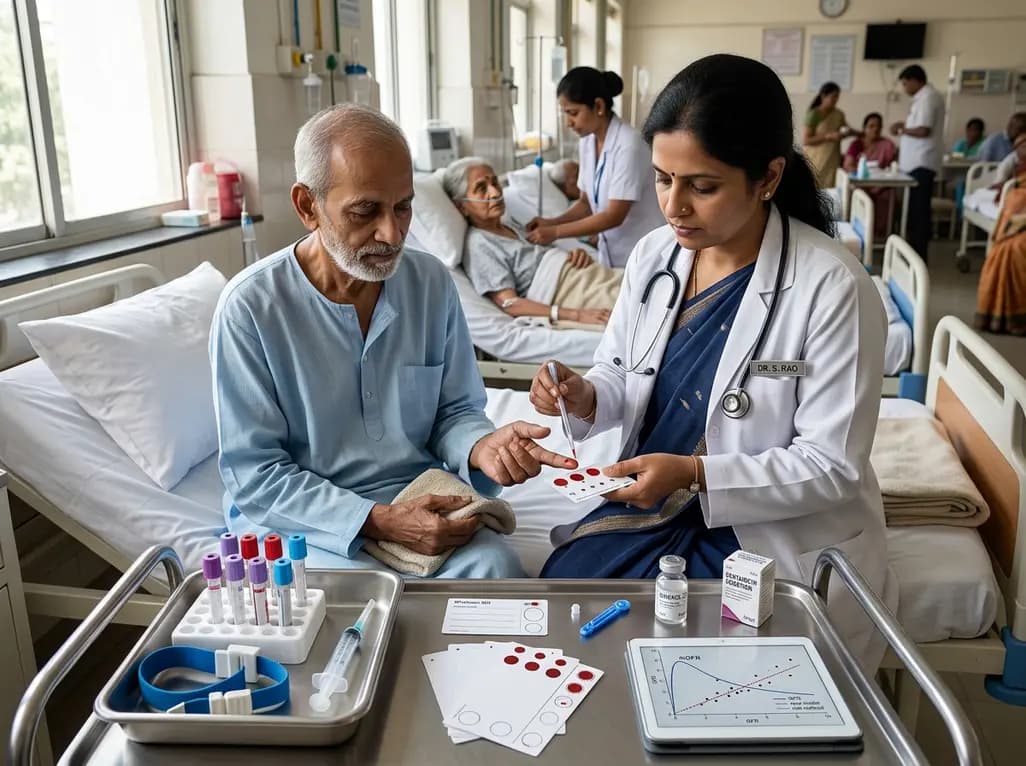
Accurate glomerular filtration rate assessment remains vital for managing renal health in elderly populations. However, traditional intravenous sampling methods are often cumbersome for patients with low appetite or poor venous access. Consequently, this research investigates whether DBS iohexol GFR measurement can reliably replace traditional intravenous techniques in geriatric care. Specifically, using population pharmacokinetic modeling, clinicians can now evaluate renal function with greater convenience. Additionally, this approach enhances diagnostic precision.
Specifically, the study compared dried blood spot sampling of iohexol against intravenous sampling. Furthermore, researchers used gentamicin clearance as a model drug to validate these measurements. Therefore, they assessed how well each method functioned as a covariate in pharmacokinetic models. Accordingly, the results demonstrated that dried blood spot sampling provided significant improvements. Similarly, the findings were comparable to standard intravenous methods. Thus, the interchangeability of these methods is statistically supported. Moreover, the performance statistics were highly encouraging for clinical adoption.
For instance, compared to intravenous iohexol, the dried blood spot method showed a minimal bias. Furthermore, the P15 value reached an impressive 98%. In contrast, intravenous 99mTc-DTPA showed a lower P15 of 78.4%. Additionally, the improvements were greater when clinicians expressed GFR in mL/min rather than indexed for body surface area. Consequently, this approach benefits patients with malnutrition. Notably, the method remains robust across different age groups. Therefore, it offers a versatile solution for renal monitoring.
In particular, measured GFR is often superior to estimated GFR in older medical patients. This is because older individuals often have low muscle mass. Therefore, adopting less invasive techniques is essential in the clinical context. Because dried blood spot sampling simplifies logistics, it reduces patient discomfort. Notably, it maintains high accuracy for drug dosing. Consequently, this technique represents a significant advancement in geriatric diagnostics. Meanwhile, clinicians should consider its broader implementation. Ultimately, this method improves patient outcomes.
DBS sampling of iohexol offers comparable accuracy to intravenous sampling, achieving a P15 of 98%. It is less invasive and more convenient for patients with difficult venous access.
Researchers used gentamicin as a model drug because GFR primarily determines its clearance. This allowed the team to test how well different measurement methods predicted drug clearance in population models.
Disclaimer: This content is for informational and educational purposes only. It does not constitute professional medical advice, diagnosis, or treatment. Always seek the advice of your physician or other qualified health provider with any questions you may have regarding a medical condition. Refer to the latest local and national guidelines for clinical practice.
References

Read summarized clinical updates, watch expert medical content, and earn CME certifications right from your smartphone.
Open your smartphone camera to scan and install.





A new study validates Dried Blood Spot (DBS) iohexol sampling for measuring GFR in older patients with poor appetite. Comparing DBS to traditional IV sampling, researchers found high accuracy (98% P15) and improved model fit for dosing renally cleared drugs like gentamicin.
4 months ago

A breakthrough study evaluated H5N1 transmission efficiency across mammalian isolates. Researchers discovered that human-derived D1.1 harboring the PB2 D701N mutation spread efficiently in ferrets, unlike strains carrying PB2 E627K. This finding highlights critical genetic markers for zoonotic surveillance.
Today

A comparative cohort study evaluates vNOTES vs TLH hysterectomy for benign conditions, demonstrating shorter operative duration, faster return to daily activities, and equivalent female sexual function scores without increased dyspareunia.
Today

Review how tailored exercise programs benefit frail older patients with heart failure. Explore pathophysiological mechanisms, individualized training prescriptions, and strategies to overcome adherence barriers in clinical practice.
Yesterday

This comparative study evaluates posterior labral tears with and without glenohumeral instability, highlighting distinct demographic patterns, MRI underestimation in stable shoulders, and successful arthroscopic repair outcomes.
Yesterday

A clinical study demonstrates that early intervention with tocilizumab, either as monotherapy or bridged with corticosteroids, achieves significant proptosis reduction and resolves active inflammation in treatment-naive thyroid eye disease.
Today
