

Loading, please wait...
Loading, please wait...
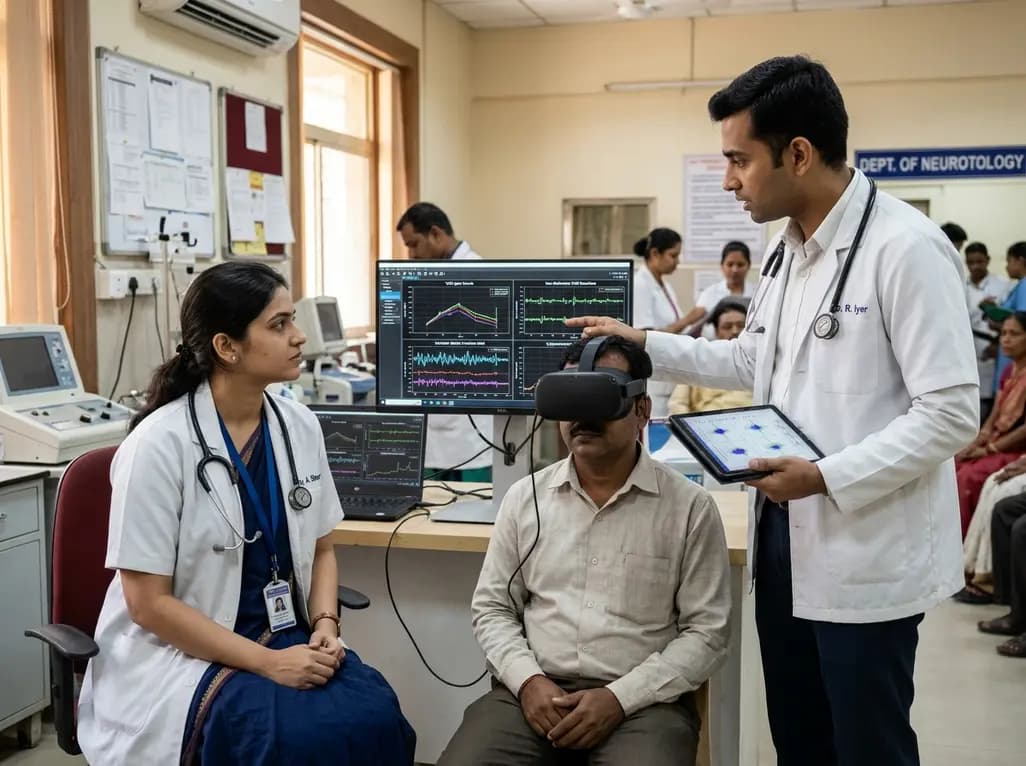
Virtual reality is rapidly expanding across neurological rehabilitation, surgical simulation, and balance training. However, virtual environments frequently cause digital disorientation and nausea, making cybersickness susceptibility a significant therapeutic barrier. Clinicians often assume that baseline vestibular hypersensitivity or subtle ocular motor dysfunction causes these adverse symptoms. Consequently, understanding the true neurophysiological drivers helps healthcare professionals design safer, patient-tailored immersive interventions.
To investigate this neurotological challenge, researchers conducted a prospective single-arm experimental study evaluating thirty-six healthy adults. Clinicians thoroughly assessed participants before immersive virtual reality immersion using comprehensive vestibular and ocular motor testing. Specifically, investigators performed high-resolution video head impulse testing across all three semicircular canals to quantify vestibulo-ocular reflex gains. Additionally, clinicians measured smooth pursuit gain, visual-vestibular interaction, and vestibulo-ocular reflex cancellation dynamics through video-oculography. Each participant also completed validated baseline questionnaires, including the Motion Sickness Susceptibility Questionnaire and the Dizziness Handicap Inventory. Participants subsequently experienced a standardized three-minute passive navigation task within a head-mounted virtual environment displaying dynamic snowy mountain terrain. Immediately following the immersion, clinicians recorded symptom profiles using the Simulator Sickness Questionnaire. Interestingly, baseline vestibular reflex metrics showed no statistically significant correlation with acute post-exposure sickness scores. Neither horizontal canal gains nor vertical semicircular canal responsiveness predicted symptom development during simulated motion. Therefore, peripheral vestibular hyperexcitability or resting canal asymmetry does not inherently determine individual tolerance in immersive digital settings.
Beyond inner ear reflexes, clinicians frequently question whether subtle ocular motor instability provokes digital nausea. Many researchers hypothesized that inefficient gaze-holding or erratic saccadic adjustments during visual flow might amplify motion discomfort. However, the experimental findings demonstrated that baseline smooth pursuit gains failed to correlate with post-immersion discomfort. Participants with high pursuit accuracy experienced identical rates of disorientation compared to those with lower tracking efficiency. Furthermore, cumulative saccadic amplitudes measured during low-frequency vestibular stimulation, visually enhanced reflexes, and reflex suppression showed no meaningful relationship. These objective oculometric measurements confirm that visual tracking pathways operate normally prior to exposure. In other words, individuals who experience severe visual fatigue or nausea do not enter virtual spaces with defective eye movement machinery. Consequently, clinicians must recognize that typical bedside ocular motor testing cannot screen for digital intolerance. Instead, ocular symptoms likely emerge as downstream consequences of perceptual discordance rather than primary oculomotor deficiencies. Clinicians should therefore interpret normal ocular motor exams with appropriate nuance when preparing patients for immersive visual therapy.
Healthcare providers commonly rely on self-reported questionnaires to anticipate clinical vertigo and motion intolerance. For instance, instruments like the Vertigo Symptom Scale and UCLA Dizziness Questionnaire reliably gauge real-world vestibular disability. Nevertheless, the study revealed that subjective scores failed to predict simulator sickness severity. Even validated tools such as the Visually Induced Motion Sickness Susceptibility Questionnaire showed no meaningful statistical correlation. Consequently, a patient who reports frequent car sickness may tolerate immersive medical simulations surprisingly well. Conversely, an individual with zero prior history of motion intolerance may develop abrupt nausea and oculomotor strain during head-mounted display use. This dissociation indicates that subjective vulnerability scales capture ecological motion patterns rather than visual-inertial discrepancies specific to virtual environments. Clinicians should therefore avoid relying exclusively on static historical surveys to exclude patients from beneficial digital therapies. Instead, clinical teams must adopt graded exposure protocols and real-time physiological monitoring to evaluate practical tolerance accurately. By adopting individualized trial sessions, medical teams can safely navigate unexpected symptom emergence across diverse patient populations.
Because peripheral reflexes and standard ocular tests fail to explain symptoms, central processing mechanisms become the primary scientific explanation. Cybersickness susceptibility appears to reflect a higher-level mismatch in sensorimotor integration within central neural networks. When a user navigates a virtual landscape, dynamic optical flow signals robust self-motion across wide retinal fields. In contrast, the peripheral otoliths and semicircular canals register minimal physical acceleration while the body remains stationary. The cerebral cortex and cerebellum must constantly resolve this profound sensory conflict by updating internal predictive models. When central neural recalibration cannot adapt quickly enough, the brain generates visceral distress, autonomic arousal, and subjective disorientation. Consequently, individual susceptibility depends heavily on how rapidly the central nervous system reweights contradictory visual, vestibular, and proprioceptive inputs. Young healthy adults exhibit substantial differences in central sensorimotor plasticity, explaining divergent outcomes under identical visual exposures. Future neuroimaging and electrophysiological research must therefore explore cortical connectivity to decode how predictive processing modulates this digital discomfort.
These neurotological findings carry immediate practical significance for modern healthcare delivery and medical training. Virtual reality platforms increasingly support physical therapy, stroke rehabilitation, Parkinson's disease gait training, and cognitive retraining across clinics. Furthermore, surgical trainees frequently practice complex endoscopic and open procedures inside immersive three-dimensional environments. When digital sickness interrupts these therapeutic or instructional sessions, patient compliance drops and training efficiency suffers. Because standard vestibular screening does not identify vulnerable individuals, clinicians must structure therapeutic VR sessions with preventive safeguards. Clinicians should implement gradual habituation schedules, starting with static visual anchors and short exposure durations before progressing to dynamic navigation. Additionally, software designers must minimize system latency and optimize visual flow rates to reduce conflicting sensory signals. Clinicians working in neurotology and otolaryngology can reassure affected individuals that their symptoms do not indicate inner ear damage or neurological disease. Instead, structured desensitization protocols can enhance central sensory tolerance, ensuring equitable access to advancing digital health technologies.
No, clinical evidence demonstrates that baseline vestibulo-ocular reflex function does not correlate with cybersickness severity. Healthy individuals with entirely normal reflex gains across all semicircular canals still experience substantial nausea and disorientation during virtual immersion. Therefore, peripheral vestibular sensitivity does not determine digital motion intolerance. Instead, symptoms arise from higher-level central processing conflicts between conflicting visual movement cues and static inner ear signals.
Clinical questionnaires rarely predict individual tolerance to immersive environments accurately. Standard screening instruments like the Motion Sickness Susceptibility Questionnaire evaluate real-world physical motion rather than artificial optical flow. Consequently, patients who experience car sickness may tolerate virtual therapy comfortably, whereas individuals without prior history may develop severe disorientation. Clinicians should therefore implement brief, graded trial sessions rather than relying solely on subjective questionnaires.
Clinicians can minimize digital sickness by introducing short initial sessions and providing stable visual reference frames within the simulation. Gradually increasing visual motion complexity allows the central nervous system to adapt without triggering severe autonomic distress. Furthermore, optimizing hardware refresh rates, minimizing display latency, and encouraging brief rest breaks significantly reduce sensory conflict. These practical adaptations enhance patient comfort and support long-term adherence during therapy.
Disclaimer: This content is for informational and educational purposes only and should not be considered professional medical advice. Refer to the latest local and national guidelines for clinical practice.
References

Read summarized clinical updates, watch expert medical content, and earn CME certifications right from your smartphone.
Open your smartphone camera to scan and install.





A prospective experimental study shows that cybersickness susceptibility does not stem from baseline vestibulo-ocular reflex gains or ocular motor deficits. Instead, higher-level multisensory discordance drives digital motion sickness, reshaping how clinicians view VR-based medical simulation and neurotology.
Today

A 12-week pilot study evaluated the Breathe Digital Ecosystem, which integrates smart inhaler caps, mobile spirometry, and environmental tracking to improve asthma control, medication adherence, and clinical partnership.
Today

A cross-sectional study of 4,862 women highlights how metabolic phenotypes alter female reproductive impairment. Metabolically unhealthy overweight and obesity presented the greatest odds for infertility and impaired fecundity, underscoring the vital need for comprehensive cardiometabolic screening.
Yesterday

A recent preclinical study demonstrates that physiological levels of ascorbate (150 µM) and catechin (5 µM) provide robust protection against myocardial ischemia-reperfusion injury by preventing lipid peroxidation and cardiomyocyte apoptosis, challenging traditional high-dose pharmacological strategies.
Today
Primary spinal bone tumors can mimic benign nerve sheath tumors as foraminal dumbbell lesions. Learn to recognize crucial CT red flags and prevent delays.
Today

Researchers have engineered a resilient LC-PAM hydrogel that resolves the trade-off between toughness and elasticity. Incorporating lignin and cellulose nanoparticles alongside selenium, this biomaterial offers durable adhesion and antibacterial activity for complex infected and diabetic wound care.
Today
