.webp&w=384&q=75)

Loading, please wait...
Loading, please wait...
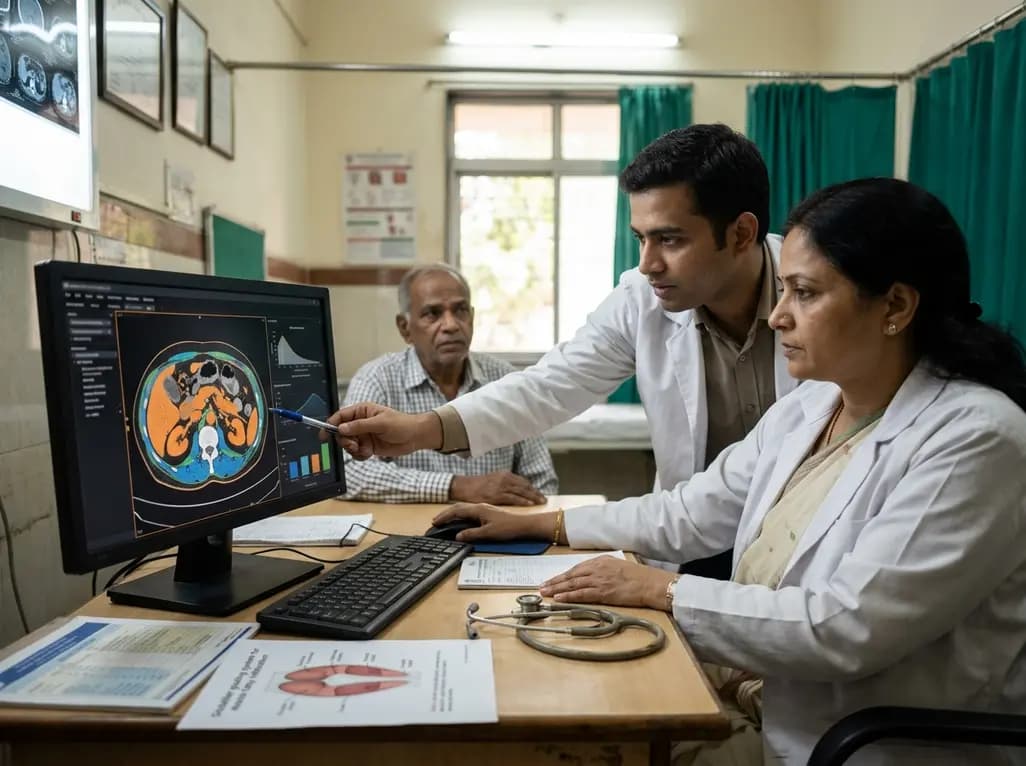
Modern oncology relies on precise metabolic profiling to improve patient outcomes. Recent research highlights CT body composition analysis for quantifying tissues in abdominal malignancies. This retrospective study specifically compared two semi-automated software tools: CoreSlicer and AsanJ-Morphometry. Clinicians analyzed CT scans at the L3 level to identify sarcopenia more reliably. Consequently, this data allows for better risk stratification before major medical interventions.
The study demonstrated high agreement between CoreSlicer and AsanJ-Morphometry for muscle parameters. Researchers found that both platforms provide consistent quantitative measurements for clinical use. However, they also noted some systematic differences between the tools. Therefore, clinicians should not use these software platforms interchangeably for one patient. Instead, practitioners should choose one platform for all longitudinal follow-ups. This consistency ensures that muscle changes reflect physiology rather than software bias.
Beyond quantitative software, the Goutallier classification serves as a valuable qualitative tool. The study revealed that higher Goutallier grades correlate with lower muscle density. Furthermore, combining quantitative data with qualitative grading improves sarcopenia assessment. This integrated approach helps physicians predict outcomes more accurately in cancer patients.
It provides precise measurements of muscle mass and fat distribution. This information helps identify sarcopenia, which is a major prognostic factor for treatment toxicity and survival in cancer patients.
While software tools like CoreSlicer and AsanJ-Morphometry show high agreement, researchers found systematic differences. Consequently, using the same software for follow-up scans is recommended to maintain measurement accuracy.
The Goutallier classification is a qualitative scale that assesses fatty infiltration in muscles. It helps clinicians understand muscle quality, which is just as important as muscle quantity in diagnosing sarcopenia.
Disclaimer: This content is for informational and educational purposes only. It does not constitute medical advice or a professional diagnosis. Always seek the advice of your physician or another qualified health provider with any questions you may have regarding a medical condition. Refer to the latest local and national guidelines for clinical practice.
References
Acar AG et al. Agreement Between Semi-Automated CT-Based Body Composition Software and Qualitative Muscle Assessment in Sarcopenia: A Comparative Study in Abdominal Malignancies. J Imaging Inform Med. 2026 Jun 11. doi: 10.1007/s10278-026-02042-7. PMID: 42277545.
Mourtzakis M, et al. A practical and precise approach to quantification of body composition in cancer patients using computed tomography images acquired during routine care. Appl Physiol Nutr Metab. 2008;33(5):997-1006.
Prado CM, et al. Prevalence and clinical implications of sarcopenic obesity in patients with solid tumours of the respiratory and gastrointestinal tracts: a population-based study. Lancet Oncol. 2008;9(7):629-635.

Read summarized clinical updates, watch expert medical content, and earn CME certifications right from your smartphone.
Open your smartphone camera to scan and install.





New research evaluates the agreement between semi-automated CT software and qualitative muscle assessment for sarcopenia in abdominal malignancies. Discover how quantitative tools and Goutallier grading enhance clinical precision for cancer care.
4 months ago

Review how tailored exercise programs benefit frail older patients with heart failure. Explore pathophysiological mechanisms, individualized training prescriptions, and strategies to overcome adherence barriers in clinical practice.
Today

Leucine Rich Bio has introduced South Asia's first comprehensive vaginal microbiome test, BugSpeaks. By profiling microbial dysbiosis, pathogens, and antimicrobial resistance, this next-generation diagnostic platform provides clinicians with deeper insights into recurrent infections, fertility, and reproductive health.
Today

In high-risk pulmonary embolism complicated by severe anemia and active uterine bleeding, systemic thrombolysis is contraindicated. Large-bore aspiration thrombectomy provides rapid hemodynamic rescue without fibrinolysis, supported by inferior vena cava filter placement and multidisciplinary critical care.
Today

This comparative study evaluates posterior labral tears with and without glenohumeral instability, highlighting distinct demographic patterns, MRI underestimation in stable shoulders, and successful arthroscopic repair outcomes.
Today

A clinical study demonstrates that early intervention with tocilizumab, either as monotherapy or bridged with corticosteroids, achieves significant proptosis reduction and resolves active inflammation in treatment-naive thyroid eye disease.
Today
