.webp&w=384&q=75)

Loading, please wait...
Loading, please wait...
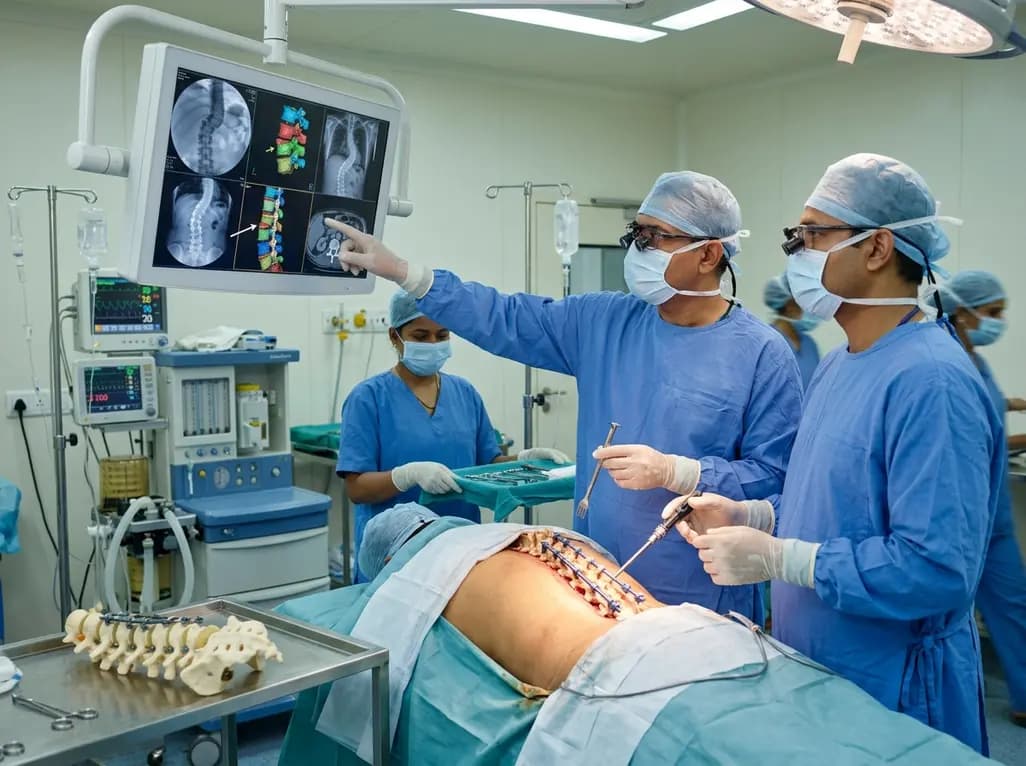
Adult spinal deformity represents a growing global health challenge that significantly reduces quality of life and functional independence among aging populations. Managing this complex condition often requires advanced surgical reconstruction to restore sagittal alignment and correct severe mechanical imbalances. For decades, spinal surgeons have relied on complex three-column osteotomies to achieve adequate lordotic realignment when conservative management fails. Pedicle subtraction osteotomy has traditionally served as the primary procedure for rigid sagittal malalignment, providing substantial focal angular correction. However, clinical experience shows that standard techniques face notable biomechanical limitations, particularly in patients with severe rigid deformities or prior fusion surgeries. Consequently, clinical investigators have developed innovative variations, such as corner osteotomy, to surpass these physical boundaries. Evaluating surgical options for adult spinal deformity demands a thorough analysis of sagittal alignment, patient safety, surgical risk, and long-term mechanical stability. Comparing outcomes between traditional pedicle subtraction osteotomy and corner osteotomy provides crucial guidance for spine specialists aiming to optimize overall clinical care.
Pedicle subtraction osteotomy is widely recognized as an effective procedure for restoring sagittal alignment in patients suffering from severe sagittal imbalance. The standard procedure involves removing a V-shaped wedge from the posterior element and vertebral body, allowing the posterior column to collapse and close the wedge space. Although this procedure provides significant focal correction, usually ranging between 30 and 40 degrees, it possesses intrinsic geometric limits. Spine surgeons frequently encounter scenarios where pedicle subtraction osteotomy fails to yield sufficient angular correction, especially when treating patients with an exceptionally large pelvic incidence. Additionally, patients who have previously undergone extensive spinal fusion present rigid structural anatomy that restricts the hinged closure of a standard pedicle wedge. Attempting to force larger corrections through a standard pedicle wedge can increase stress on surrounding neurovascular structures and compromise vertebral body support. Furthermore, high mechanical stress concentrated at a single osteotomy site frequently predisposes the construct to fatigue failure, leading to rod fracture.
Corner osteotomy has emerged as a novel three-column resection technique designed to overcome the intrinsic angular restrictions of standard pedicle subtraction. By strategically modifying the bony resection boundaries and shift points along the posterior corner of the vertebral body, surgeons can achieve a significantly wider range of angular corrections. Theoretically, corner osteotomy allows the surgical team to adjust the pivot point during wedge closure, thereby maximizing focal segmental lordosis while maintaining structural integrity. This refined structural approach is particularly useful for patients requiring custom angular adjustments exceeding 45 degrees. Moreover, corner osteotomy distributes mechanical loads across a broader bony interface, which helps reduce localized stress concentrations on posterior spinal instrumentation. By optimizing the contact area during bone closure, corner osteotomy promotes favorable conditions for osseous fusion across the resected vertebral segment. Surgeons performing adult spinal deformity correction can utilize this technique to address complex, rigid sagittal malalignments without requiring multiple high-risk osteotomies.
Evaluating radiographic parameters before and after reconstructive surgery provides valuable insights into the efficacy of distinct osteotomy techniques. A comprehensive comparative evaluation between pedicle subtraction osteotomy and corner osteotomy revealed clear differences in segmental correction capabilities. Patients undergoing corner osteotomy achieved significantly greater postoperative segmental lordosis angles compared to those undergoing standard pedicle subtraction. Specifically, corner osteotomy demonstrated a mean postoperative segmental angle of 39.3 degrees, whereas standard pedicle subtraction yielded a mean angle of 35.0 degrees. Furthermore, the overall degree of segmental angle correction was markedly higher in the corner group, reaching nearly 40 degrees compared to approximately 35 degrees in the traditional group. Crucially, corner osteotomy demonstrated a considerably broader dynamic range of achievable segmental corrections, expanding from 18 to 61 degrees, compared to the 18 to 51 degree range observed with standard pedicle subtraction. This expanded range allows spine surgeons to address extreme sagittal mismatch in patients with high pelvic incidence.
Surgical decision-making in adult spinal deformity reconstructive surgery must balance mechanical corrective power against patient safety and perioperative risk. While technical execution is vital, parameters such as operative duration, intraoperative hemorrhage, and long-term hardware survival directly impact patient outcomes. Clinical comparative data reveals distinct operational differences between corner osteotomy and standard pedicle subtraction osteotomy. Performing a corner osteotomy involves refined bony resection and meticulous hinge manipulation, which translated to a slightly longer operative time compared to standard pedicle subtraction. Specifically, mean surgical duration was approximately 342 minutes in the corner osteotomy group versus 317 minutes in the pedicle subtraction group. However, despite the longer operative time, corner osteotomy resulted in significantly lower estimated intraoperative blood loss, averaging around 2465 mL compared to 2841 mL in the standard cohort. Reduced blood loss is a crucial clinical advantage, as massive intraoperative hemorrhage correlates with severe systemic complications. Crucially, corner osteotomy demonstrated a remarkable reduction in post-operative rod fracture rates.
The comparative findings between corner osteotomy and traditional pedicle subtraction osteotomy mark a critical advancement in complex spine reconstruction. For patients with severe adult spinal deformity, particularly those with previously failed fusions or high pelvic incidence, corner osteotomy offers a powerful alternative that breaks through historical correction limits. By achieving greater segmental lordosis, providing a wider dynamic correction range, reducing estimated blood loss, and drastically decreasing rod fracture rates, corner osteotomy addresses key vulnerabilities long associated with major three-column resections. Spine specialists should carefully consider patient-specific anatomical characteristics, bone quality, and sagittal balance goals when selecting the optimal osteotomy technique. Although corner osteotomy requires slightly longer operative times due to precise technical maneuvers, the significant decrease in blood loss and hardware failure provides a compelling rationale for its adoption in experienced surgical centers. Future prospective clinical studies will further validate these long-term clinical and functional outcomes across diverse adult spinal deformity patient populations.
Corner osteotomy is an advanced three-column resection technique used in adult spinal deformity surgery. It modifies bony wedge boundaries and pivot points at the vertebral corner, allowing spine surgeons to achieve greater segmental lordotic correction and a broader range of correction angles than traditional pedicle subtraction osteotomy.
Clinical studies demonstrate that corner osteotomy results in significantly lower estimated blood loss compared to traditional pedicle subtraction osteotomy. Although corner osteotomy requires slightly longer operative time due to meticulous bony resection, reduced intraoperative bleeding enhances patient safety during complex adult spinal deformity procedures.
Yes, clinical comparative research shows that corner osteotomy significantly lowers the frequency of rod fractures compared to pedicle subtraction osteotomy. By optimizing biomechanical load distribution across the resected vertebral segment, corner osteotomy reduces mechanical stress concentration on posterior spinal instrumentation, improving overall construct longevity.
Disclaimer: This content is for informational and educational purposes only and does not constitute medical advice, diagnosis, or treatment. Always seek the advice of a qualified healthcare provider with any questions you may have regarding a medical condition or clinical decision-making. Refer to the latest local and national guidelines for clinical practice.
References
Lee KY et al. Corner Osteotomy As the More Advanced Approach to Deformity Correction in Adult Spinal Deformity: A Retrospective Comparative Study Between Two Osteotomy Techniques. Spine (Phila Pa 1976). 2025 Jun 15. doi: 10.1097/BRS.0000000000005124. PMID: 39177114.
Schwab F, Patel A, Ungar B, et al. Adult spinal deformity-postoperative standing imbalance: how much correction is needed? Spine (Phila Pa 1976). 2010;35(26):2224-2231.

Read summarized clinical updates, watch expert medical content, and earn CME certifications right from your smartphone.
Open your smartphone camera to scan and install.





A retrospective comparative study reveals that corner osteotomy provides superior segmental angle correction, reduced estimated blood loss, and significantly lower rod fracture rates compared to traditional pedicle subtraction osteotomy in adult spinal deformity surgery.
2 months ago

Discover the crucial role of glymphatic dysfunction in stroke, where perivascular clearance failure and neuroinflammation exacerbate cerebral edema and post-stroke brain injury.
Today

A prenatal case highlights severe glutaric acidemia type II presenting as bilateral hyperechoic cystic kidneys at 18 weeks. Whole-exome sequencing revealed a novel homozygous ETFDH frameshift variant, demonstrating the power of rapid genetic testing in fetal renal anomalies.
Today

Review how tailored exercise programs benefit frail older patients with heart failure. Explore pathophysiological mechanisms, individualized training prescriptions, and strategies to overcome adherence barriers in clinical practice.
Yesterday

This comparative study evaluates posterior labral tears with and without glenohumeral instability, highlighting distinct demographic patterns, MRI underestimation in stable shoulders, and successful arthroscopic repair outcomes.
Yesterday

A clinical study demonstrates that early intervention with tocilizumab, either as monotherapy or bridged with corticosteroids, achieves significant proptosis reduction and resolves active inflammation in treatment-naive thyroid eye disease.
Yesterday
