.webp&w=384&q=75)

Loading, please wait...
Loading, please wait...

Conversational AI in healthcare is rapidly becoming a cornerstone of digital health management. Medical professionals are increasingly using these tools to bridge the gap between clinical visits and daily patient support. However, many practitioners still question how these digital agents actually drive positive outcomes. A recent integrative review of 65 studies offers new clarity on this topic by examining communication processes.
The research identifies four distinct roles for these AI agents. Specifically, they act as information communicators, behavioral interventionists, emotional supporters, and service mediators. For example, an emotional supporter provides empathy to patients during stressful recovery periods. Furthermore, as behavioral interventionists, these tools help patients stick to complex medication schedules or lifestyle changes.
To optimize these interactions, the study introduces the Conversational AI-Mediated Health Communication (CA-MHC) framework. Consequently, this model helps developers and clinicians understand why outcomes differ across various settings. The framework focuses on interaction patterns and relationship strength as core dimensions. Additionally, it considers temporal orientation and institutional embedding as key success factors for clinical integration.
Ultimately, the fit between the AI agent's role and the clinical context determines its overall success. For instance, a service mediator might excel in administrative tasks but struggle with deep emotional support. Practitioners must therefore select AI tools that align strictly with their specific patient needs. This strategic approach ensures that conversational AI in healthcare enhances rather than hinders the patient experience.
AI agents typically function as information communicators, behavioral interventionists, emotional supporters, or service mediators to support patient health journeys.
The CA-MHC framework is a conceptual model that evaluates AI effectiveness based on interaction patterns, relationship strength, time orientation, and institutional integration.
Disclaimer: This content is for informational and educational purposes only. It does not constitute professional medical advice, diagnosis, or treatment. Always seek the advice of your physician or other qualified health provider with any questions you may have regarding a medical condition. Refer to the latest local and national guidelines for clinical practice.
References
Wang Z et al. Use and Efficacy of Conversational AI in Health Management: An Integrative Review. J Health Commun. 2026 Jun 10. doi: 10.1080/10810730.2026.2682496. PMID: 42271198.
Uddin J. Conversational AI in healthcare communication: opportunities, risks, and implications for health equity. J Commun Healthc. 2025 Nov 30. doi: 10.1080/17538068.2025.2594768.
Hossain M et al. Applications of artificial intelligence-based conversational agents in healthcare: A systematic umbrella review. Int J Med Inform. 2025. doi: 10.1016/j.ijmedinf.2025.106204.

Read summarized clinical updates, watch expert medical content, and earn CME certifications right from your smartphone.
Open your smartphone camera to scan and install.





A review of 65 studies explores the efficacy of conversational AI in healthcare. It identifies roles like emotional supporter and behavioral interventionist, while proposing the CA-MHC framework to optimize communication outcomes in various clinical contexts.
2 months ago

A new study reveals that lipid-related metabolic dysregulation, marked by elevated TG/HDL-C ratio and glymphatic changes, independently impacts survival in idiopathic normal pressure hydrocephalus.
Today

Explore real-world data showing how private oncogenetics and molecular tumor boards achieve 3-week consult turnaround, high ctDNA actionability, and vital germline variant detection, enhancing individualized cancer care and familial risk assessment.
Today

A meta-analysis of 13 propensity score-matched studies shows ViV-TAVR delivers lower early mortality and reduced bleeding compared to redo-SAVR for degenerated bioprosthetic aortic valves, though long-term hemodynamics warrant careful anatomical and patient-centered evaluation.
Today
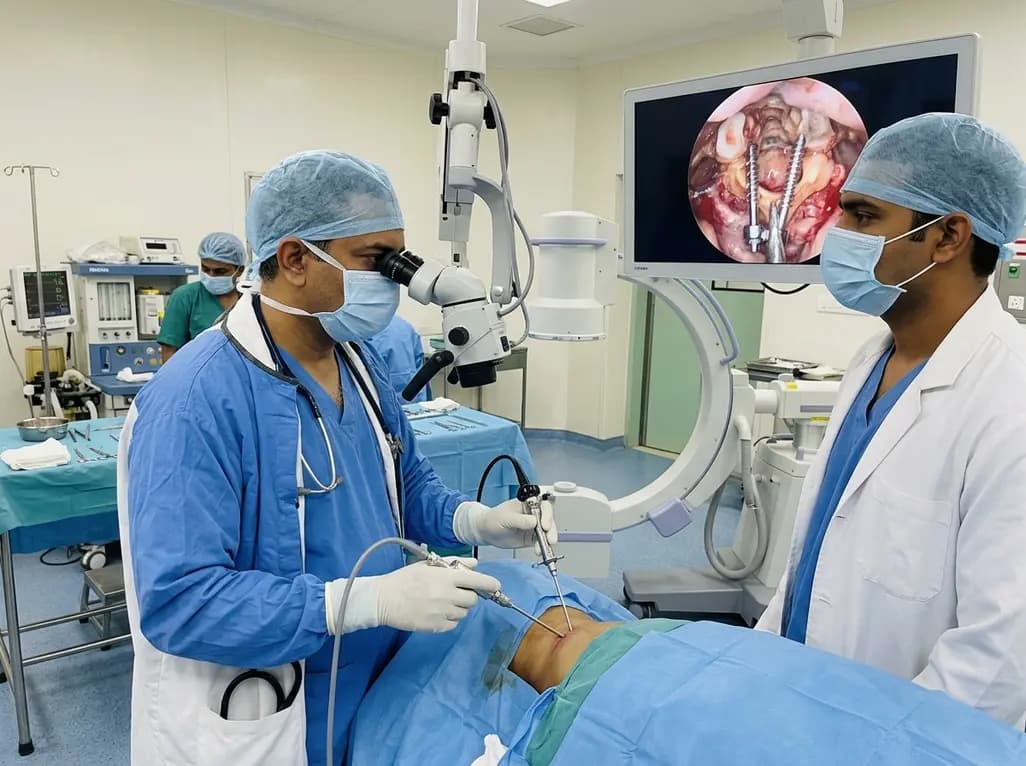
Endoscopic posterior cervical fusion combines minimally invasive decompression, joint preparation, and rigid screw-rod fixation for atlantoaxial pathologies. Early clinical findings demonstrate solid bony union, excellent symptom relief, and minimal soft-tissue morbidity without significant vascular compromise.
Yesterday

The All-India Food Processors' Association has approached the Supreme Court to oppose FSSAI's proposed per-100g benchmark for front-of-pack warning labels, advocating instead for a per-serving threshold. We explore the regulatory showdown, nutritional evidence, and implications for clinical lifestyle counseling.
Today
