.webp&w=384&q=75)

Loading, please wait...
Loading, please wait...

Evaluating body composition remains a cornerstone of preventive healthcare and cardiometabolic risk assessment. While clinical practice heavily relies on body mass index, this standard metric fails to distinguish fat distribution from lean muscle mass. To address this limitation, researchers recently developed the composite body shape index to capture comprehensive morphological features. This innovative tool integrates adiposity, skeletal muscle function, and body proportions into a unified metric, establishing sex- and age-specific reference centiles for adult disease screening.
Conventional screening approaches in primary care primarily depend on body mass index and waist circumference. However, body mass index cannot differentiate between protective skeletal muscle and pathogenic visceral adipose tissue. Consequently, many normal-weight individuals harbor substantial metabolic dysregulation, whereas muscular individuals are frequently misclassified as overweight. Furthermore, conventional measurements overlook structural proportions and regional adiposity distribution, which critically dictate cardiometabolic outcomes. These diagnostic blind spots are particularly problematic in Asian populations, where metabolic disorders often emerge at lower baseline body mass index thresholds. Therefore, relying solely on simple weight-to-height ratios obscures subclinical risk factors and delays necessary preventative interventions. Additionally, traditional anthropometry neglects the gradual loss of muscle strength that occurs during normal aging. As a result, clinicians often miss the progressive development of sarcopenic obesity in routine checkups. A comprehensive multi-parameter evaluation system provides the granular physiological data required to identify early cardiovascular, endocrine, and musculoskeletal pathology across diverse demographic cohorts.
To overcome standard measurement limitations, investigators analyzed extensive data from the China National Health Survey collected between 2023 and 2025 across six provinces. The researchers constructed sex- and age-specific percentile curves for body shape indicators using the robust Lambda-Mu-Sigma method. Subsequently, they applied sex-stratified exploratory factor analysis with varimax rotation to synthesize key metrics into the composite body shape index. This multidimensional metric uniquely merges adiposity distribution, functional muscle measures, and structural body proportions. The investigative cohort comprised a primary training population of 11,220 adults and an independent validation cohort of 5,745 participants. Significantly, the derived reference centiles illustrate how body shape trajectories differ markedly between men and women throughout adulthood. By accounting for natural physiological shifts over the human lifespan, the system establishes precise baseline thresholds that reflect genuine phenotypic changes rather than static, one-size-fits-all parameters.
The study revealed striking associations between elevated shape scores and multi-organ chronic morbidities. Specifically, participants with elevated scores demonstrated substantial increases in disease vulnerability compared to baseline reference groups. When researchers evaluated participants with composite body shape index values exceeding 0.5, they observed over a six-fold elevation in hypertension odds. Similarly, the risk of developing hyperuricemia was more than five times higher in these individuals. Moreover, elevated scores correlated strongly with increased odds of dyslipidemia, stroke, and chronic kidney disease. Endocrine and cardiovascular pathologies, including type 2 diabetes, abnormal electrocardiograms, and coronary heart disease, were also significantly heightened. Furthermore, the index captured a higher prevalence of debilitating musculoskeletal disorders, underscoring its utility across multiple physiological domains. Importantly, these pronounced associations remained statistically robust across the independent validation population and persisted among older adults aged sixty years and above.
The primary clinical objective of developing new anthropometric indices is providing superior discriminatory power over established metrics. In this investigation, researchers assessed the incremental diagnostic value of adding the composite body shape index to traditional BMI-based clinical models. They utilized integrated discrimination improvement and category-free net reclassification improvement analyses to evaluate performance. The statistical models confirmed that integrating composite shape parameters produced significant positive integrated discrimination improvement values across all evaluated chronic diseases. Additionally, the category-free net reclassification improvement demonstrated marked enhancement in correctly identifying high-risk individuals who were previously miscategorized. Consequently, clinicians can identify vulnerable patients much earlier in the disease trajectory, enabling targeted behavioral and pharmacological interventions. Incorporating this multidimensional assessment into routine practice therefore substantially sharpens diagnostic precision without requiring expensive or invasive diagnostic equipment.
Aging induces complex shifts in body composition, characterized by progressive muscle loss and concurrent visceral fat accumulation. Because standard body mass index remains relatively stable despite these internal changes, sarcopenia often goes undetected in aging populations. The age- and sex-specific reference centiles established in this survey dynamically mirror these morphological transitions across decades. Consequently, tracking these trajectories enables primary care physicians and geriatricians to identify muscle wasting and functional decline at an early, reversible stage. Moreover, the index facilitates timely lifestyle modifications, including resistance training and personalized protein nutrition, before significant frailty ensues. In clinical environments managing high disease burdens, this composite tool offers an accessible, cost-effective screening modality. Ultimately, integrating comprehensive shape centiles into routine adult care can transform preventive medicine and promote healthy longevity across diverse communities.
Implementing comprehensive anthropometric profiling into daily clinical workflows provides substantial public health advantages. For instance, physicians can easily calculate these integrated shape metrics during outpatient checkups using simple bedside measurements. Furthermore, this approach eliminates the necessity for expensive dual-energy X-ray absorptiometry scans during preliminary population-level risk stratifications. By simultaneously highlighting visceral adiposity accumulation and musculoskeletal decline, the composite scoring system bridges the gap between basic anthropometry and advanced metabolic profiling. In addition, health systems can readily integrate these algorithms into electronic medical record software to generate automated alerts for high-risk patients. Thus, healthcare providers can initiate targeted lifestyle counseling, order appropriate diagnostic investigations, and optimize preventative therapies well before severe end-organ damage manifests. This scalable model represents a practical blueprint for proactive chronic disease management worldwide.
The composite body shape index is an integrated anthropometric metric designed to assess multi-system chronic disease risk. It combines measures of body fat distribution, functional muscle status, and anatomical body proportions using exploratory factor analysis. By comparing an individual's measurements against age- and sex-specific reference curves, the index provides a more comprehensive evaluation of metabolic and physical health than standard body mass index alone.
Traditional body mass index only evaluates total body weight relative to height, failing to distinguish between fat mass and lean muscle tissue. Consequently, it often overlooks sarcopenic obesity and central visceral adiposity. The composite body shape index resolves these limitations by incorporating regional adiposity, skeletal muscle function, and structural proportions. This comprehensive approach significantly improves statistical reclassification and disease risk discrimination across diverse populations.
Elevated scores on the composite index strongly correlate with an increased likelihood of several major chronic conditions. Specifically, it effectively screens for cardiovascular disorders such as hypertension, coronary heart disease, stroke, and abnormal electrocardiograms. Additionally, the index identifies elevated risks for metabolic conditions like type 2 diabetes, dyslipidemia, and hyperuricemia, as well as chronic kidney disease and age-related musculoskeletal disorders.
Disclaimer: This content is for informational and educational purposes only. It is not intended to be a substitute for professional medical advice, diagnosis, or treatment. Always seek the advice of your physician or other qualified health provider with any questions you may have regarding a medical condition. Refer to the latest local and national guidelines for clinical practice.
References

Read summarized clinical updates, watch expert medical content, and earn CME certifications right from your smartphone.
Open your smartphone camera to scan and install.





A nationwide health survey establishes a composite body shape index combining adiposity, muscle function, and body proportions to dramatically improve chronic disease identification and sarcopenia screening over standard BMI.
last month

A systematic review of 41 preclinical studies reveals that baicalin dampens systemic inflammation, inhibits NF-κB and NLRP3 pathways, and improves organ preservation in sepsis models. However, substantial study heterogeneity and a complete lack of human clinical trials highlight the need for further translational research.
Today
Discover the crucial distinctions between mesonephric and mesonephric-like proliferations of the female genital tract. Learn the key histomorphologic, immunohistochemical, and molecular differences essential for accurate diagnosis and clinical management.
Today
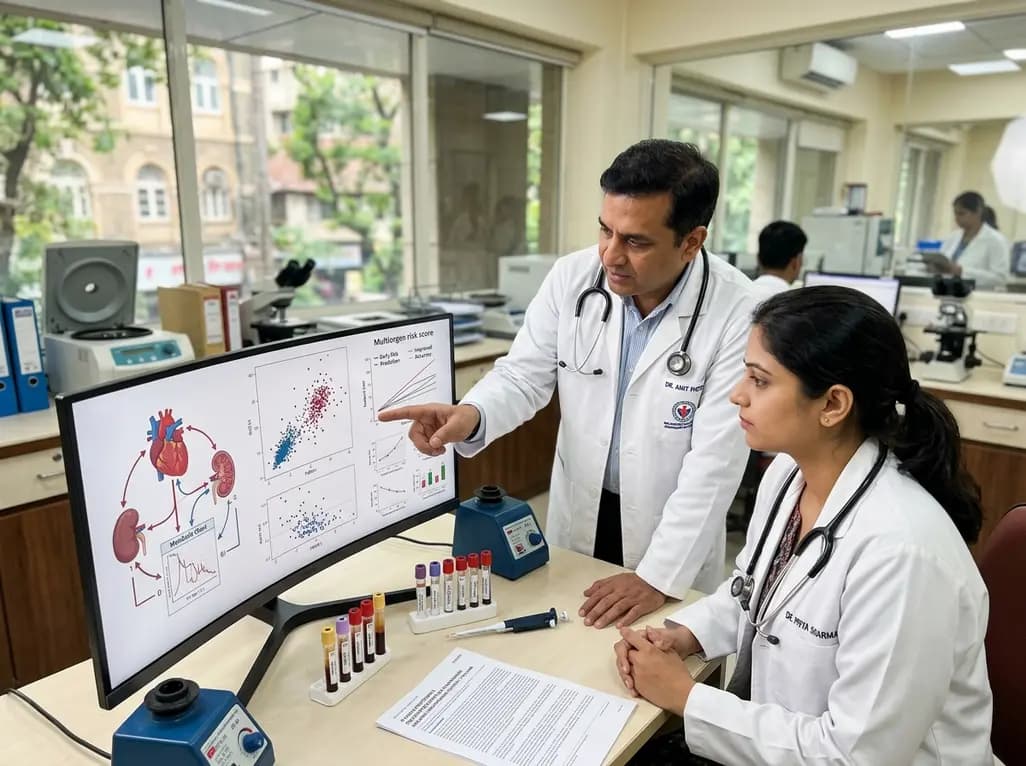
A large UK Biobank study reveals that plasma proteomic signatures capture preclinical organ damage and improve multiorgan risk prediction across early CKM syndrome stages 0 to 2 beyond traditional PREVENT clinical models.
Today
A narrative review investigates whether the articularis genus muscle functions as an independent anatomical entity or blends with the vastus intermedius. We evaluate its morphology, role in retracting the suprapatellar bursa, and direct clinical significance in anterior knee pain and arthroplasty.
Today

A Bayesian multilevel meta-analysis reveals that aerobic training combined with moderate carbohydrate restriction modestly lowers HbA1c in type 2 diabetes. However, sparse data and very low certainty leave incremental benefits over exercise or diet alone unproven, highlighting the need for individualized care.
Today
