.webp&w=384&q=75)

Loading, please wait...
Loading, please wait...

Public health officials in the United States are confronting a substantial resurgence of rubeola infections as national case numbers climb rapidly. Consequently, federal authorities face intense scrutiny surrounding the documentation of measles deaths. Meanwhile, the US Centers for Disease Control and Prevention is collaborating with state epidemiologists. Together, they plan to establish an updated, standardized case definition for measles-related mortality.
Recent epidemiological reports indicate that national measles infections have surpassed 3,470 confirmed cases. Thus, public health surveillance systems face unprecedented strain across multiple jurisdictions. In particular, Pennsylvania reported four fatalities associated with its ongoing outbreak, which involved two infants and two adults. However, the national tally published by federal authorities still recorded zero fatal cases for the current year. This divergence stems from an operational shift within federal tracking procedures. Specifically, federal officials moved away from relying solely on rapid state health department notifications. Instead, they transitioned to using vital statistics from the National Center for Health Statistics. Although this approach ensures rigorous verification through formal death certificates, it inevitably introduces substantial reporting lags. Furthermore, vital statistics rely strictly on underlying causes of death recorded by medical certifiers. In contrast, local public health officials routinely track acute infectious fatalities using real-time laboratory confirmation. Consequently, this methodological gap has sparked widespread debate among clinicians, epidemiologists, and policymakers. Moreover, medical leaders warn that delays in acknowledging fatalities could weaken community perception of outbreak severity. Therefore, resolving discrepancies between localized clinical reality and federal data registries is urgent.
To address these tracking gaps, federal and state epidemiologists are developing explicit criteria for measles deaths. Historically, epidemiologists evaluated fatal outcomes using flexible case definitions that linked recent rash illness directly to mortality. For example, the World Health Organization defines a measles-related fatality as any death occurring within thirty days of rash onset. This standard applies provided that trauma or another unrelated cause did not trigger the fatal outcome. In addition, proposed surveillance frameworks evaluate clinical compatibility, laboratory confirmation, and specific epidemiologic linkage. Clinicians often encounter fatal cases where the viral infection precipitates catastrophic secondary pathology. For instance, severe bacterial superinfections or acute respiratory distress may obscure the primary viral etiology on a death certificate. If a physician records respiratory failure as the primary cause, vital statistics algorithms might fail to register measles. Consequently, an overly narrow mortality classification risks undercounting preventable deaths during widespread community transmission. Establishing a harmonized national framework will standardize reporting across state lines. Moreover, transparent criteria allow frontline clinicians to recognize reportable events without bureaucratic delay. Accordingly, establishing consistent reporting thresholds ensures that public health interventions match the clinical reality on the ground. Therefore, rigorous epidemiological definitions enhance public trust and preserve the integrity of immunization surveillance.
Understanding why measles kills requires a thorough appreciation of rubeola pathophysiology and host immunology. Measles virus enters through the respiratory tract and infects alveolar macrophages and dendritic cells. Subsequently, the virus disseminates to regional lymphoid tissues, producing profound systemic viremia. Notably, the pathogen causes profound immune suppression, widely termed immune amnesia, which persists for months following recovery. This immunological depletion destroys pre-existing antibody memory and impairs cell-mediated responses. As a result, affected individuals exhibit marked susceptibility to lethal secondary bacterial and viral infections. Pneumonia represents the most frequent fatal complication of measles, causing the vast majority of associated deaths. In some patients, the virus directly causes severe giant cell pneumonitis, known as Hecht pneumonia. Furthermore, clinicians must recognize that secondary bacterial infections often manifest rapidly after the initial rash begins to fade. Measles can also provoke catastrophic central nervous system complications. Acute disseminated encephalomyelitis occurs during or immediately after the rash in approximately one in one thousand cases. In addition, subacute sclerosing panencephalitis can emerge years later as a fatal, progressive neurodegenerative illness. Malnourished children, unvaccinated infants, and immunocompromised individuals face the greatest clinical hazard. Consequently, timely clinical diagnosis and proactive supportive management remain paramount in mitigating severe disease outcomes.
Frontline physicians must maintain a high index of clinical suspicion during regional resurgence of fever and rash. When an unvaccinated patient presents with cough, coryza, and conjunctivitis, clinicians must enforce prompt airborne isolation. Furthermore, prompt diagnostic confirmation using reverse transcriptase polymerase chain reaction and IgM serology prevents hospital-acquired transmission. In hospital settings, measles can spread rapidly among susceptible inpatients and healthcare personnel. Therefore, institutions must verify immunization records and require two documented doses of measles vaccine for all staff. For confirmed cases, supportive therapy remains the cornerstone of medical intervention. In particular, the World Health Organization recommends therapeutic doses of oral vitamin A for all diagnosed pediatric patients. High-dose vitamin A restores mucosal barrier integrity and significantly reduces pneumonia-related mortality. Moreover, clinicians must aggressively monitor patients for secondary bacterial infections and initiate targeted antimicrobial therapy without delay. Additionally, prompt notification of suspected cases to local epidemiological registries activates contact tracing and ring vaccination strategies. Susceptible close contacts who experience exposure require urgent post-exposure prophylaxis. Specifically, administering the live attenuated vaccine within seventy-two hours or human normal immunoglobulin within six days offers substantial protection. Ultimately, early clinical suspicion and decisive hospital infection control interrupt dangerous chains of transmission.
The debates unfolding in the United States offer profound lessons for health systems worldwide, including India. India pursues aggressive measles elimination goals through the Universal Immunization Programme and the Measles-Rubella vaccination campaign. Because measles is extremely infectious, maintaining population herd immunity requires sustained coverage above ninety-five percent. However, vaccine hesitancy, localized disruptions in routine immunization, and population migration can rapidly erode community defenses. When immunity thresholds collapse, lethal outbreaks inevitably recur in vulnerable pediatric populations. Furthermore, accurate mortality surveillance remains critical for tracking program progress and identifying high-risk geographic clusters. If local health authorities use conflicting definitions to document fatalities, epidemiological models fail to capture the true disease burden. In contrast, standardized mortality reporting enables rapid mobilization of supplemental immunization activities. Clinicians in public and private practice must actively notify suspected clusters to surveillance networks. In addition, healthcare providers must counter vaccine misinformation with empathetic, evidence-based counseling during every clinical encounter. Two doses of measles-containing vaccine provide safe, lifelong immunity against a preventable disease. Furthermore, investing in high-quality epidemiological surveillance protects vulnerable pediatric communities from severe, preventable morbidity and mortality. Consequently, robust epidemiological definitions paired with rigorous immunization strategies are indispensable for achieving global elimination.
Q1: Why did the CDC exclude Pennsylvania's measles fatalities from national counts?
The CDC recently shifted its national mortality surveillance to data from the National Center for Health Statistics instead of state reports. Consequently, federal registries count fatalities only when death certificates designate measles as the underlying cause. Because formal vital statistics processing requires months, federal tallies showed zero deaths. Meanwhile, Pennsylvania identified four outbreak-related fatalities through real-time clinical, epidemiological, and laboratory surveillance.
Q2: Which clinical complications most frequently cause death in measles patients?
Severe pneumonia represents the primary cause of measles mortality, producing the majority of fatal outcomes. In addition, the virus induces profound immunosuppression by depleting lymphocytes, rendering patients vulnerable to secondary bacterial superinfections. Furthermore, measles causes severe neurological damage. Unvaccinated individuals may suffer from acute disseminated encephalomyelitis shortly after infection. Alternatively, patients may develop subacute sclerosing panencephalitis years later, which remains a fatal, progressive neurodegenerative illness.
Q3: How will a standardized mortality definition improve public health responses?
A standardized definition creates uniform criteria across jurisdictions, enabling consistent reporting of measles-associated fatalities. Consequently, it eliminates discrepancies between delayed death certificate records and rapid field investigations. Moreover, accurate tracking helps epidemiologists gauge outbreak severity and target emergency resources effectively. Standardized surveillance also prevents undercounting deaths stemming from secondary respiratory failure, thereby preserving public confidence in surveillance data and guiding timely vaccination interventions.
Disclaimer: This content is for informational and educational purposes only. It does not constitute medical advice or replace professional judgment. Refer to the latest local and national guidelines for clinical practice.
References

Read summarized clinical updates, watch expert medical content, and earn CME certifications right from your smartphone.
Open your smartphone camera to scan and install.





With measles cases surpassing 3,400 across the United States, public health agencies face mounting scrutiny over mortality reporting. The US CDC and CSTE are now formulating a standardized surveillance case definition to address discrepancies between state-level reports and federal vital statistics registers.
Today

A cross-sectional study of 700 college students highlights significant contraceptive knowledge disparities between sexually active and inactive young adults. The findings demonstrate a critical need for proactive, comprehensive sexual health counseling before sexual debut.
Yesterday
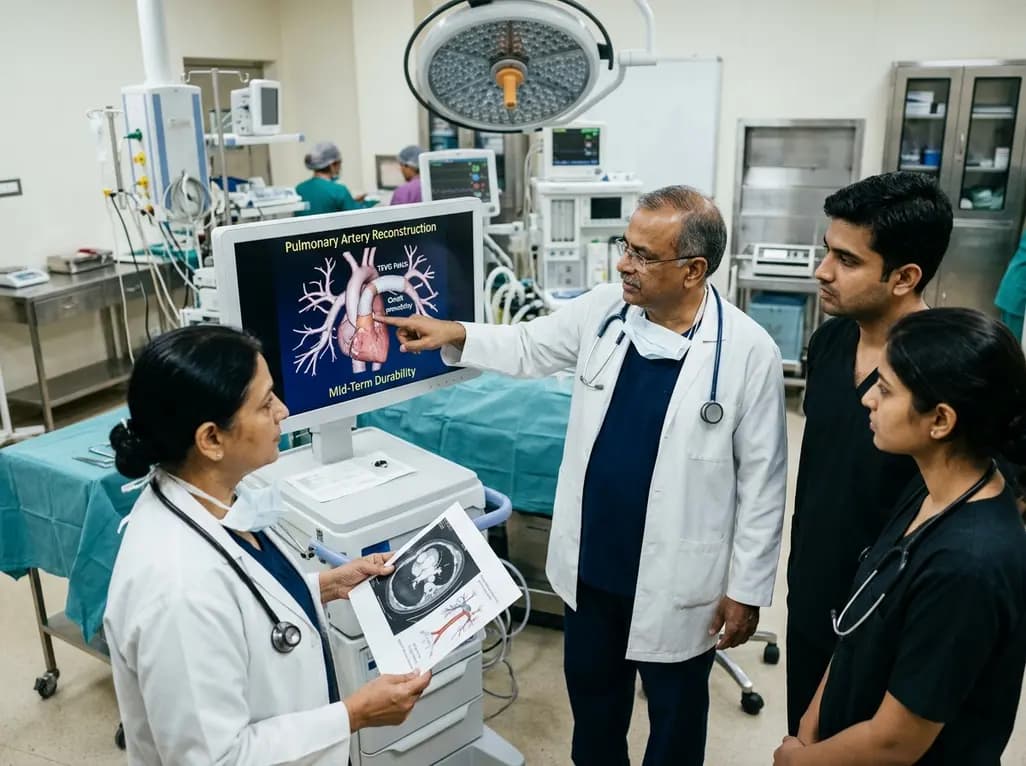
Autologous tissue-engineered vascular graft patches created via in-body tissue architecture show excellent mid-term durability and safety for pulmonary artery reconstruction in congenital heart surgery, particularly for peripheral branch augmentation.
Today

A novel cluster analysis of real-world datasets reveals four distinct CPPD disease phenotypes, validating existing EULAR categories while uncovering previously unrecognized monoarticular and axial presentations to refine patient management.
Today

Recent pharmacokinetic research demonstrates that trace dermal exposure to microgram quantities of trenbolone and metenolone produces detectable urinary metabolites for days to over a week, providing critical objective data for evaluating unintentional contamination claims in sports drug testing.
Today
