.webp&w=384&q=75)

Loading, please wait...
Loading, please wait...
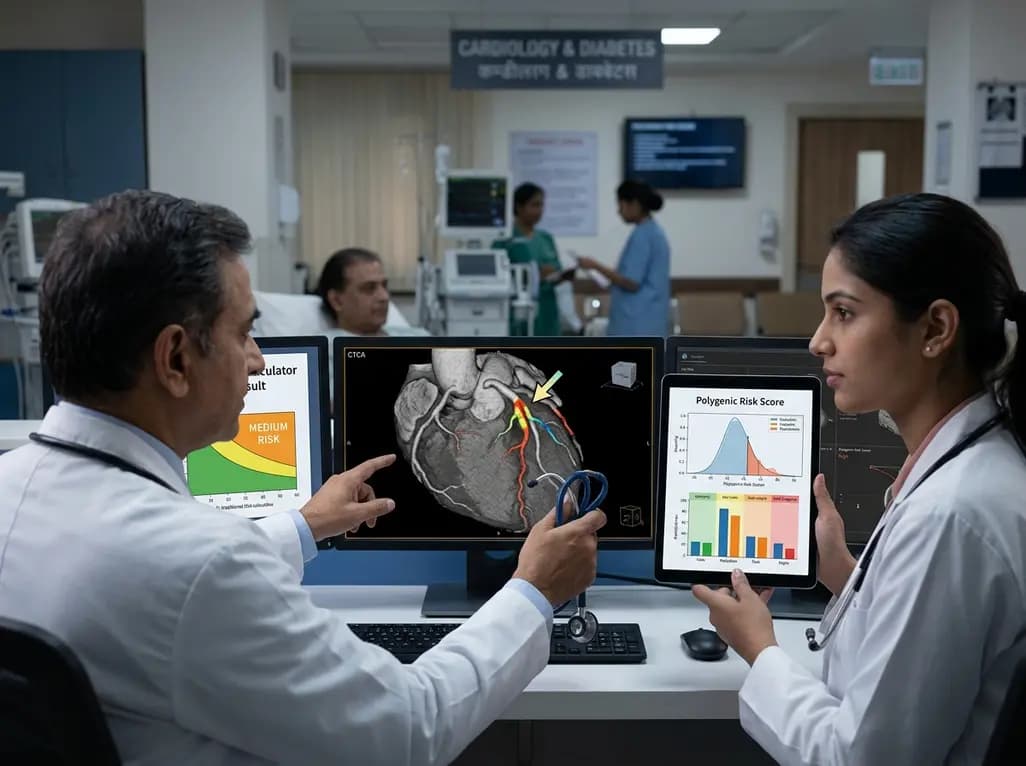
Type 2 diabetes (T2D) remains a formidable challenge for clinicians globally, particularly in India, where the prevalence of metabolic disorders is rising sharply. Cardiovascular disease (CVD) is the leading cause of morbidity and mortality in this population. Consequently, effective cardiovascular risk assessment T2D strategies are essential for primary prevention. Traditional risk calculators, while useful, often rely on population-level data that may not capture the unique anatomical and genetic nuances of an individual patient. The VOLTAIRE study addresses this gap by examining how advanced imaging and genetic profiling can provide a more comprehensive picture of heart health. By integrating computed tomography coronary angiography (CTCA) and polygenic risk scores (PRS), the study highlights a critical need for precision medicine. Furthermore, the findings suggest that many patients classified as low-risk by standard tools may actually harbor significant subclinical atherosclerosis. Therefore, moving beyond traditional clinical parameters is vital for optimizing long-term patient outcomes and preventing major adverse cardiovascular events.
Coronary artery calcium (CAC) scoring has emerged as a powerful tool for identifying subclinical atherosclerosis. In the context of type 2 diabetes, the presence of calcium in the coronary arteries often signals an advanced stage of vascular disease. The VOLTAIRE study demonstrated significant heterogeneity in atherosclerotic burden among participants. For instance, while approximately 35% of individuals had a CAC score of zero, nearly 20% presented with scores exceeding 400. This wide distribution indicates that diabetes does not affect every patient’s vasculature in the same way. Moreover, a high CAC score is strongly associated with an increased risk of future myocardial infarction. However, relying solely on calcium scores may still overlook non-calcified plaques, which are also dangerous. Consequently, clinicians are increasingly looking toward more detailed imaging modalities. Understanding these anatomical differences allows for more aggressive management of risk factors like hypertension and dyslipidemia. As a result, imaging serves as a necessary adjunct to standard clinical assessments.
While CAC scoring provides a quantitative measure of calcified plaque, CTCA offers a direct visualization of the coronary lumen and vessel walls. This high-resolution imaging technique allows physicians to assess the severity of coronary artery stenosis accurately. Significantly, the VOLTAIRE study found that 40.5% of participants had moderate-to-severe stenosis, defined as a narrowing of 50% or more. This finding is particularly striking because it included many individuals who were asymptomatic. Furthermore, CTCA can identify high-risk plaque features, such as low-attenuation components or positive remodeling, which are prone to rupture. In India, where CAD often presents at a younger age and in more aggressive forms, such detailed anatomical insights are invaluable. Additionally, CTCA provides the evidence needed to justify the use of intensive therapies like high-intensity statins or SGLT2 inhibitors. Therefore, incorporating CTCA into cardiovascular risk assessment T2D protocols helps bridge the gap between perceived risk and actual disease burden.
Beyond anatomical imaging, the genetic landscape plays a pivotal role in determining an individual’s cardiovascular trajectory. Polygenic risk scores (PRS) aggregate the effects of thousands of genetic variants to estimate a person’s inherited susceptibility to coronary artery disease. The VOLTAIRE study utilized genome-wide PRS to categorize patients into different risk tertiles. Interestingly, the distribution of genetic risk was highly variable across the cohort, and it did not always align with clinical or anatomical findings. For example, a patient might have a low clinical risk score but a high genetic predisposition to atherosclerosis. This genetic "load" is present from birth and remains constant, providing insights that traditional risk factors like age and cholesterol cannot. Specifically, PRS can identify younger patients who may benefit from earlier intervention before traditional risk factors become apparent. Consequently, genetics adds a unique, lifelong dimension to the cardiovascular risk assessment T2D framework, enabling truly personalized care.
One of the most significant findings of the VOLTAIRE study is the limited overlap between clinical, anatomical, and genetic risk domains. Only 8.7% of participants were classified as high risk across all three categories. This discordance is a major concern because it suggests that traditional clinical calculators may significantly underestimate the actual disease burden in T2D patients. For instance, the study revealed that 20.4% of those categorized as "low clinical risk" actually had moderate-to-severe coronary stenosis on CTCA. This discrepancy highlights the potential for undertreatment in a substantial portion of the diabetic population. Furthermore, patients with a high genetic risk may be overlooked if their current metabolic markers appear stable. Therefore, clinicians must recognize that a low score on a 5-year risk calculator does not guarantee the absence of severe coronary disease. This evidence supports a move away from siloed risk assessment toward a more integrated, multimodal strategy for cardiovascular risk assessment T2D.
The findings from the VOLTAIRE study strongly advocate for a multimodal approach to managing cardiovascular health in type 2 diabetes. By combining clinical data with imaging and genetics, healthcare providers can create a more nuanced and accurate risk profile for each patient. Such a strategy allows for the precise targeting of therapeutic interventions, ensuring that high-risk individuals receive aggressive management while avoiding overtreatment in those at truly low risk. In a diverse and high-burden country like India, this precision is especially relevant for resource allocation and improving public health outcomes. Moreover, visualizing disease through CTCA or understanding genetic risk can enhance patient engagement and adherence to lifestyle modifications. When patients understand their unique risks, they are often more motivated to manage their blood glucose and cholesterol levels. In conclusion, the future of cardiovascular risk assessment T2D lies in the integration of these sophisticated tools to provide a safer, more proactive model of care.
The Coronary Artery Calcium (CAC) score serves as a critical marker of subclinical atherosclerosis in diabetic patients. A higher score directly indicates a greater burden of calcified plaque and a higher risk of future cardiac events. Consequently, clinicians use these results to refine treatment strategies, often initiating or intensifying statin and antiplatelet therapy for those with significant scores. It provides a more objective measure than traditional calculators, helping to identify patients who require aggressive risk factor modification to prevent myocardial infarction.
The Polygenic Risk Score (PRS) measures an individual's inherited genetic susceptibility to coronary artery disease by analyzing thousands of genetic variants. Unlike traditional risk factors that fluctuate over time, the genetic risk remains constant from birth. This allows clinicians to identify high-risk individuals early in life, often before clinical symptoms or metabolic abnormalities arise. Integrating PRS into care enables more personalized prevention strategies, particularly for younger patients who might otherwise be classified as low risk by standard clinical tools.
Traditional risk calculators often fail to account for the anatomical reality of coronary disease and the underlying genetic predisposition. A multimodal approach, as highlighted by the VOLTAIRE study, combines clinical data with CTCA imaging and genetic profiling to provide a comprehensive view of risk. This method is superior because it identifies high-risk individuals who are frequently missed by clinical scores alone. By addressing the discordance between these domains, physicians can provide more accurate, personalized interventions that significantly improve long-term cardiovascular outcomes.
Disclaimer: This content is for informational and educational purposes only and does not constitute medical advice, diagnosis, or treatment. Always seek the advice of your physician or another qualified health provider with any questions you may have regarding a medical condition. Refer to the latest local and national guidelines for clinical practice.
References
Chen RT et al. Baseline Computed Tomography Coronary Angiography and Polygenic Risk Profiles in Adults With Type 2 Diabetes: A Cross-Sectional Analysis From the VOLTAIRE Study. Diabetes Obes Metab. 2026 Jul 08. doi: 10.1111/dom.71072. PMID: 42420749.
American Diabetes Association. Cardiovascular Disease and Risk Management: Standards of Care in Diabetes—2024. Diabetes Care 2024;47(Supplement_1):S179–S218.
Research Society for the Study of Diabetes in India (RSSDI). RSSDI Clinical Practice Recommendations for the Management of Type 2 Diabetes Mellitus 2022. International Journal of Diabetes in Developing Countries.

Read summarized clinical updates, watch expert medical content, and earn CME certifications right from your smartphone.
Open your smartphone camera to scan and install.





New data from the VOLTAIRE study highlights that traditional clinical risk calculators often miss significant coronary artery disease in patients with type 2 diabetes. The research advocates for a multimodal approach integrating CTCA imaging and polygenic risk scores to identify high-risk individuals.
3 months ago

Discover the crucial role of glymphatic dysfunction in stroke, where perivascular clearance failure and neuroinflammation exacerbate cerebral edema and post-stroke brain injury.
Today

A prenatal case highlights severe glutaric acidemia type II presenting as bilateral hyperechoic cystic kidneys at 18 weeks. Whole-exome sequencing revealed a novel homozygous ETFDH frameshift variant, demonstrating the power of rapid genetic testing in fetal renal anomalies.
Today

Review how tailored exercise programs benefit frail older patients with heart failure. Explore pathophysiological mechanisms, individualized training prescriptions, and strategies to overcome adherence barriers in clinical practice.
Yesterday

This comparative study evaluates posterior labral tears with and without glenohumeral instability, highlighting distinct demographic patterns, MRI underestimation in stable shoulders, and successful arthroscopic repair outcomes.
Yesterday

A clinical study demonstrates that early intervention with tocilizumab, either as monotherapy or bridged with corticosteroids, achieves significant proptosis reduction and resolves active inflammation in treatment-naive thyroid eye disease.
Yesterday
