.webp&w=384&q=75)

Loading, please wait...
Loading, please wait...

Modern physiotherapy relies heavily on innovative technology to restore mobility in patients with neurological and musculoskeletal impairments. Specifically, cable-driven rehabilitation robots have emerged as a superior solution due to their high power-to-weight ratio and inherent safety. These systems provide a lightweight and backdrivable alternative to traditional rigid exoskeletons. However, creating effective control strategies remains a significant challenge because of cable tension constraints and individual user variability.
A recent systematic review analyzed 70 studies from the past decade to map the evolution of control architectures. Initially, developers focused on simple position and velocity control to guide limb movement. Over time, the industry transitioned toward force-based and compliance-based methods. These newer strategies, such as impedance and admittance control, allow for safer human-robot interaction by adapting to the user's natural resistance. Consequently, the focus has shifted from merely moving a limb to actively assisting the patient\'s intention.
The review proposes a unified hierarchical framework to bridge the gap between high-level intent and low-level actuation. This structure allows researchers to integrate learning-based and intention-informed methods into the core control loop. Therefore, the robot can detect a patient's movement goals and provide real-time, environment-responsive assistance. Such advancements in cable-driven rehabilitation robots ensure that therapy is not only consistent but also highly personalized to the specific needs of each patient.
Connecting control strategies to clinical outcomes is essential for meaningful rehabilitation. The integration of adaptive control helps patients achieve better functional improvements by promoting neuroplasticity. Furthermore, constraint-aware model-based control prevents cable slack and ensures structural stability during exercise. This multi-layer approach represents the future of gait recovery, offering scalable and clinically validated solutions for healthcare providers across India and the globe.
These robots offer high power-to-weight ratios, modular designs, and inherent compliance. These features make them safer and more lightweight compared to traditional rigid robotic exoskeletons.
Intention-informed control uses sensors to detect the user's movement goals. This allow the robot to provide assistance only when needed, which encourages active participation and improves neuroplastic recovery.
A hierarchical framework organizes the control process into layers. It connects high-level decision-making, like intent detection, with low-level hardware actuation, ensuring the robot responds accurately and safely to the user.
Disclaimer: This content is for informational and educational purposes only and does not constitute medical advice. It is not intended to be a substitute for professional medical advice, diagnosis, or treatment. Always seek the advice of your physician or other qualified health provider with any questions you may have regarding a medical condition. Refer to the latest local and national guidelines for clinical practice.
References
1. Al-Rahmani N et al. The past, present and future of control architectures in lower-limb cable-driven robots for gait rehabilitation. J Neuroeng Rehabil. 2026 Apr 27. doi: 10.1186/s12984-026-01982-z. PMID: 42045969.
2. Liu Q et al. Design and Hierarchical Force-Position Control of Redundant Pneumatic Muscles-Cable-Driven Ankle Rehabilitation Robot. IEEE/ASME Transactions on Mechatronics. 2021.
3. Tiebel J. Robot-Assisted Gait Rehabilitation: Latest Evidence, Benefits, and Clinical Practice Insights. Health Business Consultant Update. 2024.
"
Read summarized clinical updates, watch expert medical content, and earn CME certifications right from your smartphone.
Open your smartphone camera to scan and install.





A systematic review highlights the shift toward personalized, intention-driven control in cable-driven robots for gait and movement rehabilitation....
4 months ago

Explore the emerging role of Brixadi, an extended-release buprenorphine injection, for managing stimulant use disorder through kappa opioid receptor antagonism and steady plasma levels.
Today

A premature neonate developed upper limb compartment syndrome after uterine rupture extruded the arm through a scar defect. Conservative management with continuous monitoring yielded complete functional recovery and normal limb growth at 10-year follow-up, highlighting non-operative safety in selected cases.
Today
Dendritic cells bridge innate and adaptive immunity in myocardial infarction. This review explores their pathological roles, circulating dynamics, novel tolerogenic interventions, and how standard cardiovascular medications modulate dendritic cells to improve post-infarction myocardial repair and patient outcomes.
Today
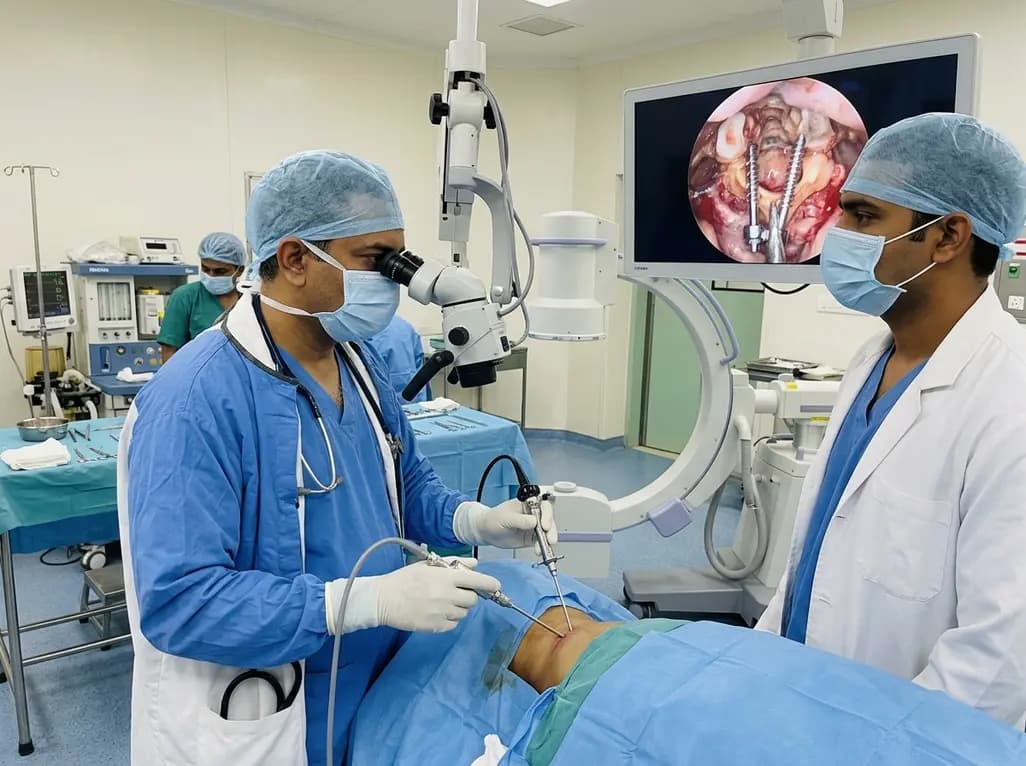
Endoscopic posterior cervical fusion combines minimally invasive decompression, joint preparation, and rigid screw-rod fixation for atlantoaxial pathologies. Early clinical findings demonstrate solid bony union, excellent symptom relief, and minimal soft-tissue morbidity without significant vascular compromise.
Yesterday
Atherosclerosis involves extensive glycometabolic reprogramming across immune and vascular cells. This review examines how glycolysis, the pentose phosphate pathway, and lactate-driven epigenetic shifts fuel plaque vulnerability, while highlighting novel therapeutic targets like PFKFB3 and LDHA.
Today
