

Loading, please wait...
Loading, please wait...

Cardiovascular diseases remain the leading cause of premature mortality worldwide. For decades, clinicians reserved blood pressure lowering treatment predominantly for individuals with severe hypertension or elevated baseline cardiovascular risk. However, whether this protective benefit extends consistently to lower-risk populations has remained controversial. Large clinical trials clearly demonstrate that pharmacotherapy prevents serious vascular complications in vulnerable cohorts. Nevertheless, primary care physicians often hesitate to initiate antihypertensive medication in lower-risk individuals. Consequently, modern international guidelines provide conflicting recommendations regarding intervention thresholds. This uncertainty underscores the necessity for comprehensive data synthesis. Recently, an international team analyzed individual participant data from numerous randomized trials. Furthermore, this collaborative project evaluated both absolute and relative outcomes across the full cardiovascular risk spectrum. Ultimately, the emerging evidence challenges traditional treatment thresholds. In doing so, it provides clinicians with clear insights to optimize primary cardiovascular prevention. Moreover, these findings suggest that relative risk reductions persist across diverse baseline patient profiles. Therefore, medical practitioners must reconsider historical paradigms that restrict treatment to high-risk individuals.
Methodologically, this comprehensive meta-analysis synthesized individual-level participant data across major randomized trials. The investigators systematically compared blood pressure lowering interventions against placebo, usual care, or active control regimens. In addition, the primary composite outcome encompassed major adverse cardiovascular events. Specifically, these events included fatal or nonfatal stroke, fatal or nonfatal ischemic heart disease, and heart failure hospitalization or death. To capture the full spectrum of baseline risk, researchers grouped participants into deciles using validated multivariable prediction models. Consequently, the study population ranged from individuals in the lowest risk decile to those with established vascular disease. Furthermore, the median five-year predicted risk of a major cardiovascular event was 12.3 percent. The authors also established rigorous secondary safety endpoints across all participants. Specifically, they monitored cardiovascular or hemodynamic events, serious renal complications, and neurovestibular symptoms such as falls or syncope. Thus, the analytical framework offered unprecedented statistical power to detect small differences in efficacy and adverse outcomes. In addition, analyzing individual participant data minimized confounding factors commonly found in aggregate trial reports. As a result, the authors achieved an exceptionally precise evaluation of treatment effects.
The core findings revealed that blood pressure reduction confers consistent proportional cardiovascular protection regardless of baseline risk. Notably, the relative risk reduction for major adverse cardiovascular events remained virtually identical across all risk deciles. Each five-millimeter reduction in systolic pressure produced proportional reductions in stroke and coronary disease across the entire spectrum. Therefore, individuals with low baseline risk achieved proportional protection comparable to high-risk patients. However, the absolute clinical benefit varied markedly according to baseline cardiovascular risk. In the lowest risk decile, absolute event rates were naturally small. Consequently, the absolute risk reduction remained modest in low-risk individuals. In contrast, patients in the highest deciles experienced substantial absolute risk reductions. For instance, high-risk patients avoided significantly more major events per thousand individuals treated over five years. Nonetheless, the relative efficacy demonstrated no significant statistical interaction across deciles. Thus, the biological benefit of blood pressure reduction functions uniformly across human vascular biology. Furthermore, these findings align with observations from large-scale lipid-lowering trials. In essence, vascular risk reduction operates as a continuous gradient rather than a binary threshold.
Balancing therapeutic efficacy against potential treatment-related harm represents an essential duty for every practicing physician. Therefore, the meta-analysis thoroughly examined adverse events across trials comparing active treatment with placebo or usual care. Specifically, investigators assessed hemodynamic instability, adverse renal events, and neurovestibular complications like dizziness and fall-related trauma. In general, active blood pressure reduction produced slight increases in reported hemodynamic events, including transient hypotension and bradycardia. However, the incidence of serious renal impairment did not increase disproportionately across the lower risk deciles. Moreover, rates of severe falls and debilitating fractures remained comparable between active treatment and control arms. Consequently, these findings alleviate long-standing physician fears regarding iatrogenic falls in vulnerable or older patients. In addition, serious adverse events rarely outweighed the vascular benefits when clinicians titrated medications carefully. Thus, the safety analysis reassures clinicians that judicious therapy rarely triggers catastrophic complications. Accordingly, physicians should not withhold life-saving blood pressure regimens solely because of unfounded safety anxieties. Nevertheless, regular biochemical monitoring of renal function and electrolytes remains a cornerstone of good clinical governance.
These landmark conclusions carry transformative implications for contemporary cardiovascular management guidelines. Historically, guidelines dictated antihypertensive therapy almost exclusively based on arbitrary blood pressure thresholds, such as 140/90 mmHg. In contrast, this evidence supports shifting toward integrated cardiovascular risk assessment to guide therapeutic decisions. When clinicians assess global cardiovascular risk, they can identify patients who benefit substantially even at modestly elevated pressures. For Indian physicians, this paradigm shift carries acute relevance. South Asian populations frequently develop coronary artery disease and stroke a decade earlier than Western populations. Therefore, implementing early blood pressure lowering treatment can prevent thousands of premature vascular events across India. Furthermore, modern generic fixed-dose combination therapies offer affordable and highly effective blood pressure control. Consequently, physicians should integrate personalized lifestyle counselling alongside pharmacotherapy. In addition, shared decision-making empowers patients to understand their baseline vascular risk. Ultimately, treating overall vascular risk rather than isolated numbers improves population longevity. Thus, clinicians must adopt proactive strategies to reduce lifetime cardiovascular burden. Moreover, routine outpatient screening enables early detection of asymptomatic vascular changes before irreversible organ damage occurs.
Baseline cardiovascular risk determines the absolute benefit of therapy rather than its relative effectiveness. Clinical trials demonstrate that relative risk reduction remains consistent across all risk categories. However, patients with high baseline risk achieve greater absolute reductions in heart attacks and strokes. Conversely, lower-risk individuals experience identical relative protection but smaller absolute event reductions over time. Therefore, clinicians must weigh absolute risk when personalizing therapy.
Evidence confirms that blood pressure lowering therapy does not significantly increase serious fall-related injuries or fractures. Although transient dizziness and mild hypotension occur slightly more frequently with active treatment, major neurovestibular complications remain uncommon. Furthermore, preventing strokes and heart failure directly preserves patient mobility and physical functional independence. Consequently, clinicians should not withhold indicated antihypertensive pharmacotherapy simply due to unfounded fears of patient falls.
Clinicians should consider pharmacotherapy for lower-risk patients whose blood pressure remains persistently elevated despite structured lifestyle modifications. Additionally, individuals with subclinical target organ damage, persistent microalbuminuria, strong family histories of premature cardiovascular disease, or diabetes warrant therapeutic consideration. Because early blood pressure lowering treatment attenuates progressive arterial stiffening, timely intervention provides substantial cumulative lifetime protection. Therefore, thorough clinical risk stratification and collaborative physician-patient discussions optimize preventative care.
Disclaimer: This content is for informational and educational purposes only and is not intended as a substitute for professional medical advice, diagnosis, or treatment. Healthcare professionals should exercise their clinical judgment when applying this information. Refer to the latest local and national guidelines for clinical practice.
References

Read summarized clinical updates, watch expert medical content, and earn CME certifications right from your smartphone.
Open your smartphone camera to scan and install.





An individual-participant meta-analysis shows that blood pressure lowering treatment provides consistent relative cardiovascular risk reduction across the entire risk spectrum, with absolute benefits highest in high-risk patients and a reassuring safety profile across lower risk tiers.
Today

Knocking out the adipocyte ETB receptor attenuates high-fat diet-induced dyslipidemia, lowering LDL, cholesterol, and free fatty acids while preserving lipid oxidation gene expression in visceral adipose tissue.
Today
Amniotic fluid cell-free DNA offers a rapid alternative to cultured amniocytes in prenatal testing. With high yield, lack of maternal contamination, and full concordance across microarrays and exome sequencing, it dramatically cuts diagnostic turnaround time.
Today

A systematic review of 15 studies and 574 competitive weightlifters establishes normative benchmarks for snatch drop-under kinematics, highlighting turnover speed, horizontal displacement, and trunk alignment to optimize performance and prevent overhead injuries.
Today
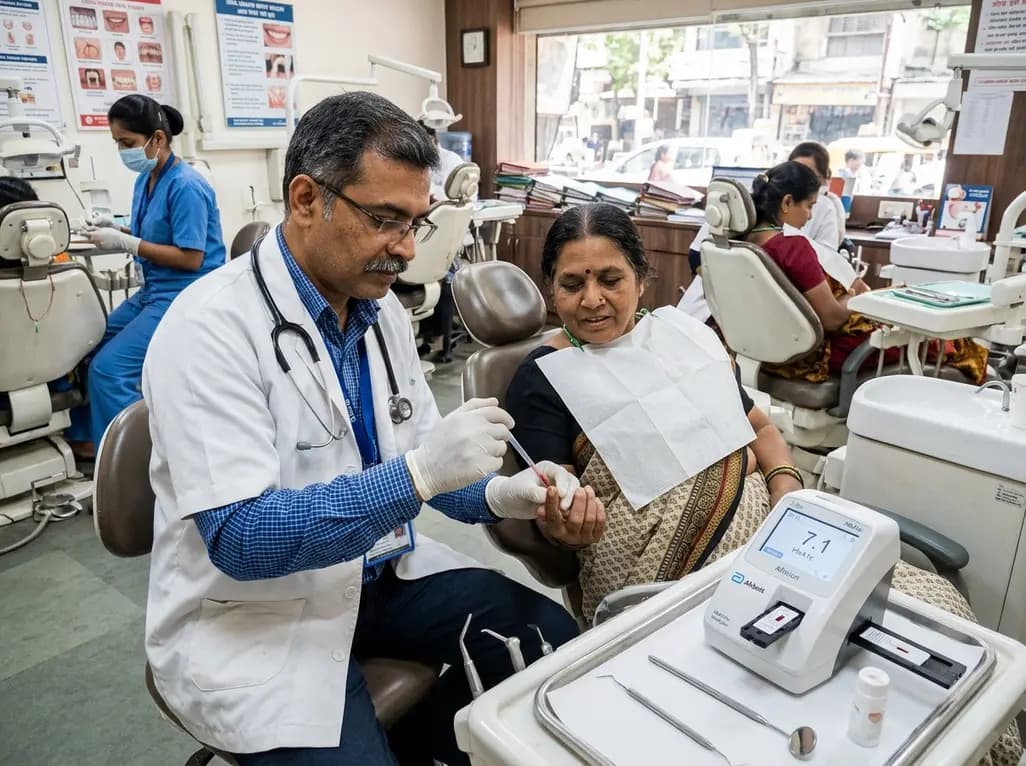
A cross-sectional study shows point-of-care HbA1c screening in dental settings detects elevated glycemia in 27.3% of adults. Over 60% of these patients had no prior glycemic concerns, especially those disconnected from primary care, highlighting the dental chair as an opportunistic screening site.
Today
