.webp&w=384&q=75)

Loading, please wait...
Loading, please wait...

Recent biomedical research has expanded our understanding of naturally occurring dicarboxylic acids beyond standard dermatological care. Investigating azelaic acid anti-aging properties reveals promising protective mechanisms that counter physiological decline and reduce cellular stress. Derived naturally from cereal grains, azelaic acid exhibits well-documented anti-inflammatory and antioxidant activities. Emerging preclinical evidence shows that this compound can extend lifespan and delay structural degeneration. Consequently, clinicians and researchers are re-evaluating its potential therapeutic scope in preventative and longevity medicine.
Azelaic acid is a non-toxic, saturated straight-chain dicarboxylic acid that clinicians have traditionally utilized to treat acne vulgaris, rosacea, and hyperpigmentation. The molecule exerts competitive inhibition on tyrosinase and reduces follicular hyperkeratinization. In addition, it neutralizes free radicals and decreases the production of reactive oxygen species in neutrophils. These unique biochemical properties make it a versatile therapeutic candidate. Beyond its cutaneous benefits, researchers have discovered that azelaic acid favorably alters systemic metabolic parameters. For instance, it modulates lipid metabolism and reduces diet-induced adiposity in experimental models. Therefore, its multi-target capability offers exciting prospects for cellular protection and tissue longevity.
To evaluate healthspan and lifespan effects, scientists frequently turn to the nematode model organism Caenorhabditis elegans. Recent experimental findings demonstrate that azelaic acid significantly prolongs survival under normal physiological conditions and severe oxidative stress. Furthermore, the intervention substantially preserves locomotor vigor and prevents age-dependent deterioration of muscle morphology. In neurodegenerative disease assays, azelaic acid markedly reduces paralysis induced by pathological protein aggregation. These phenotypic improvements confirm that the compound promotes functional vitality alongside chronological longevity. Thus, the physiological benefits span structural, behavioral, and cellular dimensions.
Mechanistic analyses reveal that the life-extending actions of azelaic acid rely heavily on the evolutionarily conserved insulin/insulin-like growth factor-1 signaling (IIS) pathway. Quantitative gene expression profiling demonstrates that azelaic acid differentially regulates central longevity nodes, including daf-2 and daf-16. The compound also couples with heat shock factor 1 (hsf-1), a master regulator of the proteostasis network. Importantly, genetic ablation studies confirm that mutations in daf-16, daf-2, or hsf-1 completely abolish the lifespan extension conferred by azelaic acid under oxidative challenge. Consequently, intact IIS signaling and proteostatic response machinery are mandatory for its therapeutic efficacy.
Oxidative stress accelerates biological aging through progressive macromolecular damage. Azelaic acid counteracts this damaging process by upregulating primary cellular defense systems. Specifically, it activates skn-1, the nematode ortholog of mammalian NRF2, which stimulates endogenous antioxidant gene expression. Following treatment, cells exhibit increased superoxide dismutase (SOD) catalytic activity and heightened SOD-3 protein expression. Consequently, intracellular levels of reactive oxygen species drop significantly. This comprehensive enzymatic enhancement shields mitochondria and genomic DNA from persistent oxidative degradation. Therefore, azelaic acid reinforces internal cellular resilience against environmental and metabolic challenges.
For clinical practitioners, these fundamental discoveries offer compelling translational insights. While topical azelaic acid remains a reliable standard for inflammatory skin conditions, its capacity to attenuate oxidative damage and preserve muscle integrity suggests broader systemic value. In aging skin, oxidative stress triggers collagen degradation and senescent cellular transformation. By activating cytoprotective pathways and suppressing inflammatory cascades, azelaic acid may mitigate photoaging and intrinsic cutaneous senescence. Furthermore, ongoing investigations into oral bioavailability and systemic formulations may eventually bridge these preclinical findings into practical geroscience interventions.
Although invertebrate studies provide robust proof-of-concept data, extensive translational research remains necessary before clinical implementation. Future studies must determine optimal dosage ranges, pharmacokinetics, and tissue distribution profiles in mammalian models. Additionally, investigators need to assess potential synergies between azelaic acid and established geroprotective agents. As longevity medicine shifts toward proactive molecular interventions, targeting conserved energy and stress-response pathways represents a rational therapeutic strategy. Ultimately, azelaic acid stands out as an intriguing candidate worthy of rigorous clinical evaluation.
Azelaic acid improves cellular longevity primarily by mitigating oxidative damage and preserving proteostasis. It upregulates endogenous antioxidant defenses, specifically elevating superoxide dismutase activity and boosting mitochondrial resilience. Furthermore, it modulates the insulin and insulin-like growth factor signaling pathway while activating heat shock factor 1. Consequently, these synchronized biochemical adaptations decrease reactive oxygen species accumulation, preserve vital muscle architecture, and protect critical cellular components from chronic age-related degenerative decline.
Currently, clinicians prescribe topical azelaic acid primarily for localized dermatological disorders such as acne vulgaris, rosacea, and post-inflammatory hyperpigmentation. Topical formulations demonstrate minimal systemic absorption, which limits their direct internal anti-aging effects. However, ongoing preclinical investigations into systemic bio-delivery methods indicate that azelaic acid can influence broader metabolic pathways. Therefore, future oral or enhanced-delivery formulations may expand its clinical scope into systemic geroscience and preventive medicine.
Preclinical genetic studies demonstrate that the longevity benefits of azelaic acid depend strictly on key regulatory genes. Specifically, loss-of-function mutations in daf-2, daf-16, and hsf-1 abolish its life-extending capacity under oxidative stress. Additionally, the skn-1 pathway contributes significantly to antioxidant transcription. Because these conserved genes govern insulin signaling, heat shock responses, and phase II detoxification, azelaic acid requires an intact genetic stress-response network to exert its full therapeutic actions.
Disclaimer: This content is for informational and educational purposes only. It is not intended as a substitute for professional medical advice, diagnosis, or treatment. Always seek the advice of qualified healthcare professionals with any questions regarding medical conditions. Refer to the latest local and national guidelines for clinical practice.
References
1. Chen Y et al. Azelaic Acid delays aging and prolongs lifespan via resisting oxidation stress mediated by IIS pathway coupling hsf-1 in C. elegans. Biosci Biotechnol Biochem. 2026 Aug 19. doi: undefined. PMID: 42616001.
2. Kim J et al. Azelaic Acid Promotes Caenorhabditis elegans Longevity at Low Temperature Via an Increase in Fatty Acid Desaturation. Pharm Res. 2021 Jan 15;38(1):123-134.
3. Kenyon CJ. The genetics of ageing. Nature. 2010 Mar 25;464(7288):504-512.
4. Murphy CT, Hu PJ. Insulin/insulin-like growth factor signaling in C. elegans. WormBook. 2013 Dec 26;1-43.

Read summarized clinical updates, watch expert medical content, and earn CME certifications right from your smartphone.
Open your smartphone camera to scan and install.





Azelaic acid, widely recognized for dermatological therapies, demonstrates potent anti-aging and neuroprotective effects in preclinical models. By regulating the insulin/IGF-1 signaling pathway and activating HSF-1, it reduces oxidative stress and extends lifespan, highlighting potential longevity applications.
last month

A recent case shows that exertional rhabdomyolysis can trigger marked transaminase spikes despite moderate creatine kinase elevation. Preserved hepatic synthetic function confirms muscle injury rather than liver failure, guiding conservative hydration and preventing unnecessary invasive diagnostics.
Today

A pharmacometric and machine learning study reveals that specific vaginal bacteria alter cervical antiretroviral exposure, highlighting the need for precision HIV PrEP strategies.
Today

Abdominal aortic aneurysm rupture remains a catastrophic vascular emergency. Groundbreaking research reveals that USP53 accelerates aneurysm progression by reprogramming smooth muscle cell metabolism toward aerobic glycolysis, highlighting a promising target beyond conventional diameter-based surveillance.
Today

A breakthrough study leverages natural language processing to accurately identify incident medication-related osteonecrosis of the jaw and track antiresorptive drug holidays from clinical narratives in electronic health records, advancing osteoporosis pharmacovigilance and dental safety.
Today
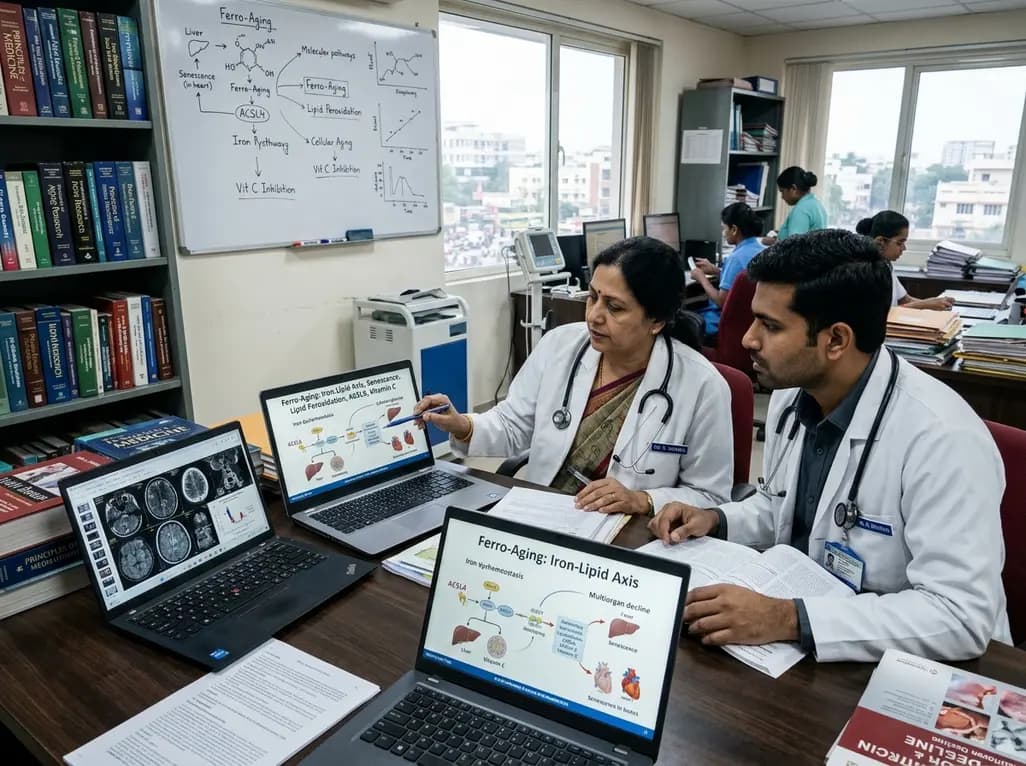
Recent research defines ferro-aging as a conserved iron-lipid axis driving organ decline across primates. Age-related iron dyshomeostasis stimulates ACSL4-mediated lipid peroxidation, promoting cellular senescence. Notably, vitamin C directly inhibits ACSL4, suppressing phospholipid oxidation and multi-organ decay.
Today
