.webp&w=384&q=75)

Loading, please wait...
Loading, please wait...
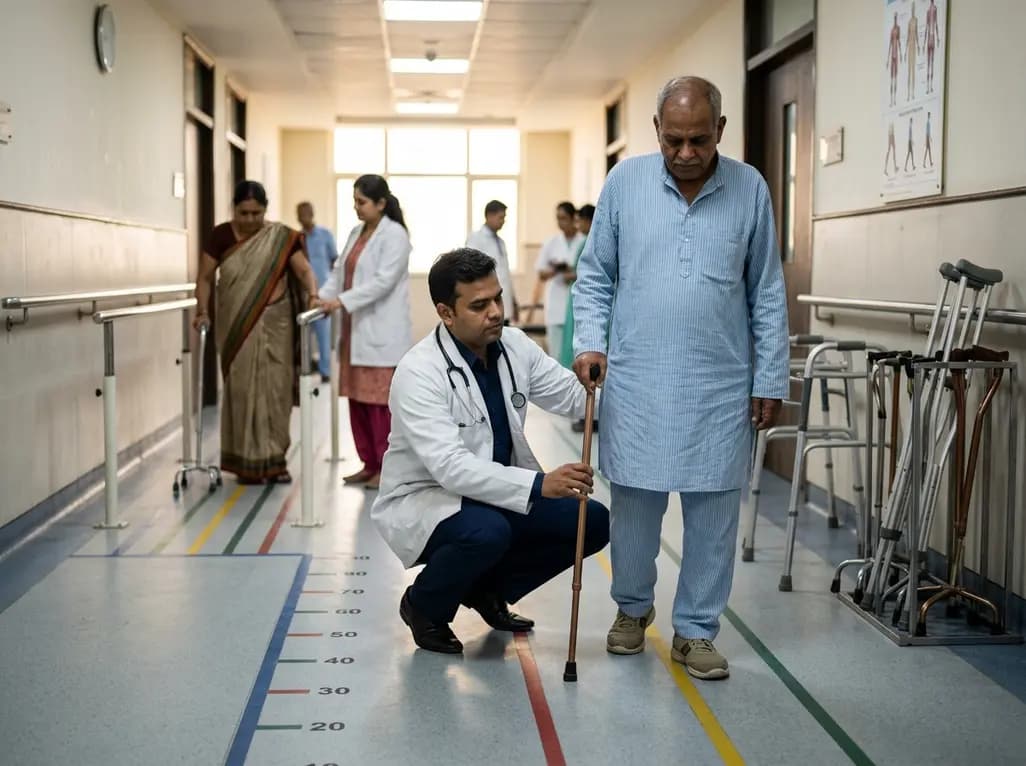
Prescribing conventional walking aids represents a cornerstone of neurological rehabilitation. Clinicians frequently recommend canes, crutches, and walkers to improve mobility, boost confidence, and prevent devastating falls. However, systematic evidence guiding the precise impact of assistive devices on gait remains nuanced and frequently misunderstood. A comprehensive systematic review and meta-analysis evaluated twenty-three experimental studies involving 461 adults with neurological conditions such as stroke and multiple sclerosis. The synthesis revealed that immediate introduction of walking aids does not automatically translate into faster or more symmetrical ambulation. In fact, many individuals exhibit acute reductions in temporal and spatial walking metrics during baseline assessments. Consequently, clinicians must recognize that immediate device application alters habitual motor patterns and requires cognitive accommodation. Understanding these initial biomechanical trade-offs ensures that physical therapists and physicians set realistic rehabilitation milestones. Furthermore, evaluating assistive devices on gait requires distinguishing between instantaneous laboratory testing and sustained functional adaptations in real-world settings. Clinicians should therefore interpret initial gait speed reductions as transient adjustments rather than treatment failures.
A striking finding from the meta-analysis is that 92% of included trials assessed only immediate effects upon device provision. When researchers tested patients without previous habituation, immediate results were uncertain and frequently trended toward negative outcomes. Specifically, gait speed demonstrated mean differences ranging from -0.131 to 0.030 m/s. Similarly, stride length decreased by -0.063 to -0.020 meters, and cadence dropped by an average of 3.6 steps per minute. These acute declines occur because novel walking aids impose additional cognitive, sensory, and motor demands on patients with compromised neurological pathways. Walking with a cane or walker requires dual-task coordination, active upper-limb weight-bearing, and modified limb propulsion mechanics. Therefore, naive users often slow down deliberately to maintain postural equilibrium and minimize immediate fall hazards. Consequently, cross-sectional evaluations that capture only immediate performance underestimate the true therapeutic utility of assistive devices. Clinicians must realize that acute assessments capture motor confusion rather than long-term functional capacity. Structured familiarization periods allow patients to integrate the device seamlessly into their automated locomotor schema.
Selecting the appropriate cane architecture is a pivotal clinical decision in neurological recovery. When comparing single-point canes to four-point quad canes, meta-analytic data clearly favour single-point models for dynamic ambulation. In stroke survivors, single-point canes produced significant improvements in gait speed, showing a mean difference of 0.058 m/s compared to quad canes. Furthermore, walking endurance increased substantially, yielding a mean gain of 20.34 meters on standardized distance tests. Although quad canes offer a wider base of support and superior static stability when standing, their bulk and multi-prong geometry disrupt continuous gait fluidity. Patients must lift the broad base entirely off the floor to advance, which prolongs swing phases and induces compensatory trunk movements. In contrast, single-point canes facilitate a more natural pendulum swing and harmonious kinetic progression during forward walking. Therefore, while quad canes remain valuable during early standing transfer training, clinicians should transition patients to single-point canes as soon as dynamic equilibrium permits. This strategic progression enhances walking velocity, reduces mechanical drag, and fosters efficient energy conservation during daily community ambulation.
The therapeutic advantages of assistive mobility devices vary across distinct diagnostic categories and exposure durations. In individuals recovering from stroke, short-to-intermediate daily use of a single-point cane demonstrated meaningful clinical gains compared to non-users. Daily practice led to consistent increases in self-selected walking speed, with mean improvements ranging from 0.14 to 0.18 m/s. This magnitude of acceleration represents a clinically meaningful threshold capable of transforming household ambulators into functional community walkers. Similarly, preliminary evidence in individuals with multiple sclerosis indicates comparable enhancements in gait velocity and overall walking distance when using streamlined single-point devices. However, individuals with progressive neurological diseases face fluctuating fatigue, spasticity, and sensory deficits that alter device efficacy over time. Consequently, prescription protocols cannot remain static throughout a patient's lifespan. Physical therapists must regularly reassess device appropriateness as motor symptoms evolve or improve. By tailoring device selection to the specific stage of pathology, rehabilitation teams maximize functional independence while preventing maladaptive compensations. Longitudinal tracking remains imperative to ensure that prescribed aids match individual neuromuscular capabilities.
The meta-analysis highlights a critical gap in contemporary neurorehabilitation: the urgent need for structured training programs. Simply handing an assistive device to a patient without comprehensive instruction yields suboptimal biomechanical outcomes and elevates fall risks. Effective prescription requires individualized biomechanical fitting, ergonomic handle selection, and progressive multi-session gait retraining. During structured rehabilitation, therapists instruct patients on optimal sequencing, symmetrical weight-bearing, and smooth coordination between the paretic limb and the walking aid. Moreover, training must incorporate diverse functional tasks, including navigating thresholds, ascending stairs, and managing outdoor terrain. When patients undergo systematic training, they overcome initial motor clumsy patterns and achieve automated control. Furthermore, clinicians should educate patients and caregivers on recognizing ergonomic warning signs, such as upper-extremity joint strain or asymmetrical trunk lean. By integrating targeted motor learning principles into cane prescription, healthcare teams transform assistive devices from awkward obstacles into empowering mobility tools. Structured rehabilitation bridges the gap between mechanical support and authentic locomotor independence.
For neurologists, geriatricians, and general practitioners, these findings offer vital practical insights for daily clinical practice. First, clinicians should avoid judging the long-term utility of an assistive device solely on initial baseline walk tests. Second, rehabilitation teams should prioritize single-point canes over quad canes when the primary clinical goal is enhancing dynamic walking speed and community endurance. Third, interdisciplinary collaboration between prescribing physicians, physiotherapists, and occupational therapists is essential to deliver personalized gait training. Additionally, fall prevention strategies must balance static stability against dynamic mobility. While heavy multi-point frames provide reassurance during quiet standing, they can inadvertently impede step initiation and increase trip risks during community travel. Therefore, periodic clinical reviews should evaluate whether a patient can safely de-escalate to a lighter, more agile device. Ultimately, thoughtful device selection and dedicated training regimens empower adults with neurological disorders to regain safe mobility, expand social participation, and achieve enhanced long-term quality of life.
When patients first use a walking aid without prior training, the device imposes additional cognitive and motor processing demands. Naive users must actively coordinate upper-limb placement while adjusting baseline balance strategies. Consequently, individuals instinctively decrease walking speed, cadence, and stride length to ensure safety and prevent balance loss. Once patients complete structured familiarization and motor training, their gait velocity and temporal parameters improve significantly beyond baseline levels.
Single-point canes promote greater dynamic walking speed and superior endurance compared to four-point quad canes in stroke survivors. Quad canes offer greater static stability during quiet standing, but their wide base requires deliberate lifting during swing phases, which slows forward propulsion. In contrast, single-point canes allow a more fluid, natural gait cycle, resulting in average gains of 20 meters in walking distance and improved functional ambulation in the community.
Structured rehabilitation is essential to transform assistive walking aids into effective functional tools. Professional gait retraining teaches proper device positioning, reciprocal coordination, and symmetrical weight distribution between the paretic and non-paretic limbs. Without formal instruction, patients often adopt inefficient compensatory habits that increase joint strain and elevate fall risks. Supervised training ensures automated motor integration, safer community navigation, and optimal long-term functional recovery.
Disclaimer: This content is for informational and educational purposes only. It is not intended as medical advice, diagnosis, or treatment. Always consult a qualified healthcare provider regarding clinical decisions. Refer to the latest local and national guidelines for clinical practice.
References

Read summarized clinical updates, watch expert medical content, and earn CME certifications right from your smartphone.
Open your smartphone camera to scan and install.





A meta-analysis evaluates the impact of conventional assistive devices on gait in neurological disorders. While immediate use can slow speed, regular training with single-point canes improves walking speed and endurance in stroke and MS compared to quad canes, emphasizing the need for structured gait training.
4 weeks back

A systematic review of 41 preclinical studies reveals that baicalin dampens systemic inflammation, inhibits NF-κB and NLRP3 pathways, and improves organ preservation in sepsis models. However, substantial study heterogeneity and a complete lack of human clinical trials highlight the need for further translational research.
Today
Discover the crucial distinctions between mesonephric and mesonephric-like proliferations of the female genital tract. Learn the key histomorphologic, immunohistochemical, and molecular differences essential for accurate diagnosis and clinical management.
Today

A large UK Biobank study reveals that plasma proteomic signatures capture preclinical organ damage and improve multiorgan risk prediction across early CKM syndrome stages 0 to 2 beyond traditional PREVENT clinical models.
Today
A narrative review investigates whether the articularis genus muscle functions as an independent anatomical entity or blends with the vastus intermedius. We evaluate its morphology, role in retracting the suprapatellar bursa, and direct clinical significance in anterior knee pain and arthroplasty.
Today

A Bayesian multilevel meta-analysis reveals that aerobic training combined with moderate carbohydrate restriction modestly lowers HbA1c in type 2 diabetes. However, sparse data and very low certainty leave incremental benefits over exercise or diet alone unproven, highlighting the need for individualized care.
Today
